Check patentability & draft patents in minutes with Patsnap Eureka AI!

Low-boiling-point two-dimensional material layer-by-layer stacking forming method

A technology of two-dimensional materials and molding methods, applied in the field of additive manufacturing, can solve problems such as printing evaporation, and achieve the effects of improving stability, high precision, and reducing weld defects

Active Publication Date: 2021-11-26
SUQIAN COLLEGE
View PDF8 Cites 0 Cited by
  • Summary
  • Abstract
  • Description
  • Claims
  • Application Information

AI Technical Summary

Problems solved by technology

However, in the existing technology for additive manufacturing of low-boiling point materials, due to the low boiling point of low-boiling point materials, it is easy to be printed and evaporated due to the low boiling point during printing. There has been no good solution to this problem.

Method used

the structure of the environmentally friendly knitted fabric provided by the present invention; figure 2 Flow chart of the yarn wrapping machine for environmentally friendly knitted fabrics and storage devices; image 3 Is the parameter map of the yarn covering machine
View more

Image

Smart Image Click on the blue labels to locate them in the text.
Viewing Examples
Smart Image
  • Low-boiling-point two-dimensional material layer-by-layer stacking forming method

Examples

Experimental program
Comparison scheme
Effect test

Embodiment approach 1

[0027] This embodiment provides a method for layer-by-layer accumulation of low-boiling point two-dimensional materials. The low-boiling point two-dimensional materials are 400-mesh magnesium alloy powder particles, and the weight percentages are 40% of paraffin, 40% of high-density polyethylene and stearic acid. 20% of the organic binder bonded to form a strip, the width is preferably 5mm, and the thickness is preferably 0.03mm. The mass of magnesium alloy powder accounts for 90%, and the organic binder accounts for 10%.

[0028] Its forming method comprises the following steps:

[0029] S1: Control the temperature of substrate 1 to 150°C;

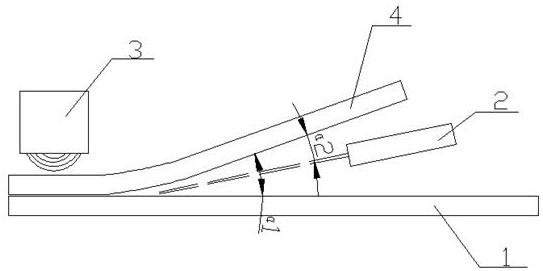
[0030] S2: if figure 1 , keep the first layer of two-dimensional material of the low-boiling point material and the substrate 1 at an angle α1 of 45°, and then preheat the first layer of two-dimensional material to 165°C, then use an energy gun 2 (preferably a laser energy gun or Electron beam energy gun) is incident between the first ...

Embodiment approach 2

[0041] This embodiment provides a method for layer-by-layer accumulation of low-boiling point two-dimensional materials. The low-boiling point two-dimensional materials are 300-500 mesh aluminum alloy powder particles, and the weight percentages are 40% of paraffin, 30% of acrylic resin, stearic acid 30% of the organic binder bonded to form a strip, the width is preferably 5mm, and the thickness is preferably 0.03mm.

[0042] Its forming method comprises the following steps:

[0043] S1: Control the temperature of substrate 1 to 130°C;

[0044] S2: if figure 1 , keep the first layer of two-dimensional material of the low-boiling point material and the substrate 1 at an angle α1 of 45°, and then preheat the first layer of two-dimensional material to 160°C, use an energy gun 2 (preferably a laser energy gun or Electron beam energy gun) is incident between the first layer of two-dimensional material and the substrate, and the incident angle α2 between the energy gun 2 and the t...

the structure of the environmentally friendly knitted fabric provided by the present invention; figure 2 Flow chart of the yarn wrapping machine for environmentally friendly knitted fabrics and storage devices; image 3 Is the parameter map of the yarn covering machine
Login to View More

PUM

PropertyMeasurementUnit
Power densityaaaaaaaaaa
Login to View More

Abstract

The invention relates to the field of additive manufacturing, and discloses a low-boiling-point two-dimensional material layer-by-layer stacking forming method. The method comprises the following steps of keeping a preset included angle between a first layer of two-dimensional material of to-be-printed low-boiling-point materials and a substrate, preheating the first layer of two-dimensional material, and using an energy gun for injecting between the first layer of two-dimensional material and the substrate, and according to the shape of a target product, melting and welding the surface, directly facing the substrate, of the first layer of two-dimensional material to the substrate; performing compaction and surface cleaning on the first layer of two-dimensional material melted on the substrate by using ultrasonic waves to form a first forming layer; forming a second forming layer in the same manner; and cyclically repeating the steps in sequence, forming a third forming layer on the second forming layer, forming a fourth forming layer on the third forming layer until the last forming layer is formed, and obtaining the target forming product. By means of the method, two-dimensional material layers are welded through energy, so that the forming purpose is achieved, and the problem that low-boiling-point materials are evaporated due to the low boiling point during printing is solved.

Description

technical field [0001] The invention relates to the technical field of additive manufacturing, in particular to a method for layer-by-layer accumulation of low-boiling point two-dimensional materials. Background technique [0002] At present, the raw materials for additive manufacturing include metal powder, metal wire, wire and liquid of polymer material, ceramic powder, etc., but there is no report of using two-dimensional materials to achieve additive molding. Powder is a zero-dimensional material, and wire is a one-dimensional material. It needs to increase the size in another three-dimensional and two-dimensional respectively to form. For the molding of larger size products, the more the number of welding seams on the same layer, the more welding seam defects, the worse the performance and the worse the stability. In the prior art, there is no product obtained by layer-by-layer welding of two-dimensional materials. Since two-dimensional materials are mostly in the form...

Claims

the structure of the environmentally friendly knitted fabric provided by the present invention; figure 2 Flow chart of the yarn wrapping machine for environmentally friendly knitted fabrics and storage devices; image 3 Is the parameter map of the yarn covering machine
Login to View More

Application Information

Patent Timeline
no application Login to View More
IPC IPC(8): B22F10/16B22F10/50B22F10/64B22F3/10B22F3/15B33Y10/00B33Y40/10B33Y40/20B33Y70/10
CPCB22F10/16B22F10/50B22F10/64B22F3/1007B22F3/15B33Y10/00B33Y40/10B33Y40/20B33Y70/10B22F2999/00B22F2201/20Y02P10/25
Inventor 陈业高徐琼张俊邵国有焦欣洋
Owner SUQIAN COLLEGE
Features
  • R&D
  • Intellectual Property
  • Life Sciences
  • Materials
  • Tech Scout
Why Patsnap Eureka
  • Unparalleled Data Quality
  • Higher Quality Content
  • 60% Fewer Hallucinations
Social media
Patsnap Eureka Blog
Learn More