Check patentability & draft patents in minutes with Patsnap Eureka AI!

Separation of azeotropic mixture

A technology of mixtures and azeotropes, applied in the field of separation of liquid mixtures, can solve problems such as limiting distillation temperature and corrosion

Inactive Publication Date: 2002-10-16
BASF AG
View PDF0 Cites 6 Cited by
  • Summary
  • Abstract
  • Description
  • Claims
  • Application Information

AI Technical Summary

Problems solved by technology

The chlorinated hydrocarbons thus decompose to form hydrogen chloride, which causes considerable corrosion problems in the double pressure distillation process
In addition, temperature-dependent substances limit the choice of distillation temperature

Method used

the structure of the environmentally friendly knitted fabric provided by the present invention; figure 2 Flow chart of the yarn wrapping machine for environmentally friendly knitted fabrics and storage devices; image 3 Is the parameter map of the yarn covering machine
View more

Image

Smart Image Click on the blue labels to locate them in the text.
Viewing Examples
Smart Image
  • Separation of azeotropic mixture
  • Separation of azeotropic mixture
  • Separation of azeotropic mixture

Examples

Experimental program
Comparison scheme
Effect test

Embodiment 1

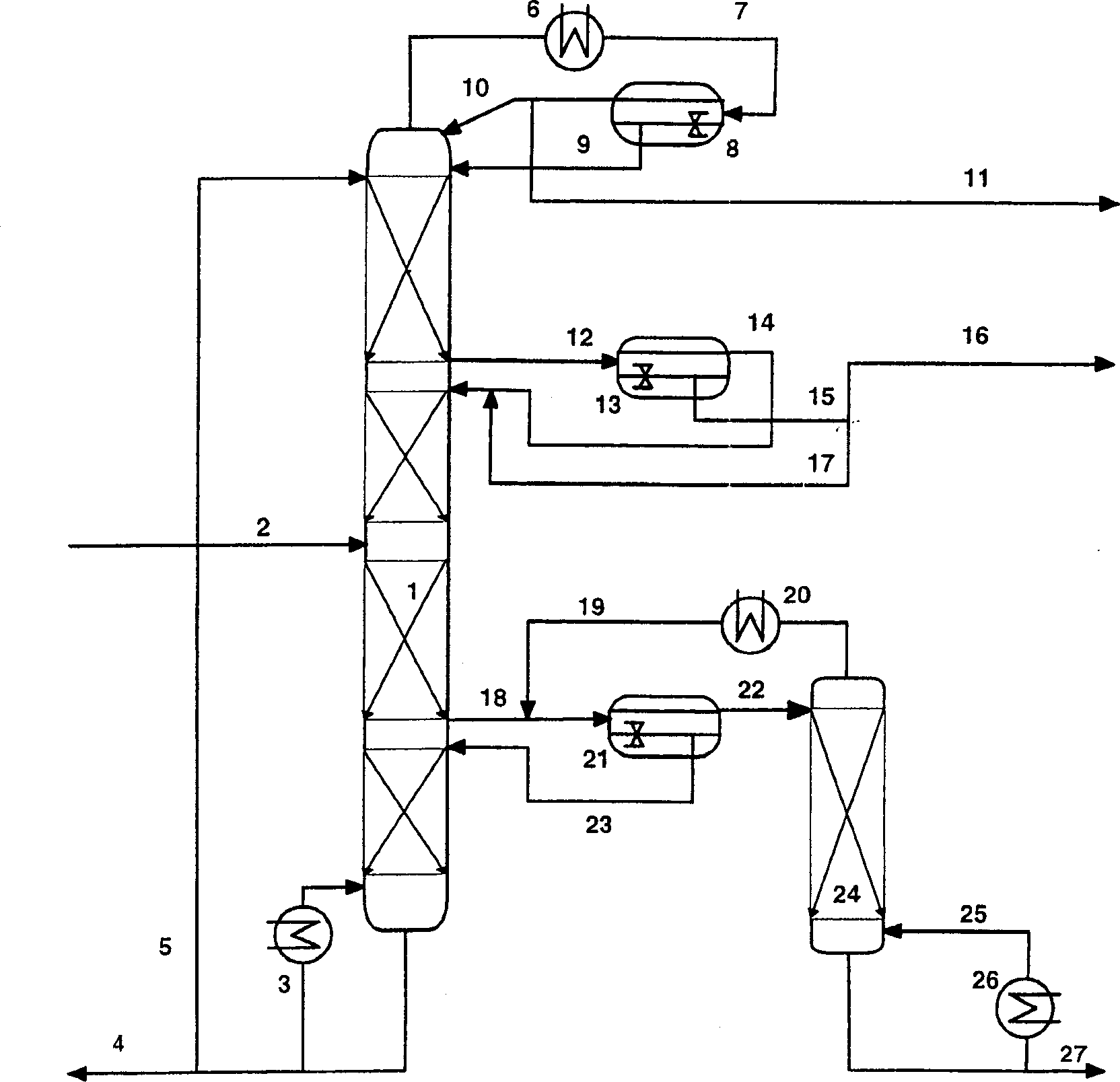
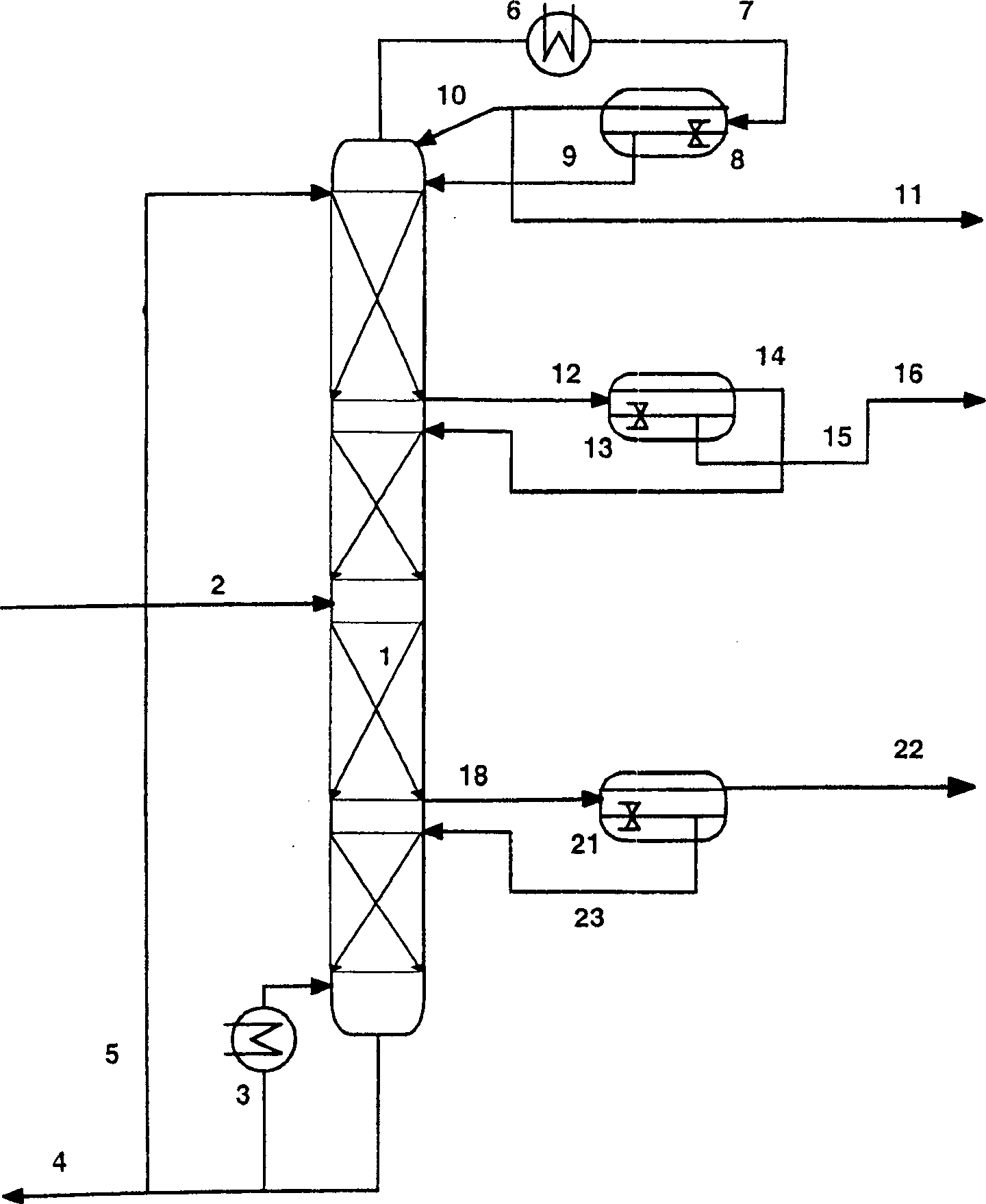
[0047] use figure 2 device shown.

[0048] A liquid mixture consisting of 44% by weight of 1-butanol, 40.6% by weight of perchlorethylene, 14.2% by weight of water and 1.2% by weight of butyl chloride is fed into column (1) via line (2). The composition of each stream is shown in Table 1.

[0049] The glass column ( 1 ) has a diameter of 43 mm, has 20 theoretical plates, and is filled with a screen packing of type CY from Sulzer Chemtech AG, Winterthur. The reflux ratio of the organic phase was 30. The column operates at a top pressure of 1 bar. The temperature at the bottom of the column was 104°C, and the temperature at the top of the column was 69°C. The feed point (2) is approximately in the middle of the column, above the second packing element of the 10th theoretical plate. The recycle stream (5) is returned to the column above the top of the fourth packing element. Stream (18) is withdrawn from the bottom of the second packing element in the middle of the lower s...

Embodiment 2

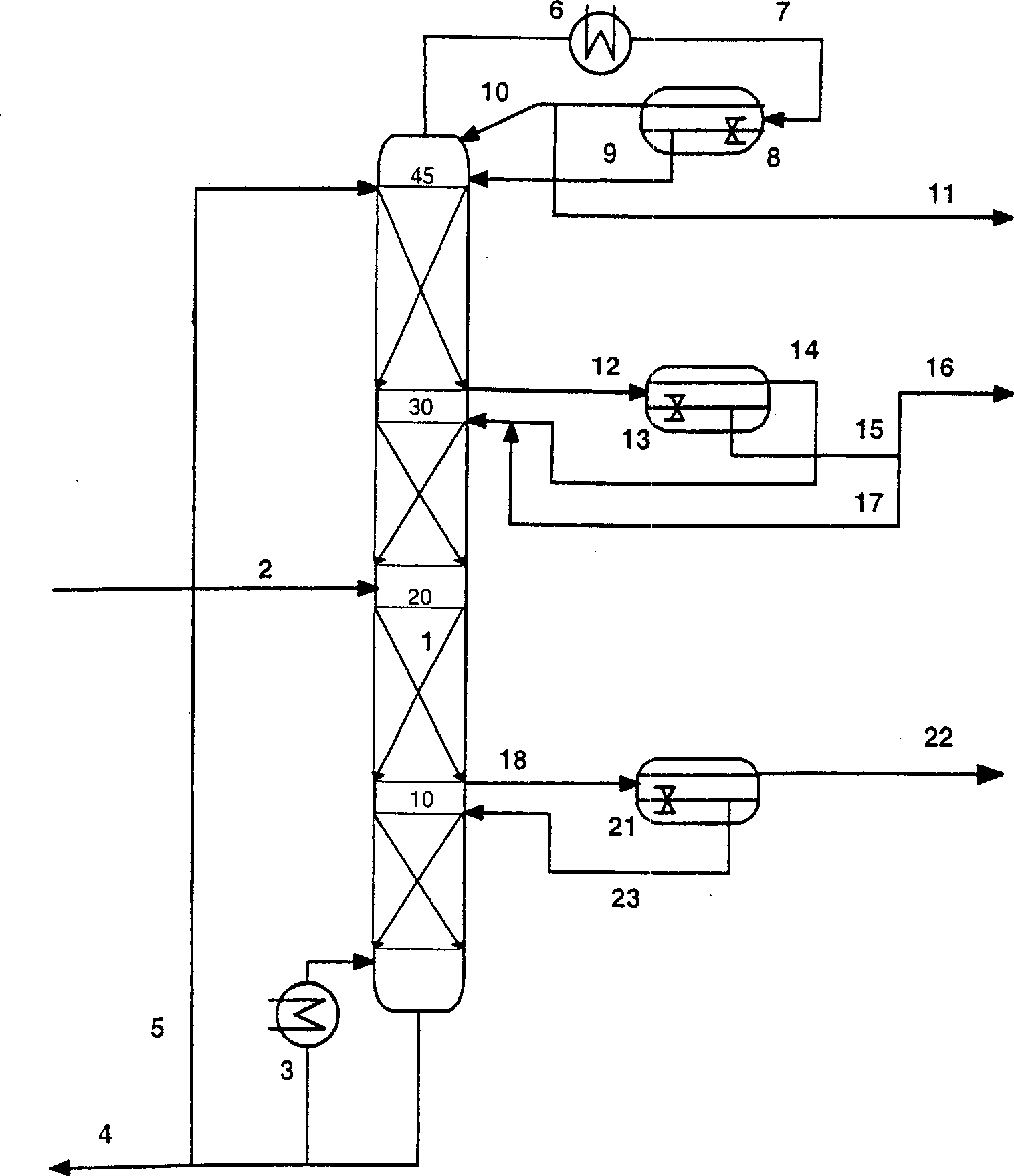
[0052] use image 3 device shown.

[0053] A liquid mixture consisting of 44% by weight of 1-butanol, 40.6% by weight of perchlorethylene, 14.2% by weight of water and 1.2% by weight of butyl chloride is fed into column (1) via line (2). The composition of each stream is shown in Table 2.

[0054] The glass column (1) has a diameter of 30 mm and is equipped with 45 bubble-cap trays. The reflux ratio of the organic phase was 30. The column operates at a top pressure of 1 bar. The temperature at the bottom of the column was 101.5°C, and the temperature at the top of the column was 68°C. The feed point (2) is approximately in the middle of the column, at the 20th theoretical plate. The recycle stream (5) is returned to the column on the uppermost tray.

[0055] logistics

the structure of the environmentally friendly knitted fabric provided by the present invention; figure 2 Flow chart of the yarn wrapping machine for environmentally friendly knitted fabrics and storage devices; image 3 Is the parameter map of the yarn covering machine
Login to View More

PUM

PropertyMeasurementUnit
Diameteraaaaaaaaaa
Login to View More

Abstract

A method for separating a liquid mixture composed of at least two components A and B which form an azeotrope with each other together with optional other components, the method comprising (i) in the presence of an auxiliary agent H, distilling the desired Separated mixture, the additive H and each of the two components A and B form a binary azeotrope AH or BH with a lower boiling point than H, (ii) separate the fraction containing A, H and the fraction containing B The fractions containing A and H contain less B than the mixture to be separated, while the fractions containing B and H contain less A than the mixture to be separated.

Description

technical field [0001] The invention relates to a method for the separation of a liquid mixture consisting of at least two components which form an azeotrope with each other. Background technique [0002] Liquid mixtures consisting of two or more components are common in chemical processes. By separating these mixtures it is possible, for example, to improve the quality of the raw materials, to further process intermediate products, to isolate desired products, etc. The classic separation method is distillation or rectification. However, simple distillation or rectification cannot separate the components that form azeotropes with each other because the liquid and vapor have the same composition at the azeotropic point. [0003] Various methods of separating azeotropic mixtures are described in the prior art. A comprehensive overview can be found, for example, in E.-U. Schlünder and F. Thurner in "Destillation, Absorption, Extraktion", Thieme Verlag, Stuttgart, 1986. [0...

Claims

the structure of the environmentally friendly knitted fabric provided by the present invention; figure 2 Flow chart of the yarn wrapping machine for environmentally friendly knitted fabrics and storage devices; image 3 Is the parameter map of the yarn covering machine
Login to View More

Application Information

Patent Timeline
no application Login to View More
IPC IPC(8): B01D3/36C07C17/386C07C21/12C07C29/82C07C31/12
CPCB01D3/36
Inventor W·布尔斯特G·凯贝尔T·昆策J·科尼
Owner BASF AG
Features
  • R&D
  • Intellectual Property
  • Life Sciences
  • Materials
  • Tech Scout
Why Patsnap Eureka
  • Unparalleled Data Quality
  • Higher Quality Content
  • 60% Fewer Hallucinations
Social media
Patsnap Eureka Blog
Learn More