
High frequency winding assembly and magnetic resonance imaging apparatus
A magnetic resonance imaging, high-frequency coil technology, applied in magnetic resonance measurement, measurement device, material analysis through resonance, etc., can solve problems such as the distance between the outer surface coil and the spine becoming larger, the sensitivity cannot be obtained, and the imaging sensitivity cannot be achieved. , to achieve the effect of increasing the consultation rate and reducing the burden
- Summary
- Abstract
- Description
- Claims
- Application Information
AI Technical Summary
Problems solved by technology
Method used
Image

Examples
no. 1 Embodiment
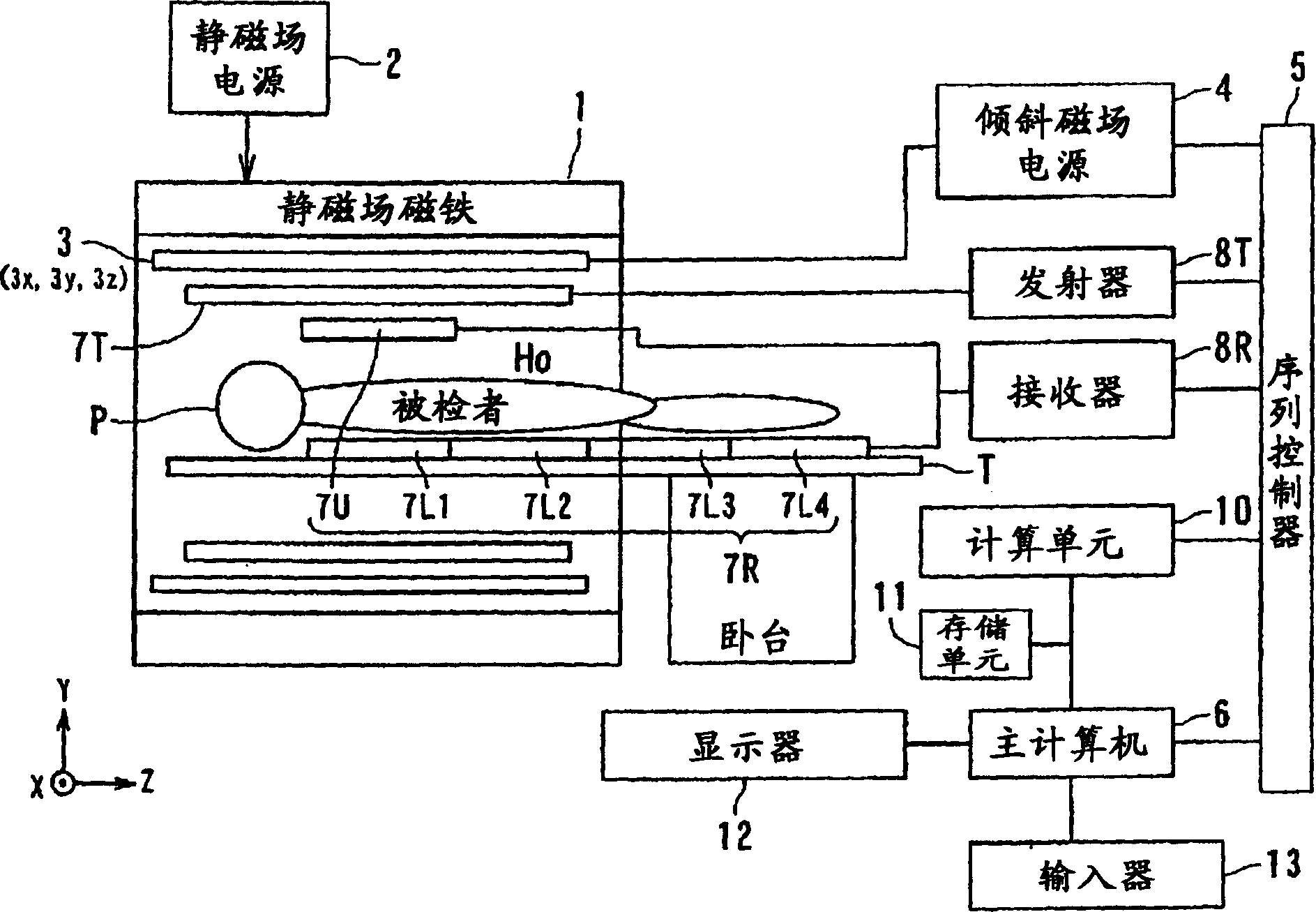
[0067] Refer below Figure 1-9 A magnetic resonance imaging apparatus according to a first embodiment of the present invention will be described.
[0068] figure 1 A schematic configuration of a magnetic resonance imaging (MRI: Magnetic Resonance Imaging) apparatus according to the first embodiment is shown.
[0069] This magnetic resonance imaging apparatus has a bed portion on which the subject P is placed, a static magnetic field generating portion generating a static magnetic field, a gradient magnetic field generating portion for adding position information to the static magnetic field, a transmitting and receiving portion for transmitting and receiving high-frequency signals, and a control system. The control and calculation unit of the overall and reconstructed image.
[0070] The static magnetic field generator includes, for example, a superconducting magnet 1 and a static magnetic field power supply 2 that supplies current to the magnet 1, and is positioned in the a...
no. 2 Embodiment
[0119] Figure 19 It is a diagram showing the configuration of the magnetic resonance imaging apparatus of the second embodiment.
[0120] The magnetic resonance imaging device has a static field magnet 101, a gradient magnetic field coil 102, a gradient magnetic field coil drive circuit 103, a bed 104, a transmitting unit 105, a transmitting high-frequency coil 106, a receiving high-frequency coil assembly 107, a receiving unit 108, Data collection unit 109 , computer 110 , sequence controller 111 , display 112 and console 113 .
[0121] The static magnetic field magnet 101 is in the shape of a hollow cylinder, and generates a uniform static magnetic field in the inner space. As the static field magnet 101, for example, a permanent magnet, a superconducting magnet, or the like is used. The gradient magnetic field coil 102 has a hollow cylindrical shape and is disposed inside the static field magnet 101 . The gradient magnetic field coil 102 is composed of three coils corre...
no. 3 Embodiment
[0148] Figure 24 It is a diagram showing the structure of the magnetic resonance imaging apparatus of the third embodiment. In addition, in Figure 24 In pair with Figure 19 The same symbols are used for the same parts, and detailed description thereof will be omitted.
[0149] The magnetic resonance imaging device has a static field magnet 101, a gradient magnetic field coil 102, a gradient magnetic field coil drive circuit 103, a bed 104, a transmitting unit 105, a transmitting high-frequency coil 106, a receiving unit 108, a data collection unit 109, a computer 110, Sequence controller 111 , display 112 , console 113 and receiving high-frequency coil assemblies 114 and 115 .
[0150] That is, the magnetic resonance imaging apparatus of the third embodiment has high-frequency coil units 114 and 115 instead of the high-frequency coil unit 107 of the second embodiment.
[0151] The high-frequency coil assembly 114 is placed on the top plate 104A. The high-frequency coil...
PUM
 Login to View More
 Abstract
Description
Claims
Application Information
 Login to View More