
Process for producing dried food eaten after hot-water cooking or hot-water reconstitution, and dried noodle
A technology for drying food and a manufacturing method, which is applied in the directions of food preparation, food preservation, and application, and achieves the effects of good separation, promotion of heat conduction, and improved separation.
- Summary
- Abstract
- Description
- Claims
- Application Information
AI Technical Summary
Problems solved by technology
Method used
Image

Examples
Embodiment
[0148]
[0149] The purpose of this verification test is to verify the influence of the cooking treatment time in the first process on the final product, so as to select a suitable cooking time.
[0150] In this test, 3 kg of quasi-strong wheat flour was used as 100 parts by weight, mixed with 1 part by weight of salt, 1 part by weight of water-sensitive powder, 0.05 parts by weight of pigment, and 35 parts by weight of water, and rolled to form noodle strips. The obtained noodle strips were shaped by blades No. 20 (noodle thickness 1.25 mm), No. 16 (noodle thickness 1.15 mm), and No. 16 thick noodles (noodle thickness 1.40 mm) to obtain raw noodle strands as objects to be processed.
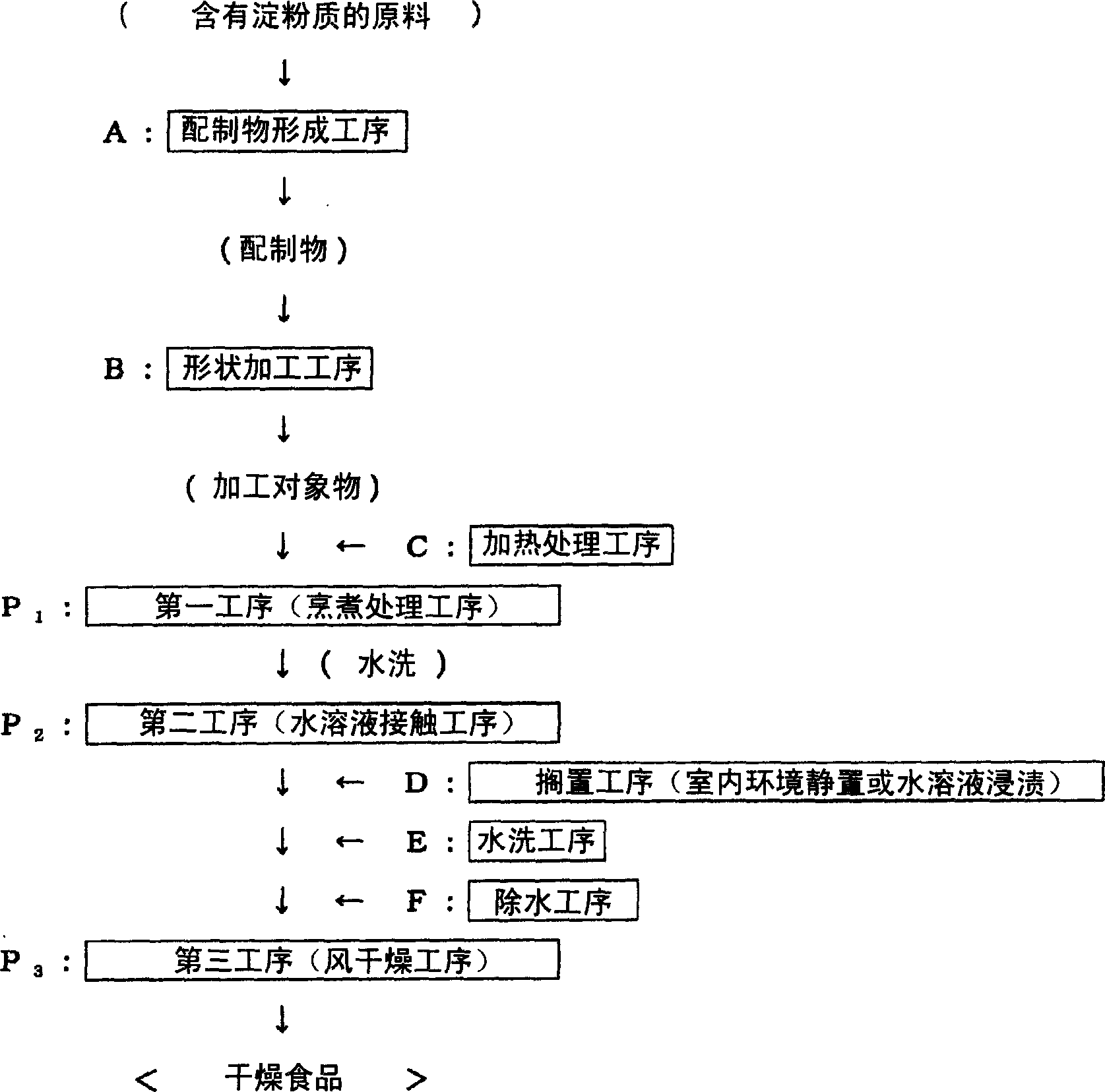
[0151] The object to be processed is subjected to steam heat treatment at 100°C for 3 minutes (heat treatment step), and in hot water at about 100°C, the first step ( cooking treatment). Immediately after that, make it contact with cold water, then take appropriate amount, and leave it for 1 ...
PUM
 Login to View More
 Abstract
Description
Claims
Application Information
 Login to View More