

Human auditory system modeling with masking energy adaptation
a human auditory system and energy adaptation technology, applied in the field of audio signal processing, can solve the problems of unwanted audible artifacts, unclear interpretation of masking phenomena, and the inability to understand the masking phenomenon of complex sounds, so as to improve the performance, improve the compression effect, and improve the effect of machine estimation
- Summary
- Abstract
- Description
- Claims
- Application Information
AI Technical Summary
Benefits of technology
Problems solved by technology
Method used
Image

Examples
Embodiment Construction
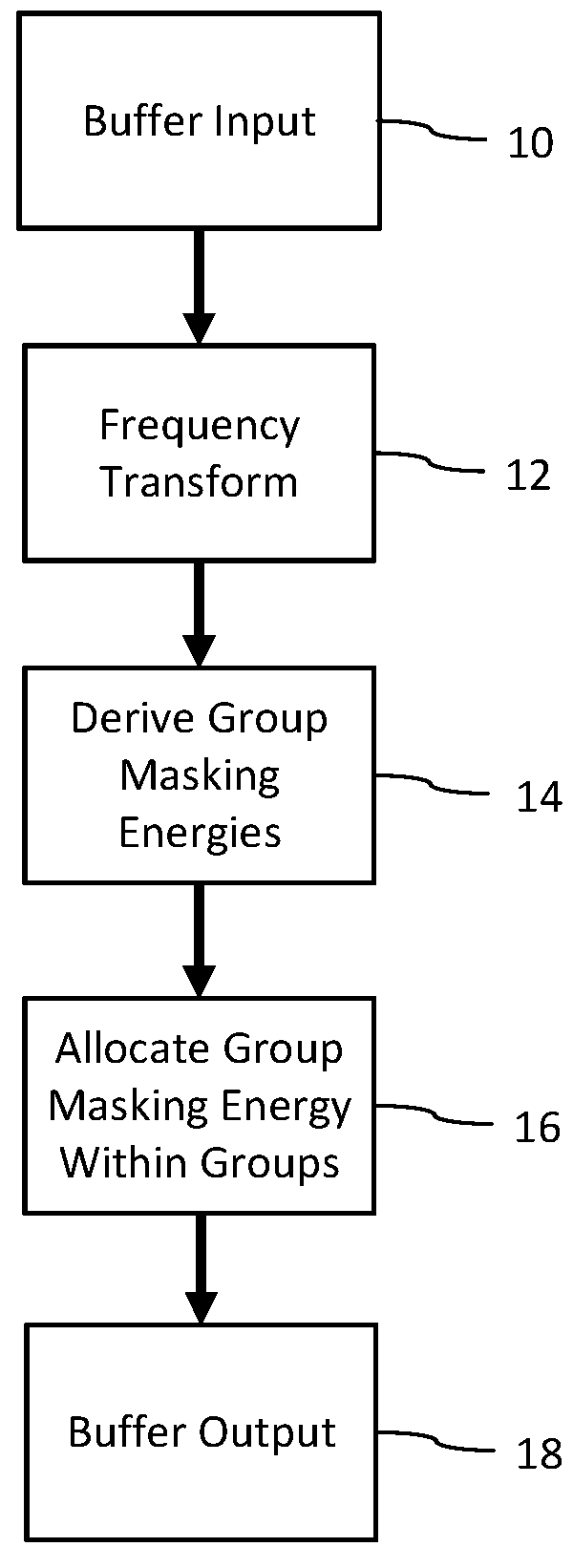
[0026]FIG. 1 is a diagram illustrating a method of allocating group masking energy. The method operates on an incoming audio stream, which is sub-divided into blocks. The blocks are buffered (10), processed to generate a masking model for a block (102-106), and the model and audio signal is buffered again for the next stage of audio processing. For real time or near time operation, the generation of the model is implemented to minimize latency of model generation and application. As is common in digital signal processing, the audio stream is digitized into samples at a particular sampling rate and bits / sample according to the level of quantization applied (e.g., 8, 16, 24, etc. bits per sample). Because the frequency range of human hearing is about 20 to 20 kHz, typical sampling rates are at or above the Nyquist rate (e.g., 44.1 kHz, 48 kHz or higher for more recent audio formats). One implementation, for example, operates on block size of 1024 samples at a sampling rate of 48 kHz. ...
PUM
| Property | Measurement | Unit |
|---|---|---|
| pressure | aaaaa | aaaaa |
| frequencies | aaaaa | aaaaa |
| frequencies | aaaaa | aaaaa |
Abstract
Description
Claims
Application Information
 Login to View More