

Semiconductor storage device and method for writing of the same
a storage device and semiconductor technology, applied in the field of semiconductor storage devices and a method for writing of the same, can solve the problems of not necessarily true that the writing is efficiently conducted to all of the memory cells, and the threshold of the memory cells to which data have been written will vary, so as to improve the uniformity of writing and improve the writing efficiency
- Summary
- Abstract
- Description
- Claims
- Application Information
AI Technical Summary
Benefits of technology
Problems solved by technology
Method used
Image



Examples
first embodiment
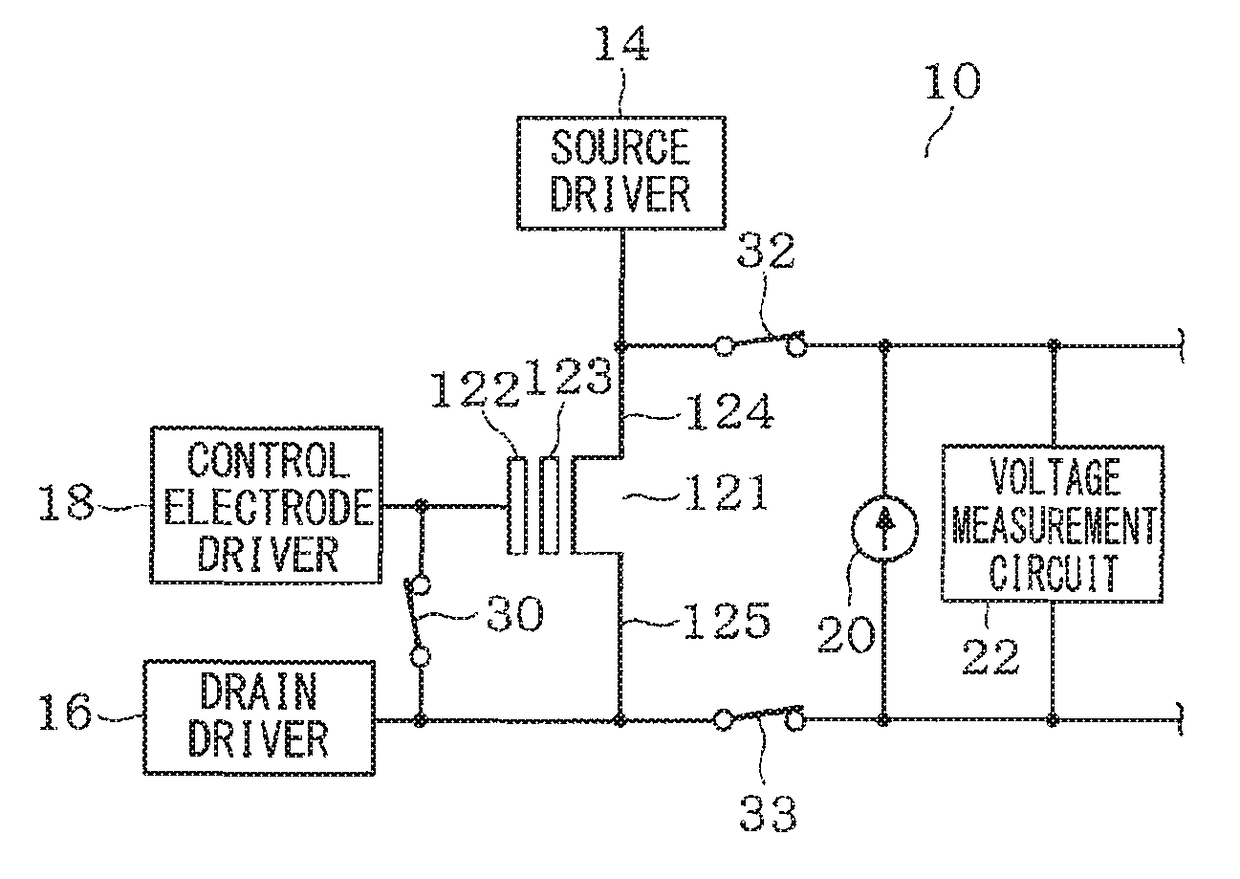
[0027]As shown in FIG. 1, a semiconductor storage device 10 according to the present embodiment is, for example, a p-channel flash memory, and has a memory cell 121. The memory cell 121 has a control electrode 122, a floating electrode 123, a source 124 and a drain 125. Writing to the memory cell 121 is implemented as electrons are injected to the floating electrode 123.
[0028]The semiconductor storage device 10 includes a source driver 14 and a drain driver 16. The source driver 14 is connected to the source 124, and applies a predetermined voltage to the source 124. The drain driver 16 is connected to the drain 125, and applies a predetermined voltage to the drain 125. The semiconductor storage device 10 includes a control electrode driver 18. The control electrode driver 18 is connected to the control electrode 122, and applies a predetermined voltage to the control electrode 122.
[0029]A switch 30 is provided between the control electrode 122 and the drain 125, and is configured t...
second embodiment
[0038]Next, a second embodiment will be described. Hereinafter, only the differences from the first embodiment will be described. The structure of a semiconductor storage device 10 of the second embodiment is the same as the structure of the first embodiment.
[0039]As shown in FIG. 3, in a writing processing of the second embodiment, firstly, the switches 30, 32 and 33 are turned on (B1). Next, a predetermined current is caused to flow to the memory cell 121 from the current source 20 (B2). That is, a voltage is applied between the control electrode 122 connected to the drain 125 and the source 124 so that the predetermined current flows in the memory cell 121. Next, a first potential difference (La, voltage, voltage difference) generated between the source 124 and the drain 125 is measured by the voltage measurement circuit 22 (B3). Since the control electrode 122 and the drain 125 are in the connected state, the first potential difference (voltage) is a threshold voltage of the mem...
third embodiment
[0051]Next, a third embodiment will be described. Hereinafter, only the differences from the first embodiment will be described. As shown in FIG. 5, the third embodiment is different from the first embodiment as having a reference memory cell 121a and a storage memory cell 131.
[0052]As shown in FIG. 5, a semiconductor storage device 10 has a reference memory cell 121a and a storage memory cell 131. The semiconductor storage device 10 includes a source driver 141 that is connected to a source 124a of the reference memory cell 121a, and applies a predetermined voltage to the source 124a. The semiconductor storage device 10 includes a drain driver 161 that is connected to a drain 125a, and applies a predetermined voltage to the drain 125a. Also, the semiconductor storage device 10 includes a control electrode driver 181 that is connected to a control electrode 122a, and applies a predetermined voltage to the control electrode 122a.
[0053]A switch 30 is provided between the control elec...
PUM
 Login to View More
 Abstract
Description
Claims
Application Information
 Login to View More