
Anti-phytopathogenic compositions
a composition and anti-phytopathogenic technology, applied in the field of anti-phytopathogenic compositions, can solve the problems of affecting the consistency of grape production and quality, and conventional application was proven inefficient, and achieve the effect of reducing the symptoms of the pathogen
- Summary
- Abstract
- Description
- Claims
- Application Information
AI Technical Summary
Benefits of technology
Problems solved by technology
Method used
Image


Examples
example 1
Isolation and Identification of the Bacterium of the Invention
[0268]Bacteria Isolation and Identification:
[0269]Plating homogenate of the planthopper on CV agar after surface sterilization resulted in growth of 7*105 colony forming units with identical morphology. The 1421 bp long DNA sequence of the 16S rRNA gene showed 97% identity to Dyella ginsengisoli (accession No. EF191353) and Frateuria aurantia (accession No. CP003350) (Xanthomonadaceae), isolated from soil and plant, respectively. The identity of this isolate was confirmed by its internal transcribed spacer (ITS) sequence 877 bp long DNA sequence, which showed 84% identity to Frateuria aurantia (accession No. CP003350). These results indicate that the isolate is a new genus.
[0270]Bacterial Genome Analyses:
[0271]The bacteria's genome contains 4,191471 bp, with a G+C content of 68.6%. The mutual Effective Overlap Score between the bacteria and phytoplasma was 0, indicating that the growth capacity of both species is not depe...
example 2
Antagonistic Effect of the Bacteria's Supernatant
[0272]Antagonistic Test of the Bacteria's Supernatant:
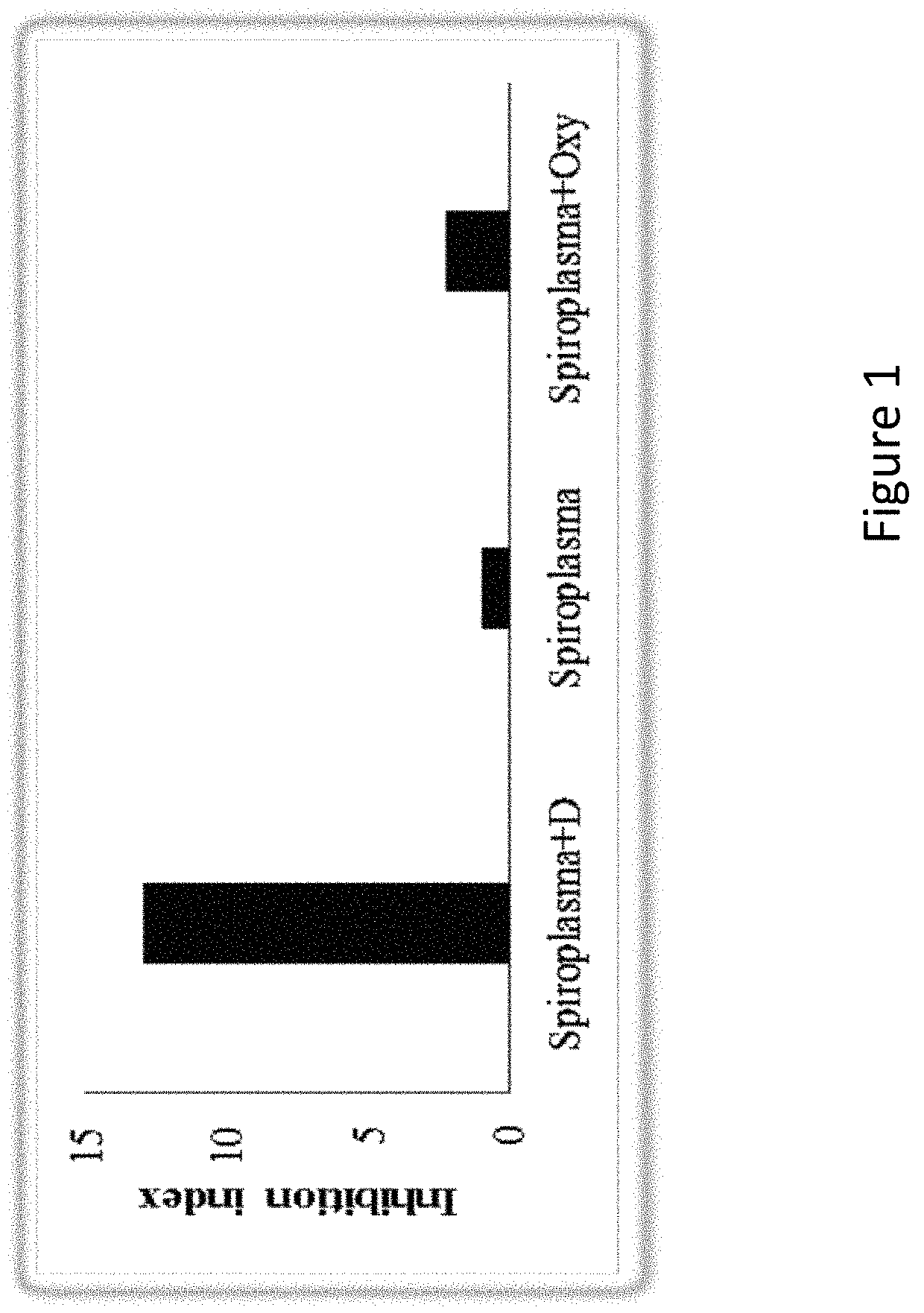
[0273]Filtrate of the bacteria'a supernatant inhibited spiroplasma development in vitro (FIG. 1).
[0274]Identification of Active Fraction Extracts:
[0275]When the effect of each fraction extract on spiroplasma growth was assessed, only methanol and acetone extracts inhibited spiroplasma in vitro while none of the fractions obtained from sterile control medium inhibited this model bacterium (FIG. 2).
[0276]Volatiles Identification in Dyella Active Fraction Extracts:
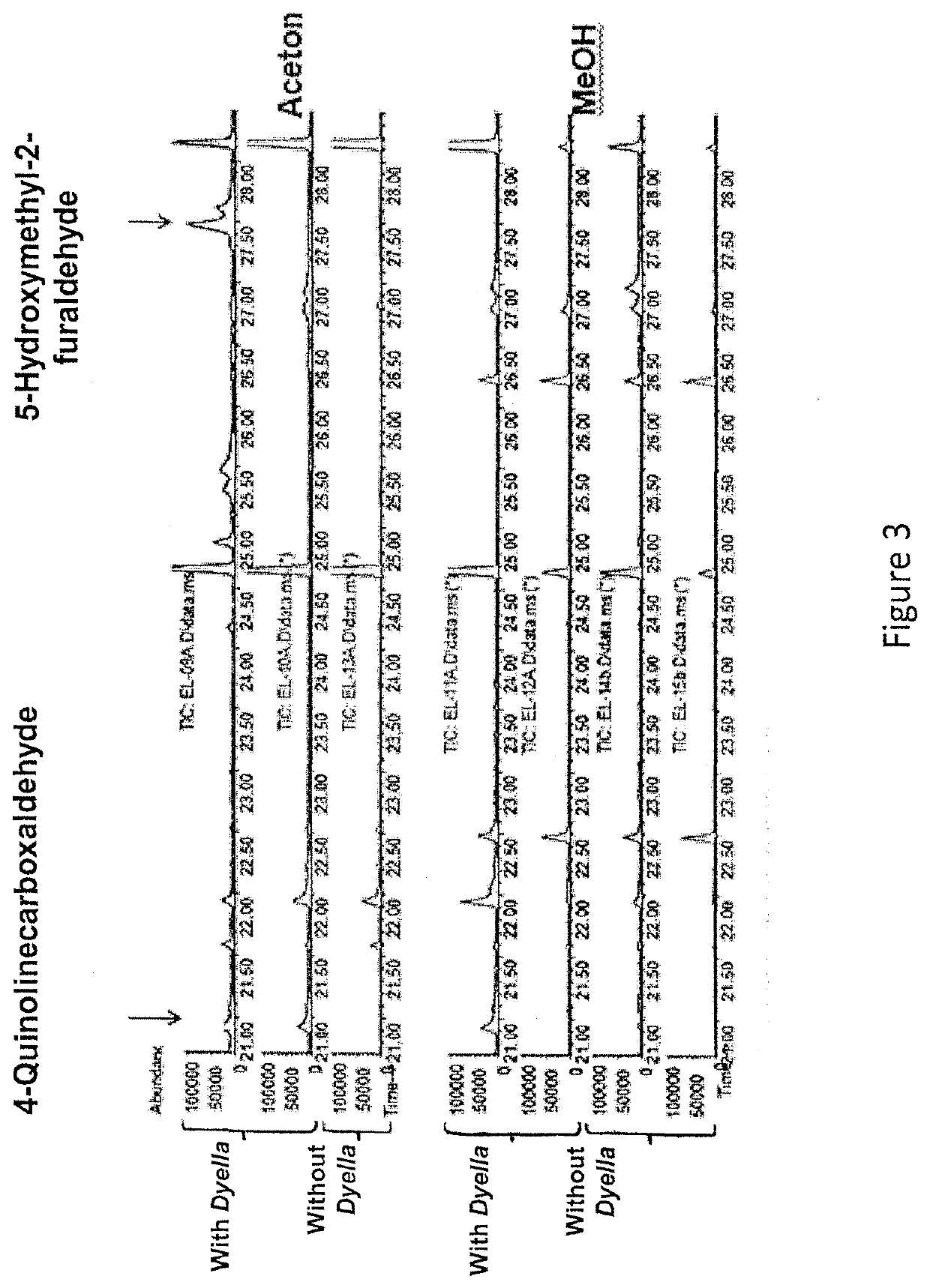
[0277]By comparing the pattern of volatiles in the active fraction extracts (methanol and acetone) to the same fraction extract of the sterile control medium—two compound were identified as potential inhibitory against spiroplasma (FIG. 3). These compounds were 4-Quinolinecarboxaldehyde and 5-Hydroxymethyl-2-furaldehyde. In addition the compound Pyrrolo[1,2-a]pyrazine was identified by LC-MS analysis (data not shown).
[0278]A...
example 3
Bacteria Detection in Plants After Inoculation
[0280]PCR.
[0281]The bacteria was able to penetrate plantlets by all methods examined including spraying, petting leafs, injection to the stem and root submergence in bacterial culture. However, the best inoculation was achieved by leaf spraying reaching up to 73% of the plants were inhabited by the bacteria a week after spraying. the bacteria was able to move in the plant up to 28 cm (3 internodes) but most of the samples showed that it remained in the first internode it was injected to. Examination the presence of the bacteria in inoculated plantlets by specific PCR showed that the bacteria occupied the new emerging leaves of grapevine plants three weeks post inoculation while no PCR product was detected in the non-inoculated plants. In addition, six weeks post inoculation the bacteria could not be detected in any of the plants.
[0282]Microscope.
[0283]Observations on the bacteria culture showed that this bacterium is a 1 μm long rod shap...
PUM
| Property | Measurement | Unit |
|---|---|---|
| temperature | aaaaa | aaaaa |
| mean thickness | aaaaa | aaaaa |
| mean thickness | aaaaa | aaaaa |
Abstract
Description
Claims
Application Information
 Login to View More