
Gene treatment to enhance feed efficiency and growth rate of livestock
a technology of gene treatment and growth rate, applied in the direction of drug compositions, medical preparations, peptides, etc., can solve the problems of reducing the benefits of these approaches, and increasing the growth rate and weight gain. , to achieve the effect of stimulating the growth rate of animals, enhancing feed conversion efficiency, and cost-effectiv
- Summary
- Abstract
- Description
- Claims
- Application Information
AI Technical Summary
Benefits of technology
Problems solved by technology
Method used
Image

Examples
example 2
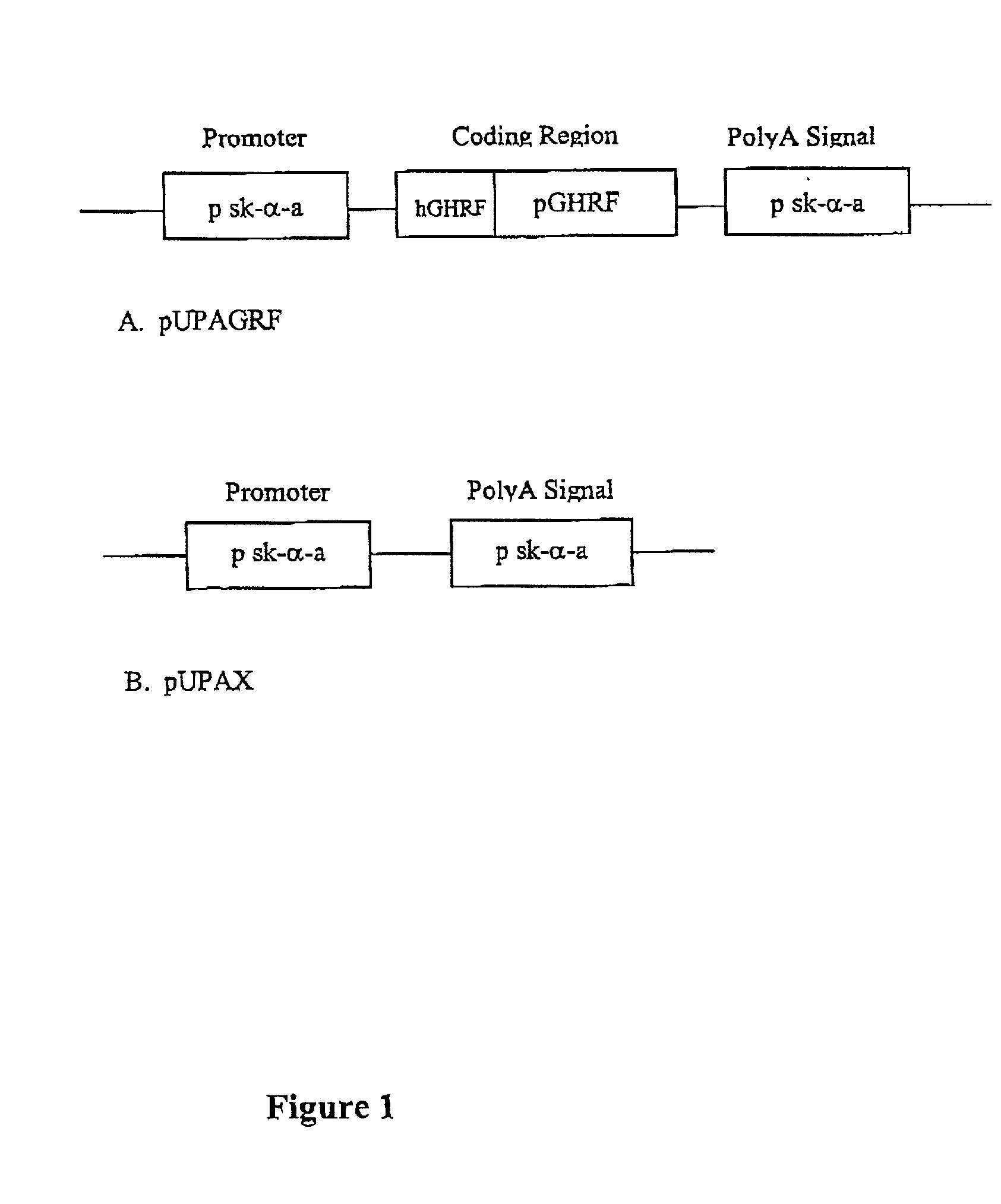
[0050] To test the ability of the pUPAGRF construct to enhance growth performance, we injected this plasmid in the quadriceps muscle of the mouse.
[0051] From a breeding colony of C57BL / 6J mice, forty-eight male mice of 14.5-18 g body weight were selected and randomly assigned to four groups of twelve. Each group of 12 mice were given a single injection of 100 .mu.l PBS containing either 100 .mu.g of control plasmid, or GHRF expression plasmid (pUPAGRF) at 30, 100 or 200 .mu.g, respectively. The mice were weighed, toe-marked for identification, then given a single injection in the middle of the left quadriceps muscle. The mice were kept on a 12 hour daylight cycle under a controlled climate, minimal disease environment and given standard rat chow and water. Body weights were recorded twice per week. The mice were anesthetized with ketamine / xylazine (0.15 ml per 100 g body weight) to obtain blood and tissue samples. Blood was collected by cardiac puncture into a 1 ml insulin syringe c...
example 3
[0054] We then tested the ability of the pGHRF gene treatment to improve growth performance in farmed pigs.
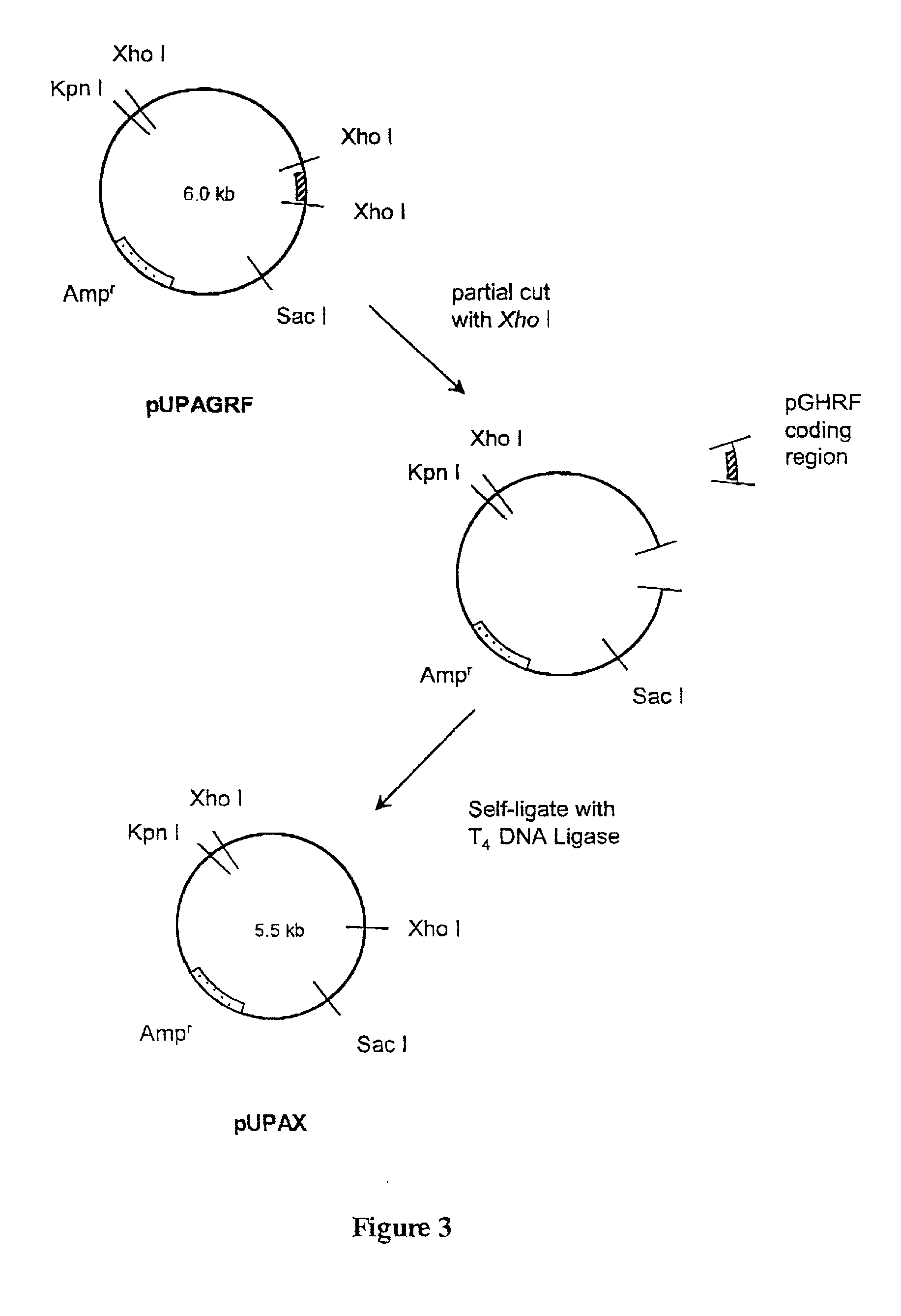
[0055] Breeder pigs of a triple cross from Landrace / Yorkshire / Duroc (YD) were used in this study. Young male pigs were randomly assigned into three adjacent pens on a breeder farm at 10 weeks of age. Pigs were given the plasmid preparation by a single injection in the gluteus muscle with a 11 / 2 inch 16 gauge syringe. Pigs in pen A and B were injected with 1 mg and 4 mg of pUPAGRF respectively, while those in pen C were given 4 mg of the control plasmid pUPAX. The pigs were given feed and water ad libitum and weighed weekly.
Results
[0056] Pigs given a single injection of 1 mg of pUPAGRF showed a weight gain from 62.53 to 87.17 kg (increase of 37.8%o) in the 6 weeks period of the experiment. Pigs injected with 4 mg grown from mean weight of 60.20 kg to 98.28 kg (gain of 44.1%). Those in the control group grown from 58.59 to 89.33 kg (a 34.4% gain) in the same period. Thus after 6 ...
example 4
[0057] Studies were conducted to determine the effects of injecting 2 mg of pUPAGRF plasmid to Landrace / Yorkshire (LY) pigs on the accumulation of back-fat. Twenty LY pigs at approximately 32 weeks old and average weight of 55 kg were assigned to two groups of ten, each with 5 males and 5 females. One group was administered 2 mg of pUPAGRF plasmid by intramuscular injection. The second group was similarly treated with the plasmid, pUPAX, and served as a control. Back-fat thickness at positions lateral to the last thoracic vertebra was determined weekly using a Renco ultrasound meter. Three measurements were taken at positions PI, PII, and PIII being 45 mm, 65 mm, and 80 mm lateral to the center of the spine at the last rib vertebra respectively, and averaged to give a mean back fat thickness.
[0058] The results are summarized in FIG. 7. In mates, both pGHRF treated and control pigs showed gradual increases in back fat thickness as the animals aged, although those, given the pGHRF exp...
PUM
| Property | Measurement | Unit |
|---|---|---|
| Weight | aaaaa | aaaaa |
| Electrical resistance | aaaaa | aaaaa |
| Efficiency | aaaaa | aaaaa |
Abstract
Description
Claims
Application Information
 Login to View More