
Indazole compounds and pharmaceutical compositions for inhibiting protein kinases, and methods for their use
a technology of indazole compounds and pharmaceutical compositions, which is applied in the direction of drug compositions, extracellular fluid disorders, and metabolic disorders, can solve the problems of progressive damage to the retina, affecting the ability of the retina to absorb light, etc., to reduce or inhibit abnormal cell growth, reduce endothelial cell migration, and reduce endothelial cell division.
- Summary
- Abstract
- Description
- Claims
- Application Information
AI Technical Summary
Benefits of technology
Problems solved by technology
Method used
Image

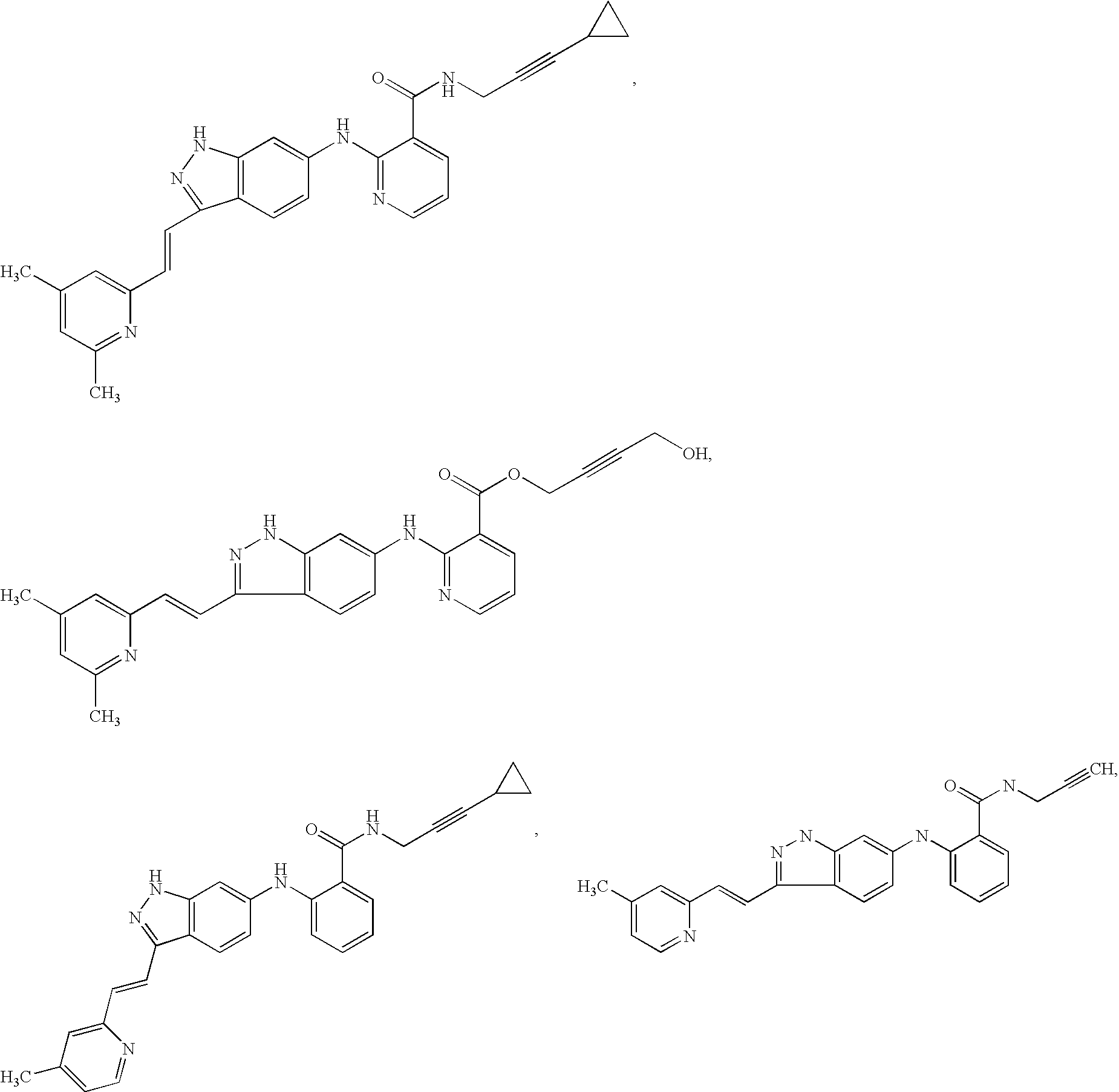
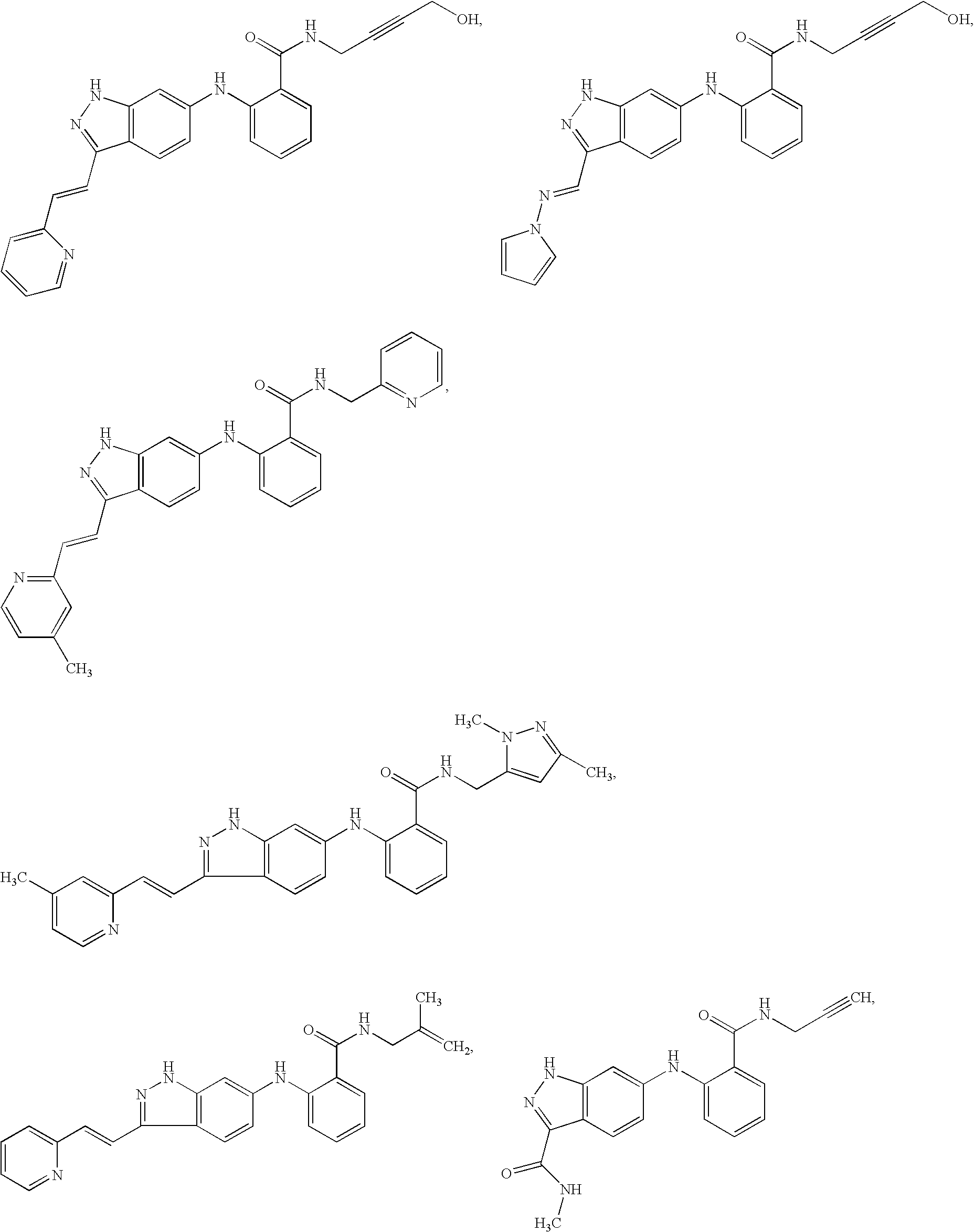
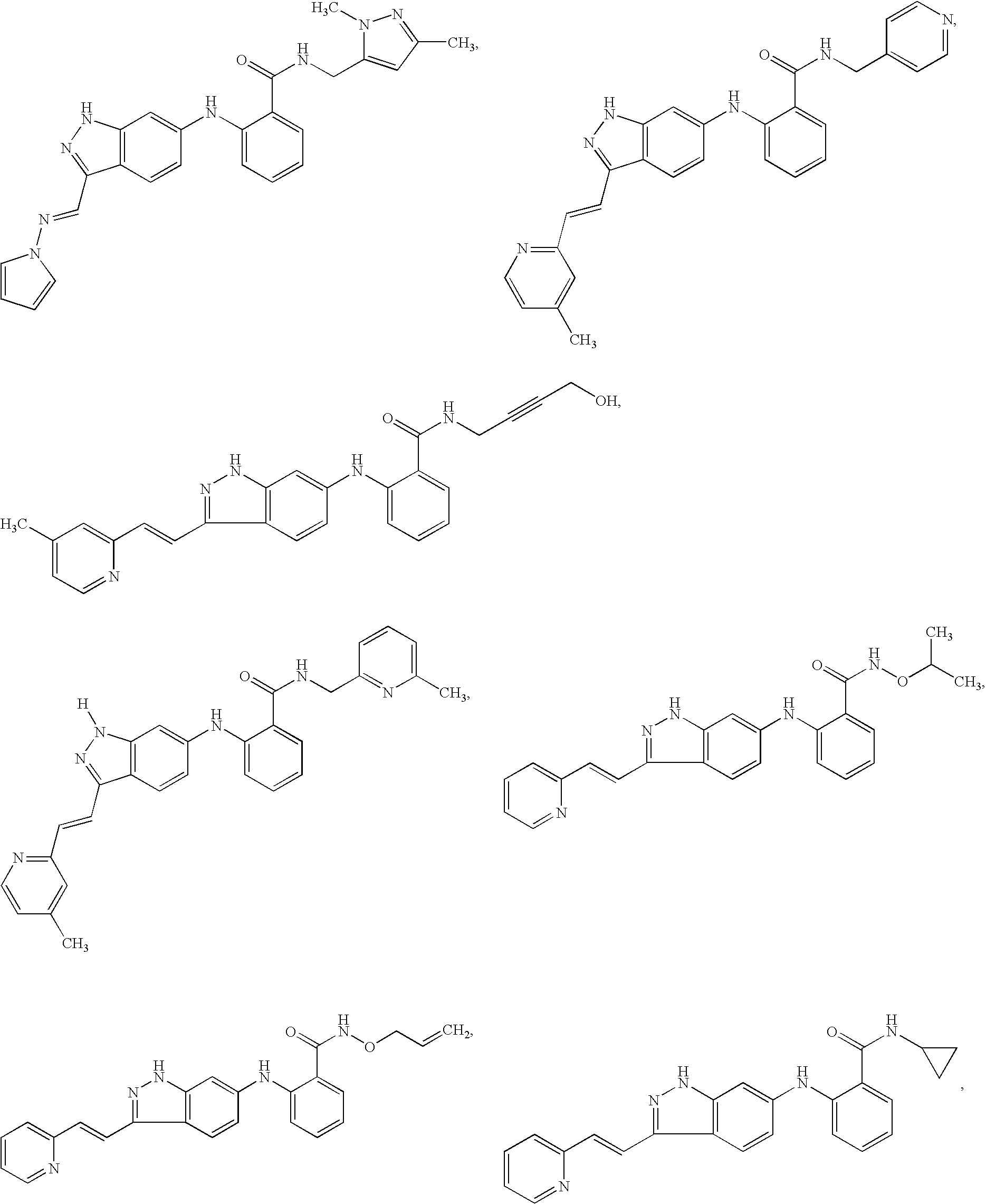
Examples
example 1 (
Example 1(k)
6-(2-Prop-2-ynylcarbamoyl-phenylamino)-1H-indazole-3-carboxylic acid methylamide
[0196] 23
[0197] Dissolved 6-(2-Prop-2-ynylcarbamoyl-phenylamino)-1-(tetrahydro-pyra-n-2-yl)-1H-indazole-3-carboxylic acid methylamide (30 mg) in 1.5 mL of a 90:10:1 mixture of CH.sub.2Cl.sub.2:Trifluoroacetate TFA:triethyl silane and heat to reflux for 2 hours. Diluted the solution with toluene (40 mL) and concentrate by rotary evaporation to an oil. Dissolved the oil in DMF (1 mL), and filter using a 0.2-micron syringe filter. Used prep-HPLC to isolate the desired compound (12 mg, 50%). .sup.1H NMR (CDCl.sub.3-d) .delta. 9.96 (1H, s), 9.49 (1H, s), 8.28 (1H, d, J=8.85 Hz), 7.47 (1H, m), 7.34 (1H, m), 7.22 (1H, m), 7.15 (1H, dd, J1=8.76 Hz, J2=1.79 Hz), 6.99 (1H, m), 6.86 (1H, t, J=6.97 Hz), 6.31 (1H, m), 4.23 (2H, dd, J1=5.18 Hz, J2=2.54 Hz), 3.49 (3H, s), 2.29 (s,1 H).
[0198] Anal. Calcd. For C.sub.19Hl.sub.7N.sub.50.sub.2e1.0 MeOHo0.1 TFA: C, 62.08; H, 5.44; N, 17.92. Found: C, 61.78; H, 5....
example 2 (
Example 2(h) N-Cyclopropyl-2-3-[(E)-2-(4-methyl-pyridin-2-yl)-vinyl]-1H-in-dazol-6-ylamino}-benzamide
[0213] 31
[0214] The title compound was prepared analogously to 2-{3-[2-(5-Ethyl-pyridin-2-yl)-vinyl]-1H-indazol-6-ylamino)N-prop-2-ynyl--benzamide described above, substitutiting 2,4-dimethyl-pyridine for 4-ethyl-2-methyl-pyridine in the step where 1-(6-Chloro-1H-indazol-3-yl)--2-(5-ethyl-pyridin-2-yl)-ethanol was prepared, and substituting cyclopropyl amine in place of propargyl amine in the final step of the sequence. .sup.1H NMR (DMSO-d.sub.6): .delta. 9.85 (1H, s), 8.56 (2H, m), 8.20 (3H, m), 7.53 (5H, m), 7.35 (1H, s), 7.2 (1H, d, J=6.5 Hz), 7.0 (1H, s), 2.83 (1H, m), 0.70 (2H, m), 0.56 (2H, m). ESIMS (M+H.sup.+): 410.3.
Example 3(a)
N-Methoxy-2-[3-((E)-2-pyridin-2-yl-vinyl)-1H-indazol-6-ylamino]-benzamide
[0215] 32
[0216] A solution of 2-[3-(2-Pyridin-2-yl-vinyl)-1H-indazol-6-ylamino]-ben-zoic acid (50.0 mg, 0.084 mmol), O-methyl-hydroxylamine hydrochloride (15 mg, 0.17 mmol), trie...
example 3 (
Example 3(q)
N-Prop-2-ynyl-2-[3-((E)-2-pyridin-2-yl-vinyl)-1H-indazol-6-ylamino]-benzam-ide
[0245] 47
[0246] A solution of 2-(3-Pyridin-2-ylethynyl-1H-indazol-6-ylamino)-benzoi-c acid (41 mg, 0.117 mmol), propargylamine (24 .mu.L, 0.35 mmol), triethylamine (81 pl, 0.58 mmol), dissolved in DMF (0.5 mL), was treated with HATU (89 mg, 0.233 mmol). The mixture was stirred overnight, then purified by reverse phase HPLC yielding 27 mg (59%) of the title compound as a yellow solid. .sup.1H NMR (DMSO-d.sub.6): .delta. 9.78 (1H, s), 8.99 (1H, m), 8.61 (1H, d, J=2.1), 7.88 (1H, s), 7.72 (3H, m), 7.43 (4H, m), 7.29 (1H, s), 7.04 (1H, d, J=7.3), 6.91 (1H, t, J=5.2), 4.04 (2H, s), 3.04 (1H, s). ESIMS (M+H.sup.+): 392.1.
Example 4(a):
2-Bromo-4,6-dimethyl-pyridine.
[0247] 48
[0248] A solution of 48% HBr (aq) (Aldrich, 65 mL, 1.2 mol, 10 eq) was cooled to -5.degree. C. and treated with 4,6-dimethyl-pyridin-2-ylamine (Aldrich, 15.0 g, 0.12 mol. 1.0 eq). The thick white salt mixture was stirred with a mech...
PUM
| Property | Measurement | Unit |
|---|---|---|
| Molar density | aaaaa | aaaaa |
| Molar density | aaaaa | aaaaa |
| Molar density | aaaaa | aaaaa |
Abstract
Description
Claims
Application Information
 Login to View More