

Method
- Summary
- Abstract
- Description
- Claims
- Application Information
AI Technical Summary
Benefits of technology
Problems solved by technology
Method used
Image



Examples
example 1
[0363] Large Scale Mapping of Genomic Regulatory Motifs in HeLa Cells Using a Hypersensitive Site Cloning Strategy
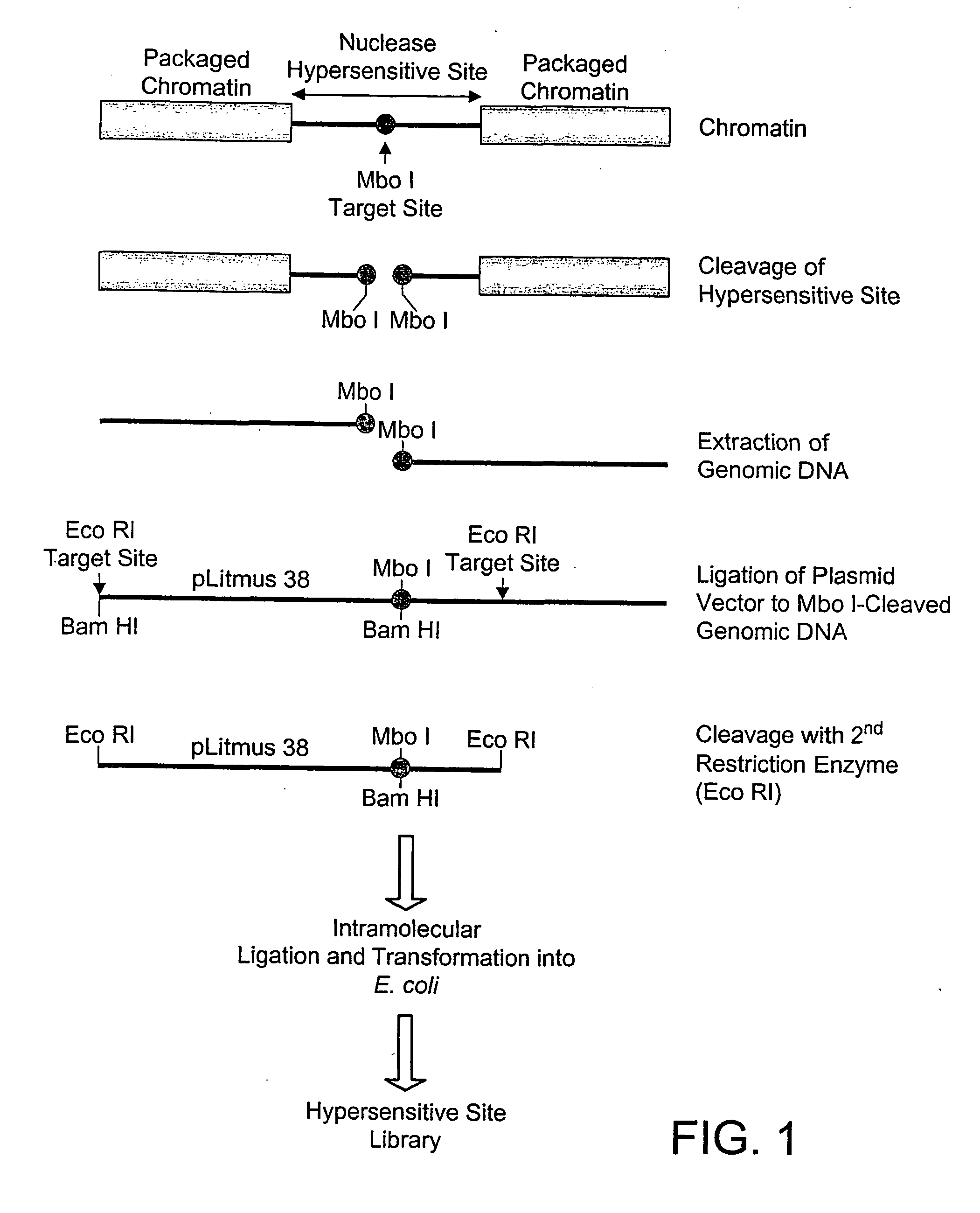
[0364] Until now the mapping of HSs using the `indirect end-labeling` method (Wu, 1980) has exclusively focused on a small number of genes and no genome-global approaches for efficiently mapping HSs have been described. Global HS mapping data will allow unique insights concerning their location relative to transcription units, their sequence features and DNA structure and how the presence of HSs correlates with transcriptional state of adjacent genes. Such data is currently not obtainable on a large scale using the low-throughput methods that have been developed for studying HS patterns of individual genes. Implementation of a method that is capable of mapping of HSs in a comprehensive and genome-global manner is described. The principle is summarized in FIG. 1. To create a genomic library highly enriched in DNA fragments derived from HSs, DNA present in nuclei is digest...
example 2
[0395] Identification of Hypersensitive Sites with `Hypertag Display`
[0396] HSs are useful experimental markers for the presence of functional regulatory regions in eukaryotic genomes. HSs have been mapped, often in great detail, for a number of genes, but the labour-intense nature of the procedure has up to now precluded a genome-wide approach. The method described in Example 1 for constructing and characterizing libraries containing DNA selectively cloned from HSs promises a solution to this problem. This method allows the establishment of a comprehensive map of genomic HS locations in a particular cell type. Since many genes involved in regulatory events are selectively expressed in a tissue- and cell type-specific manner it is important to develop additional methods for comparing HSs patterns in a large number of different cells. This concept is foundation of the `hypertag display` method described here.
[0397] The principle of hypertag display is shown schematically in FIG. 5; D...
example 3
[0415] Identification of Hypersensitive Sites with RLGS
[0416] Cell Culture and HS Cleavage
[0417] HeLa S3 cells (obtained from the European Collection of Cell Cultures; ECACC Ref. No. 87110901) are grown to 80% confluency in 150 cm.sup.2 flasks at 37.degree. C. in Dulbecco's Minimal Essential Medium / 10% newborn calf serum (Sigma) in a 5% CO.sub.2 humidified atmosphere. Before carrying out the procedure the appearance of cells is visually checked and their overall viability (>97%) assessed by trypan blue staining. After removing the medium the adherent cells are rinsed in Dulbecco's PBS (--Ca.sup.2+ / Mg.sup.2+) and around 75% of the cells are detached by trypsin treatment.
[0418] Cell Permeablisation and Fragmentation
[0419] Cells are temporarily permeabilised by lysolecithin treatment.
[0420] Aliquots of the permeabilised cells are distributed into six separate microcentrifuge tubes which are subjected to the following treatments:
[0421] Reaction 1: no enzyme (negative control)
[0422] Reac...
PUM
| Property | Measurement | Unit |
|---|---|---|
| Structure | aaaaa | aaaaa |
| Therapeutic | aaaaa | aaaaa |
Abstract
Description
Claims
Application Information
 Login to View More