[0011] According to the invention the abovementioned object for a system is achieved by means of the features of claim 1. One important
advantage of the invention is the simple and automatic
verification of the exchange of data. It can be ascertained whether specified information has actually been exchanged. In other words it can be verified whether information has actually been sent by a sender and has reached the recipient. Also
transmission errors or bottlenecks that occur can be identified and analyzed very easily. Optimization options for the underlying
software system or project can thereby be derived. A further
advantage is that mandatory records for the authorities e.g. FDA can very easily be kept (e.g. by means of generated reports).
[0012] In a first advantageous embodiment of the present invention for a system, the results of the analysis of the
exchange of information and / or the
error analysis can be further processed directly by the
software system. The results of the analysis and the derived conclusions (e.g. optimization options) can be taken into account directly in the software system (e.g. modified component configuration,
dimensioning or arrangement of communication connections). This results in a quasi-closed self-regulating control loop.
[0013] In a further advantageous embodiment of the present invention for a system, specific information and / or errors can be selected by creating a filter. Users can thereby access information in a targeted manner very easily. Possible filters are for example, sender, recipient, time period, message IDs. The filters can be defined for example by means of input masks and input tools (keyboard, mouse, etc.). The user then has the option of procuring information in a progressive and dedicated manner.
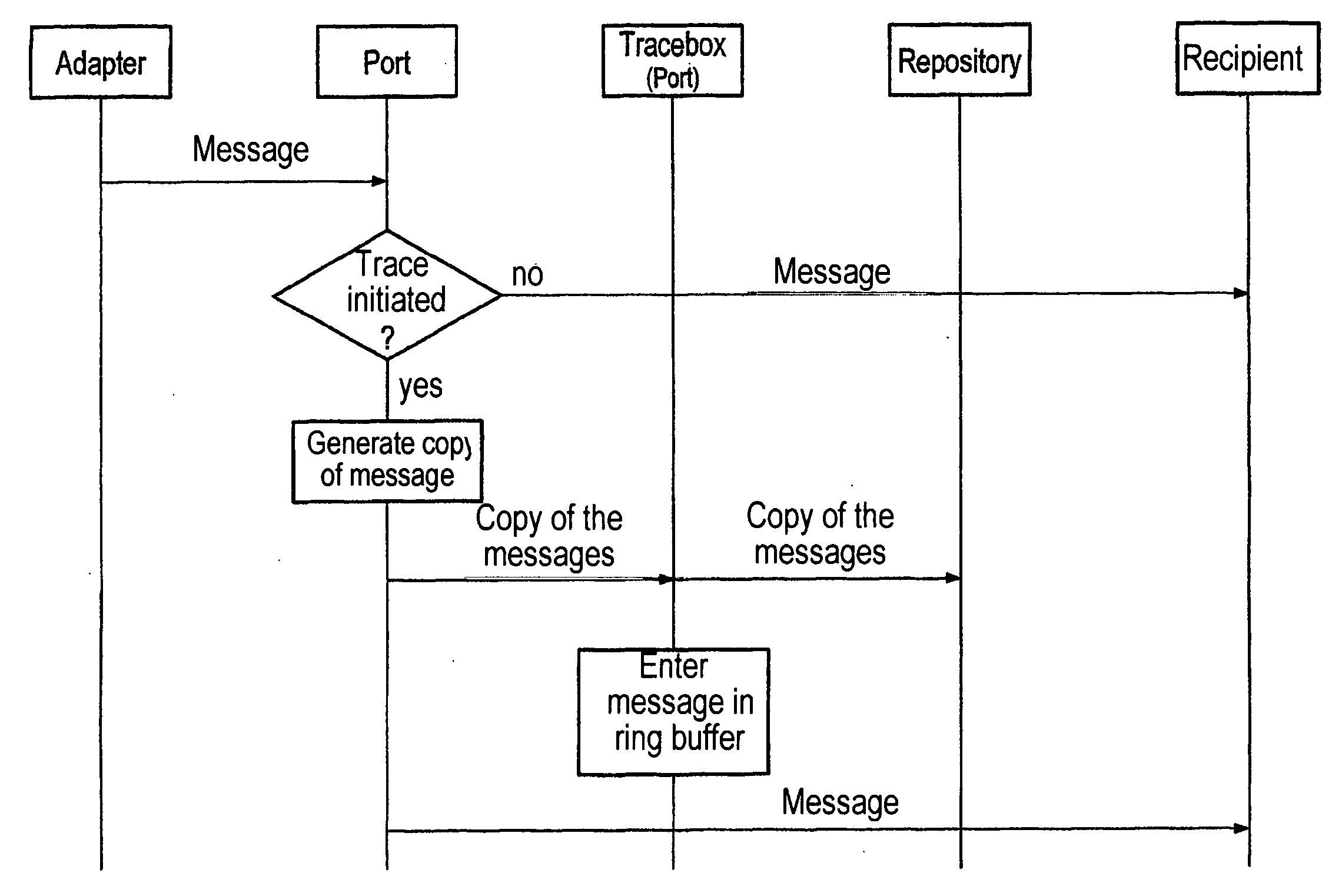
[0014] In a further advantageous embodiment of the present invention for a system, tracing and / or evaluation is carried out at project level or at adapter level or at the level of an information channel. This allows progressive information procurement and evaluation at different abstraction levels (project level, adapter level, port level).
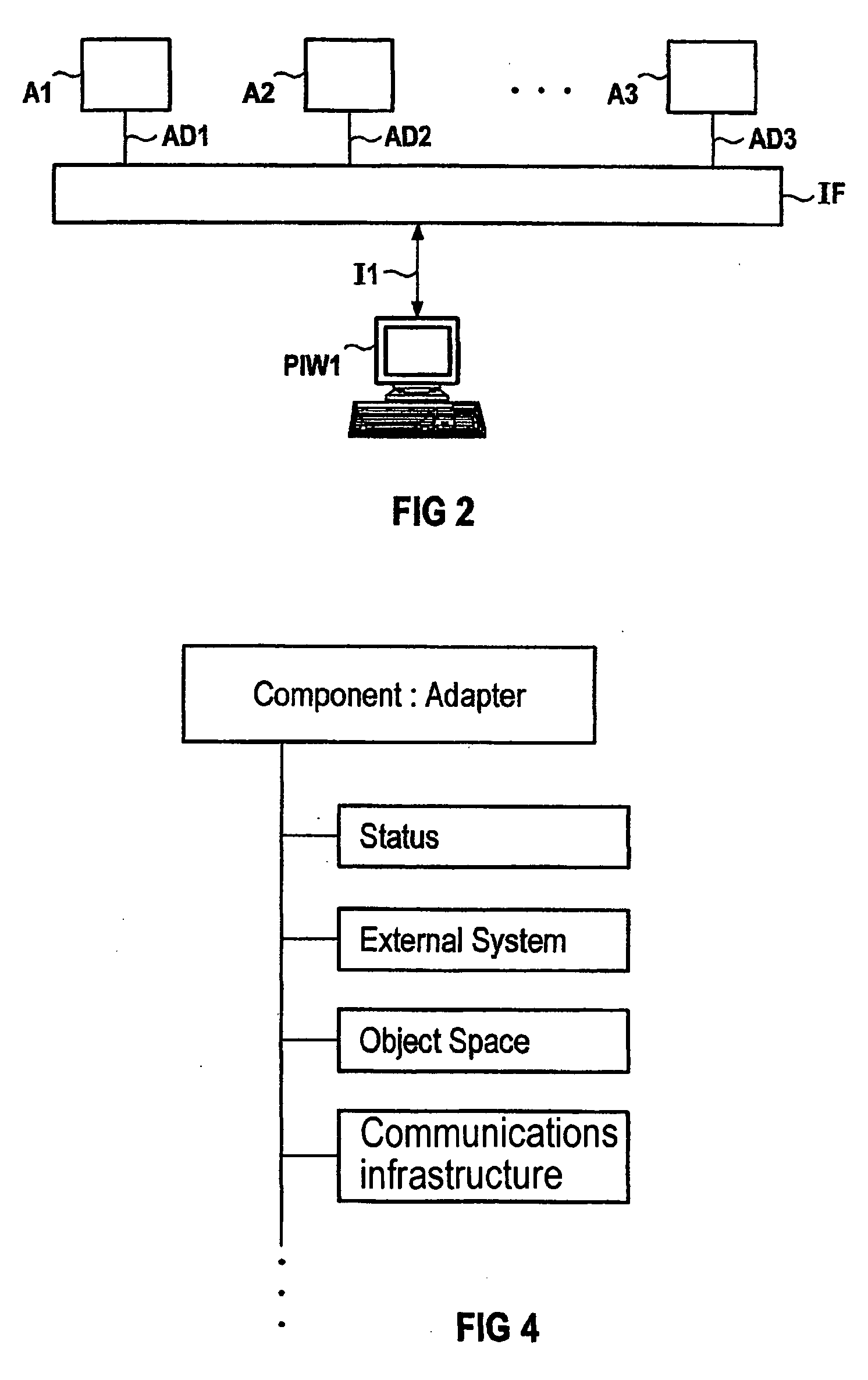
[0015] In a further advantageous embodiment of the present invention for a system, adapters and / or wrappers are deployed as the link mechanisms. Adapter and wrapper technologies are known mechanisms in
information technology for integrating software components into a system. A wrapper maps the API (Application Programmable Interface) of an external component (e.g. a MES application of a third-party provider) onto the
object model of the framework program. Thus for example a framework program method is obtained from a method of the API of the external component or an integer
data type of the framework program is obtained from an integer
data type of the API of the external component, etc. For COM (
Component Object Model) objects, creation of a wrapper for a component to be integrated can be automated. A wrapper corresponds to a bridge. Wrappers can be produced very quickly.
[0016] Adapters are one abstraction level higher than wrappers. They provide a uniform view of linked applications. An adapter offers the functionality to start, control, etc. the component to be linked. In the language of design patterns an adapter corresponds to a facade.


 Login to View More
  Login to View More