
Soft-switching three-phase power factor correction converter
a three-phase power factor and converter technology, applied in the field of soft-switching three-phase power factor correction converters, can solve the problems of relatively high switching loss of active switch s, relatively heavy and larger industry, and relatively large size of the industry of silicon steel industries, so as to reduce the size of the magnetic elements of the converter and reduce the thd
- Summary
- Abstract
- Description
- Claims
- Application Information
AI Technical Summary
Benefits of technology
Problems solved by technology
Method used
Image

Examples
Embodiment Construction
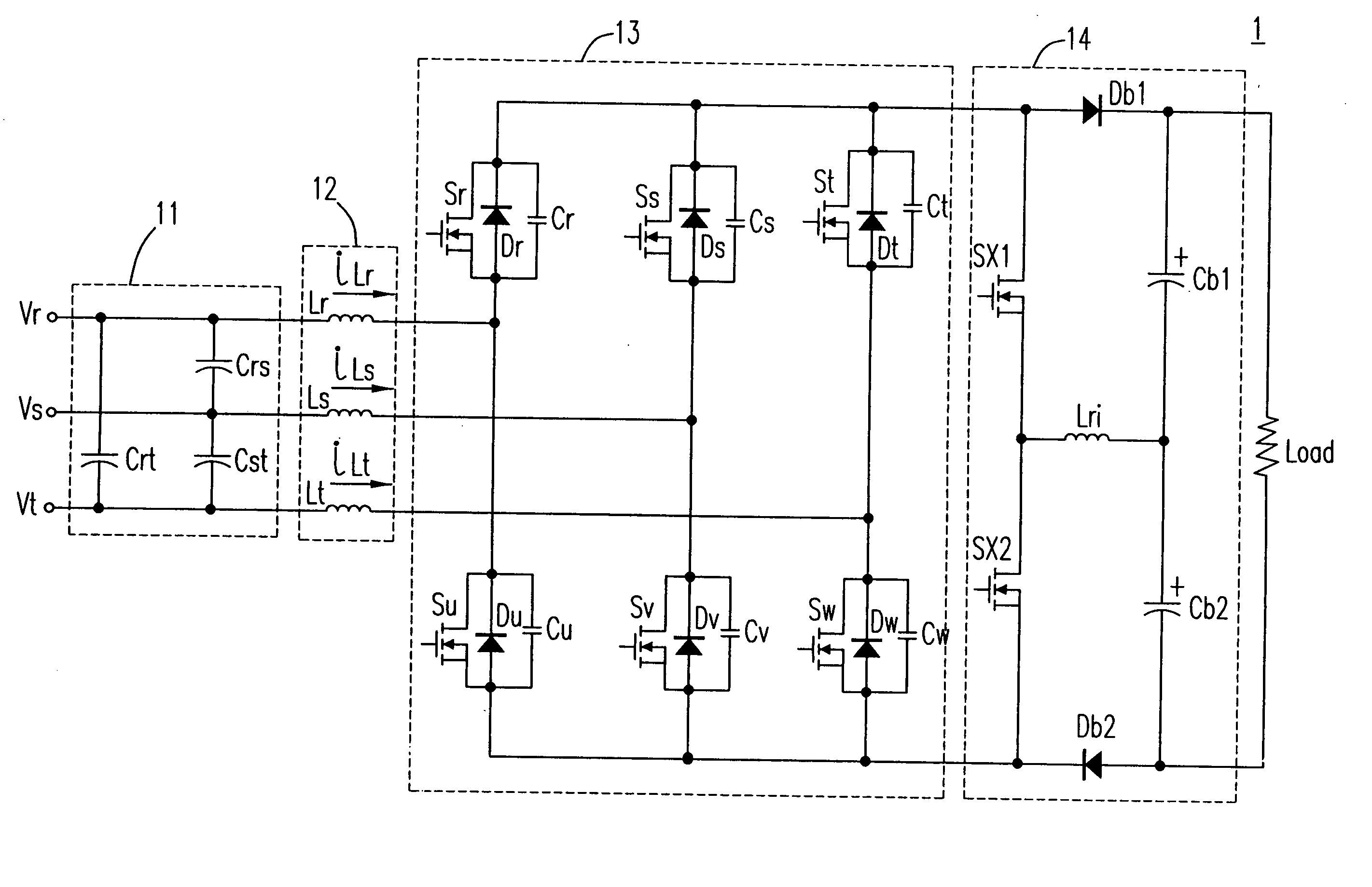
[0028] Please refer to FIG. 3, it shows the schematic circuit diagram of the first preferred embodiment of the three-phase power factor correction converter of the present invention 1 which includes a filter circuit 11, a plurality of boost inductors 12, a plurality of half-bridge switching devices 13 (each having a upper main switch module and a lower main switch module), and a soft-switching cell 14 (including a plurality of auxiliary switching devices each having an upper auxiliary switch and a lower auxiliary switch, a plurality of resonant inductors, a plurality of output capacitors, and a first and a second diodes). In which, the proposed converter 1 includes: three boost inductors Lr, Ls, and Lt, three filter capacitors Crs, Cst, and Crt (for filtering the high frequency harmonics inputted through the commercial power supply), six main switch modules Sr, Ss, St, Su, Sv, and Sw, two auxiliary switches Sx1 and Sx2, a resonant inductor Lri, two main diodes Db1 and Db2 (rectifyin...
PUM
 Login to View More
 Abstract
Description
Claims
Application Information
 Login to View More