
Variable length packet communication device
a packet communication and variable length technology, applied in the field of routers, can solve problems such as reducing the throughput of the switch, and achieve the effects of less overhead in the switch, less hardware on the transmitting interface side, and less load on the scheduler of the switch
- Summary
- Abstract
- Description
- Claims
- Application Information
AI Technical Summary
Benefits of technology
Problems solved by technology
Method used
Image

Examples
third embodiment
[0041] We explain a packet communication device of a first, second and third embodiment of the present invention.
[0042] First of all, using FIG. 17 and FIG. 18, we explain a common block diagram for a packet communication device of a first, second and third embodiment of the present invention.
[0043] A packet communication device shown in FIG. 17 is comprising input physical layer processing unit 102, input interface 3, core switch 101, output interface 4, input physical layer processing unit 103 and controller 100. Input physical layer processing unit 102 performs terminated processing of the physical layer of an input variable length packet. Input interface 3 decides the output path of the packet. Core switch 101 transmits the packet to the desired path. Output interface 4 performs transmission processing for the packet. Input physical layer processing unit 103 performs processing of the physical layer of the packet such as putting the packet in a frame. Controller 100 performs se...
first embodiment
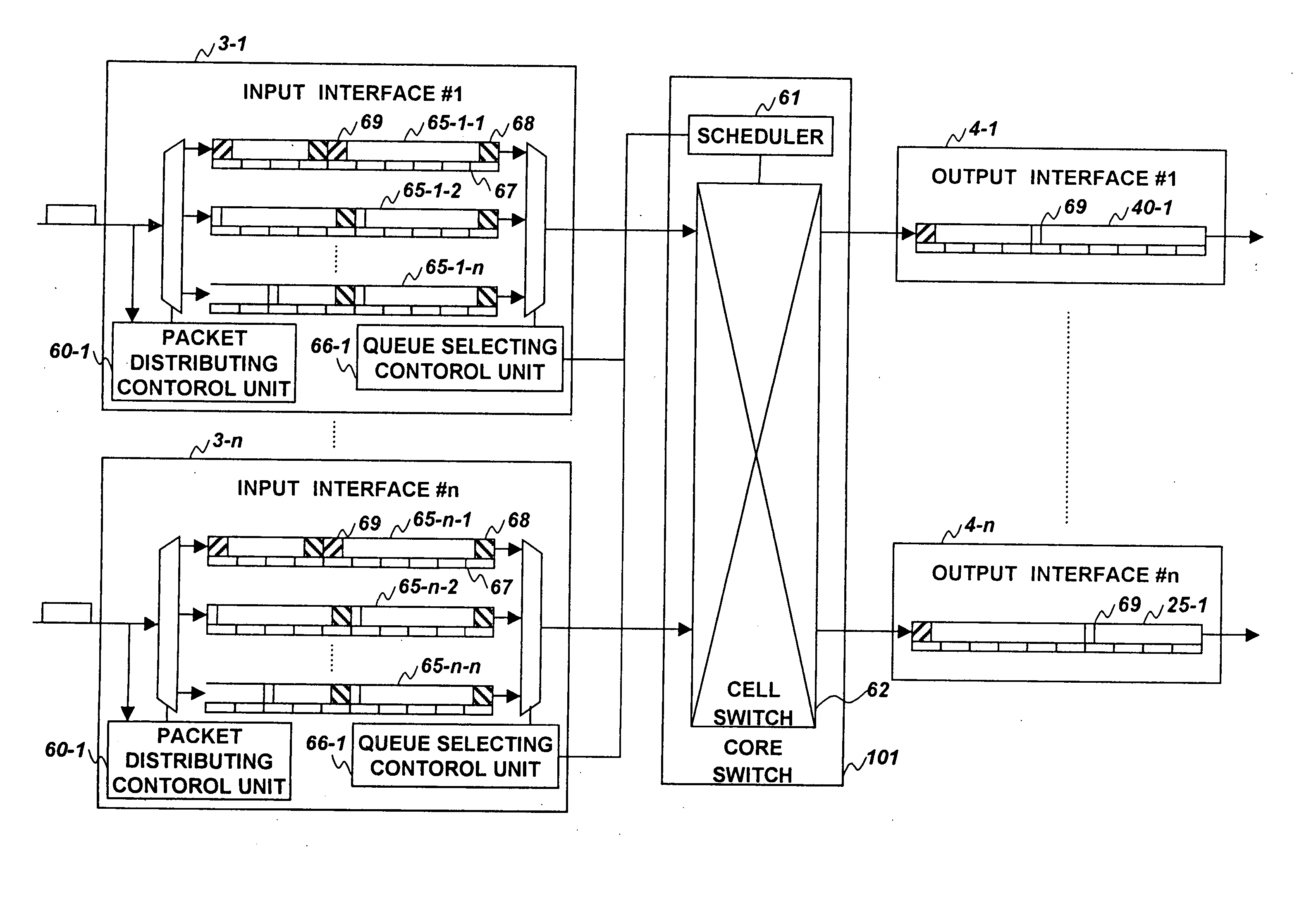
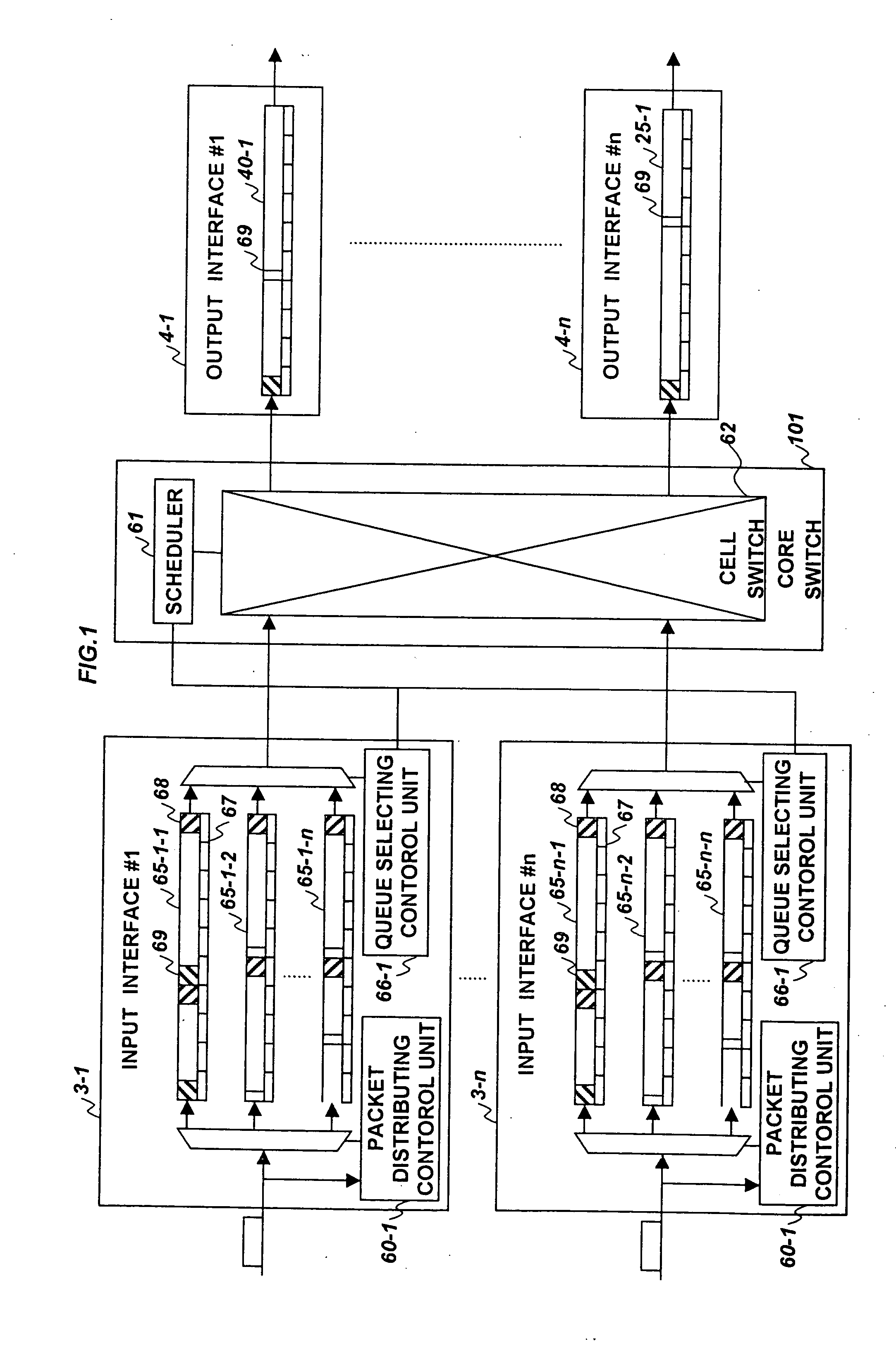
[0047]FIG. 1 is a schematic view for a packet communication device of the present invention. FIG. 1 shows input interface 3, core switch 101 and output interface 4 in detail. Cell switch 62, for example, is composed of a crossbar switch. Each of interfaces has “n” queues 65 corresponding to n output interfaces 4 respectively, packet distributing control unit 60, and queue selecting control unit 66. The number of “n” is the number of output interfaces 4. Packet distributing control unit 60 specifies the output interface 4 to which the input variable length packet is to be transmitted based on the header information of the input packet and distributes the input packet to the corresponding queue 65. Queue selecting control unit 66 selects one of the n queues 65 and transmits the variable length packet queued in it to cell switch 62. Each of output interfaces 4 has a queue 40. Hereinafter, a variable length packet may be called a packet.
[0048] One of the futures of a communication devic...
second embodiment
[0071]FIG. 3 is a schematic view for a packet communication device of the present invention. In this embodiment, input interfaces 3 generates a container to be put a packet / packets to be transmitted to the same output interface 4. Container switch 2 in core switch 101 performs switching in container units. Container switch 2 reserves / releases the switch resource by a time slot, which is the time a container is through container switch 2. Output interface 4 retrieves the packet / the packets from the container and transmits the packet / the packets to the transmission line connected to output interface 4.
[0072] Each of input interfaces 3 has “n” queues 15 corresponding to output interfaces 4 respectively and packet distributing control unit 10 that distributes a input packet to queue 15 based on its destination. Herein, the number of “n” is the number of output interfaces 4. The upper section of each of queues 15 shows packets and the lower section of each of the queues shows container...
PUM
 Login to View More
 Abstract
Description
Claims
Application Information
 Login to View More