Check patentability & draft patents in minutes with Patsnap Eureka AI!

Magnetic random access memory

a random access memory and magnetic random access technology, applied in the field of magnetic random access memory, can solve the problems of increasing the memory capacity of 1-bit data stored in two tmr elements, the resistance change r of a tmr element cannot be large enough to prevent data from being buried in noise, and the difficulty of a magnetic random access memory to adopt a sense schem

Inactive Publication Date: 2005-05-19
KK TOSHIBA
View PDF27 Cites 3 Cited by
  • Summary
  • Abstract
  • Description
  • Claims
  • Application Information

AI Technical Summary

Benefits of technology

This approach allows for accurate data reading regardless of variations in resistance values among TMR elements, enhancing memory capacity and integration by increasing the resistance change difference, thus improving data reliability and noise resistance.

Problems solved by technology

There is one big problem with read operation.
It is therefore difficult for a magnetic random access memory to adopt a sense scheme using reference cells like those used in a NOR type flash memory.
At such MR ratios, in consideration of manufacturing margin and yield in mass production, it is impossible to attain the resistance change ΔR of a TMR element large enough to prevent data from being buried in noise.
In this case, however, storage of 1-bit data in two TMR elements disadvantageous increases the memory capacity.
In addition, this technique cannot completely eliminate the influence of variations in resistance value among a plurality of TMR elements.
Depending on the magnitude of variations in resistance value among TMR elements, therefore, the resistance change ΔR of a TMR element may not be sufficiently large.
In this read operation principle, the data stored in a selected TMR element may be destroyed (destructive read) at the time of read operation.

Method used

the structure of the environmentally friendly knitted fabric provided by the present invention; figure 2 Flow chart of the yarn wrapping machine for environmentally friendly knitted fabrics and storage devices; image 3 Is the parameter map of the yarn covering machine
View more

Image

Smart Image Click on the blue labels to locate them in the text.
Viewing Examples
Smart Image
  • Magnetic random access memory
  • Magnetic random access memory
  • Magnetic random access memory

Examples

Experimental program
Comparison scheme
Effect test

example 1

(1) CIRCUIT EXAMPLE 1

[0664]FIG. 42 shows Circuit Example 1 of a read circuit of a magnetic random access memory.

[0665] A plurality of TMR elements are connected in parallel with each other. One terminal of each TMR element is connected to a ground terminal. The other terminal of each TMR element is connected to a node n1 via an NMOS transistor N7 (SW) serving as a column select switch. The TMR element group shown in FIG. 42 corresponds to one column in the reference example and Improved Examples 1, 2, and 5, and one block in one column in Improved Examples 3, 4, and 6.

[0666] The potential of the node n1 is set to a clamp potential Vclamp by a clamp circuit. The clamp circuit is comprised of an operational amplifier OP1 and NMOS transistor N8.

[0667] The NMOS transistor N8 is placed between the node n1 and a current mirror circuit M1. The operational amplifier OP1 controls the gate potential of the NMOS transistor N8 to equalize the potential of the node n1 with the clamp potential...

example 2

(2) CIRCUIT EXAMPLE 2

[0680]FIG. 43 shows Circuit Example 2 of a read circuit in the magnetic random access memory.

[0681] Circuit Example 2 is a modification to Circuit Example 1. As compared with Circuit Example 1, Circuit Example 2 is characterized in a storage circuit 43. More specifically, the storage circuit 43 in Circuit Example 1 has the two inverter circuits I7 and I8 and operational amplifier OP2, whereas the storage circuit 43 in Circuit Example 2 has no operational amplifier but has four inverter circuits I9, I9′, I10, and I11.

[0682] In Circuit Example 2, initial data is latched in the storage circuit 43 using a current mirror circuit without using any operational amplifier.

[0683] For example, in the first read operation (initial data read), since a control signal READ1S is set at “H”, the potential (initial data) of a node n1 is transferred to the storage circuit 43 constituted by the four inverter circuits I9, I9′, I10, and I11. After the first read operation, since t...

example 3

(3) CIRCUIT EXAMPLE 3

[0684]FIG. 44 shows Circuit Example 3 of a read circuit in the magnetic random access memory.

[0685] Circuit Example 3 is also a modification to Circuit Example 1. As compared with Circuit Example 1, Circuit Example 3 is also characterized in a storage circuit 43. More specifically, in Circuit Example 3, the storage circuit 43 is formed from a capacitor C1.

[0686] In this example, for example, the potential (initial data) of a node n2 is dynamically stored in the capacitor C1. For this reason, the interval between the first read and the second read must be shorter than the interval during which the capacitor C1 keeps holding data.

[0687] The interval during which the capacitor C1 keeps holding data is, for example, several ms, as fully studied in the field of DRAMs (Dynamic Random Access Memories). If, therefore, the interval between the first read and the second read is set to be shorter than several m, the capacitor C1 can be used for the storage circuit 43.

(...

the structure of the environmentally friendly knitted fabric provided by the present invention; figure 2 Flow chart of the yarn wrapping machine for environmentally friendly knitted fabrics and storage devices; image 3 Is the parameter map of the yarn covering machine
Login to View More

PUM

No PUM Login to View More

Abstract

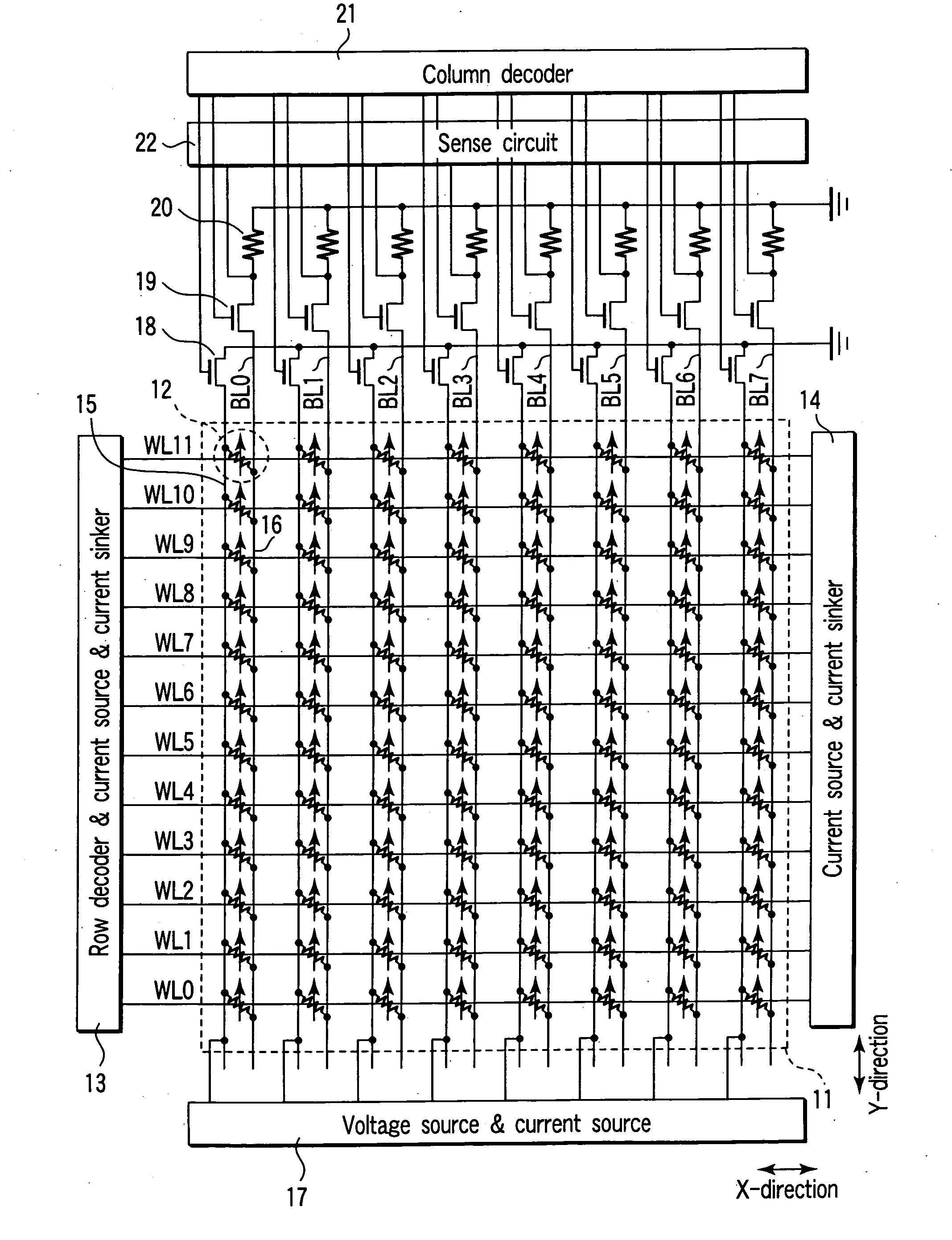
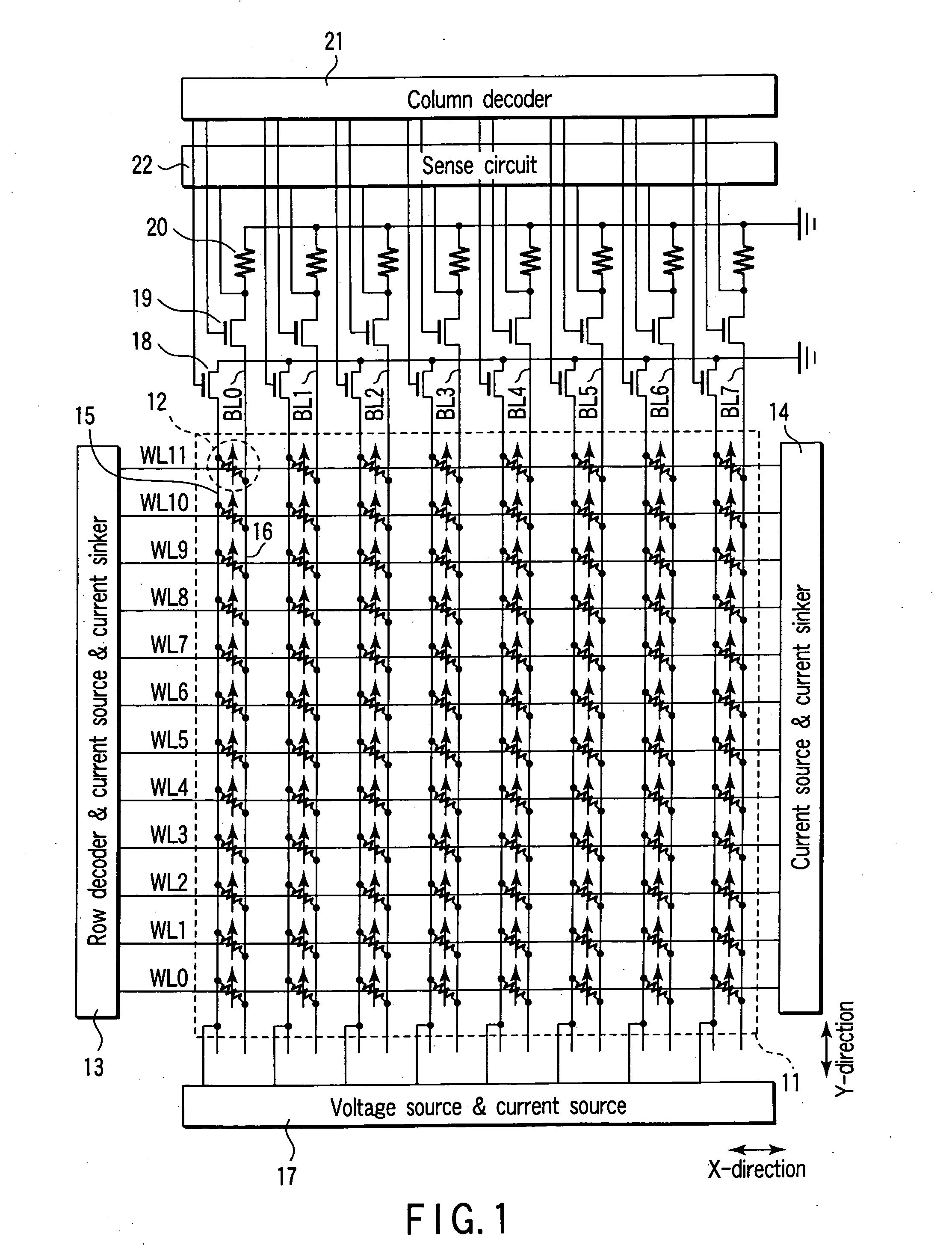
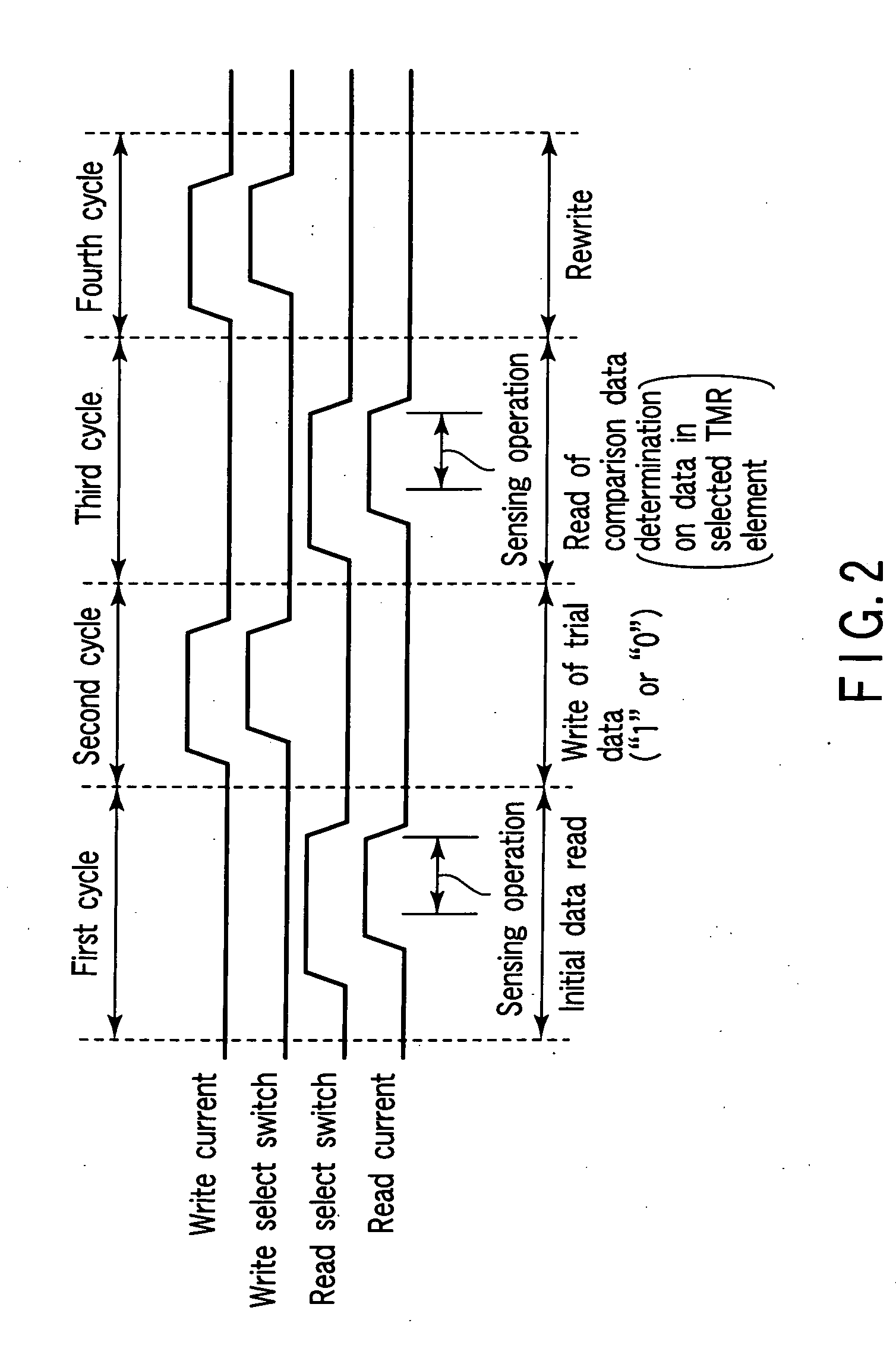
In the first read operation, a read current is supplied to TMR elements connected in parallel in one column or one block to detect initial data. Trial data is then written in a selected memory cell. At the same time of or in parallel with writing of the trial data, the second read operation is performed. In the second read operation, a read current is supplied to the TMR elements connected in parallel in one column or one block to read comparison data. Subsequently, the initial data is compared with the comparison data to determine the data value in the selected memory cell. Finally, rewrite operation is performed for the selected memory cell.

Description

CROSS-REFERENCE TO RELATED APPLICATIONS [0001] This application is a division of and claims the benefit of priority under 35 USC §120 from U.S. application Ser. No. 10 / 170,366, filed Jun. 14, 2002, and is based upon and claims the benefit of priority under 35 USC §119 from Japanese Patent Application No. 2001-350013, filed Nov. 15, 2001, the entire contents of which are incorporated herein by reference.BACKGROUND OF THE INVENTION [0002] 1. Field of the Invention [0003] The present invention relates to a magnetic random access memory (MRAM) which stores “1”- and “0”-data using a magnetoresistive effect. [0004] 2. Description of the Related Art [0005] In recent years, many memories which store data by new principles have been proposed. One of them is a magnetic random access memory which stores “1”- and “0”-data using a tunneling magnetoresistive (to be referred to as TMR hereinafter) effect. [0006] As a proposal for a magnetic random access memory, for example, Roy Scheuerlein et al,...

Claims

the structure of the environmentally friendly knitted fabric provided by the present invention; figure 2 Flow chart of the yarn wrapping machine for environmentally friendly knitted fabrics and storage devices; image 3 Is the parameter map of the yarn covering machine
Login to View More

Application Information

Patent Timeline
no application Login to View More
Patent Type & Authority Applications(United States)
IPC IPC(8): G11C11/14G11C11/15G11C11/16H01L21/8246H01L27/105H01L43/08
CPCG11C2207/2263G11C11/16G11C11/1655G11C11/1657G11C11/1673G11C2207/2209G11C11/15
Inventor IWATA, YOSHIHISA
Owner KK TOSHIBA
Features
  • R&D
  • Intellectual Property
  • Life Sciences
  • Materials
  • Tech Scout
Why Patsnap Eureka
  • Unparalleled Data Quality
  • Higher Quality Content
  • 60% Fewer Hallucinations
Social media
Patsnap Eureka Blog
Learn More