[0008] Computer communications in the
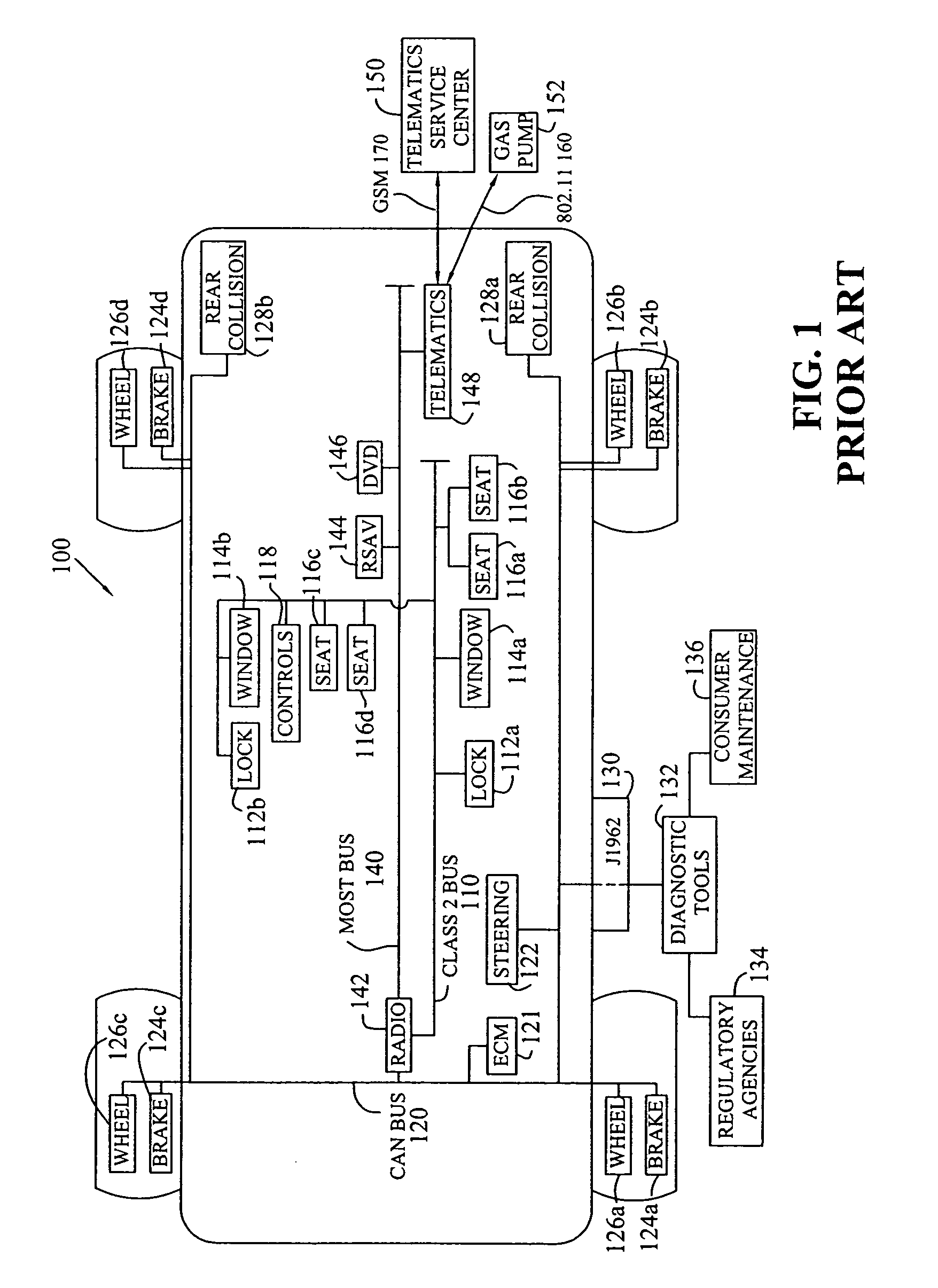
automotive industry, like in many embedded industries, are often done using specialized communication buses that are optimized for embedded environments. These specialized buses are used to improve performance in areas of concern to the automotive industry, such as
power consumption,
electromagnetic radiation and
immunity, over the level that may be achieved with more general buses (e.g.,
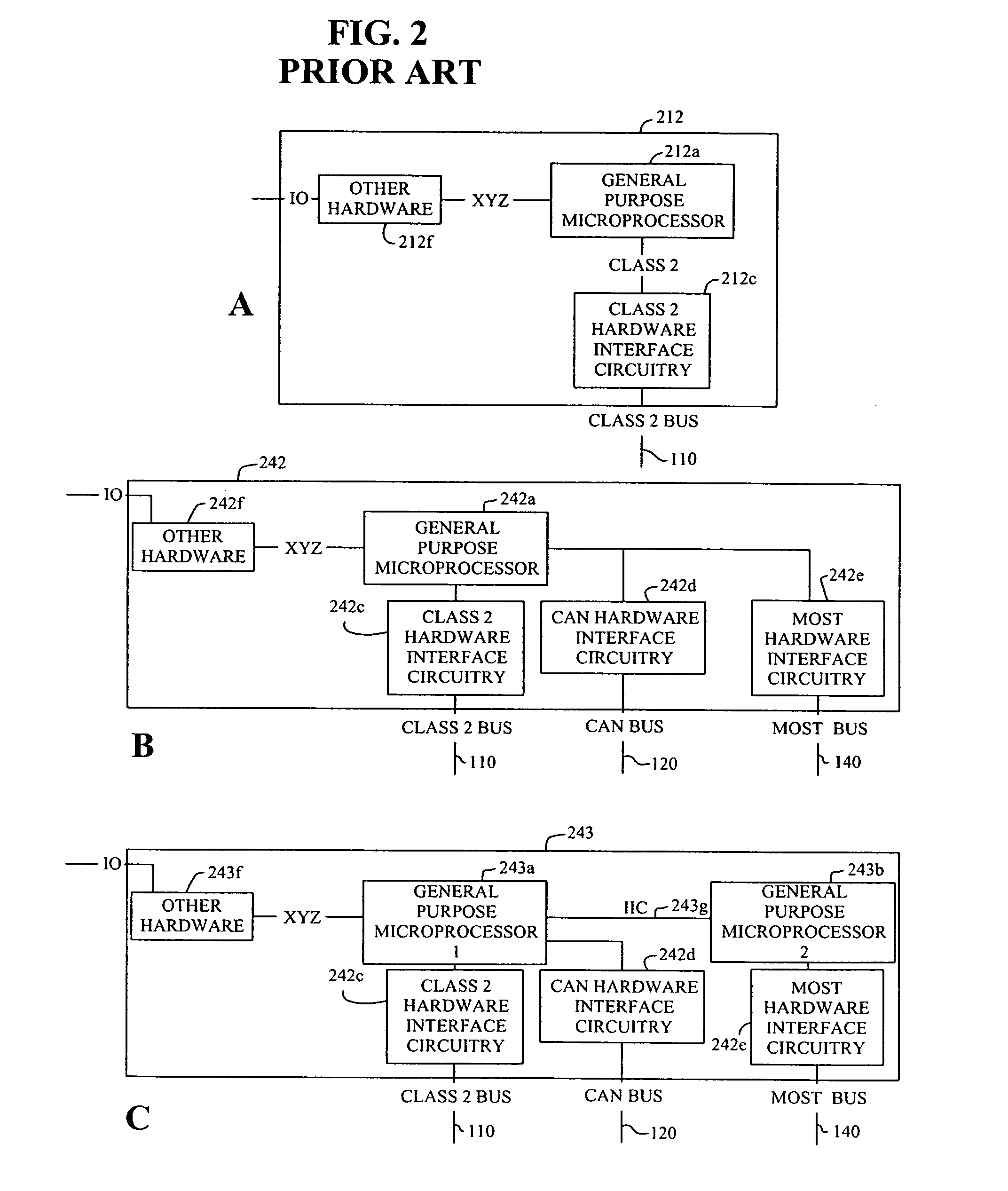
ethernet). However, the efficiency and optimization gained through the use of these domain-specific communication bus designs tend to come at the expense of poor layering. Typical automotive buses such as Class 2, Controller
Area Network (“CAN”), BEAN, Media Oriented Systems Transport (“MOST”), etc. are typically defined as one monolithic standard or a series of tightly coupled standards which cover layers all the way from the
physical layer to the
application layer. Even in cases where the lower layers (e.g.,
CAN bus) may be technically separate from upper layers (e.g., a specific vehicle's radio-specific CAN messages), the practical effect on the designers of computers that communicate on the bus is no different from a poorly layered monolithic standard.
[0015] The automotive industry has taken several approaches to address the problems of incompatible application-layer communications by standardizing diagnostics. California Air Resources Board (CARB) has defined a series of diagnostics standards, including the most recently passed On-Board Diagnostics II standard (OBD-II). OBD-II defines standard information that must be made available through service diagnostics by vehicles sold in the state of California. OBD-II allows flexibility in the choice of communication bus, allowing a number of buses such as CAN, Class 2, Keyword 2000, etc. to be used to make the physical connection between the automobile and diagnostic tool. Because of the incompatible nature of these buses, however, the application layers differ on each bus. For this reason, to implement OBD-II, CARB and the automotive industry created and implemented a series of specifications that not only define the standard information, but also define how the information is exchanged over each of the specific communication buses. While the former definition is efficient in that it is done once, the latter part is inefficient because it has to be done once for each supported bus. Though CARB succeeded in adding functionality across diverse buses through
standardization and legislation, computer device suppliers, diagnostic tool manufacturers and vehicle manufacturers still incur the costs associated with multiple
application layer standards on the different buses.
[0023] In one way, the changes created by the use of
telematics impact the need for application-layer compatibility because
telematics open up the possibility of adding
remote diagnostics. The additional
telematics connections are different in nature than the traditional J1962 connection.
Wireless networks in the automobile are generally geared more towards additional
consumer features and functions rather than diagnostics. Therefore,
wireless networks are a more appropriate portal through which to provide diagnostics information to consumers than the traditional J1962 connector. The addition of convenient (
wireless)
consumer-focused external interfaces to the vehicle greatly facilitates the possibility of remote whole-vehicle diagnostics as a saleable function, but the cost and functional performance problems caused by the application-layer communication incompatibilities across the automotive industry currently
hamstring the growth of remote whole-vehicle diagnostics.
[0038] Diagnostics in the automotive industry can be significantly improved in terms of both cost and functionality to help keep vehicles functioning properly, to improve
consumer safety, and to improve consumer satisfaction.
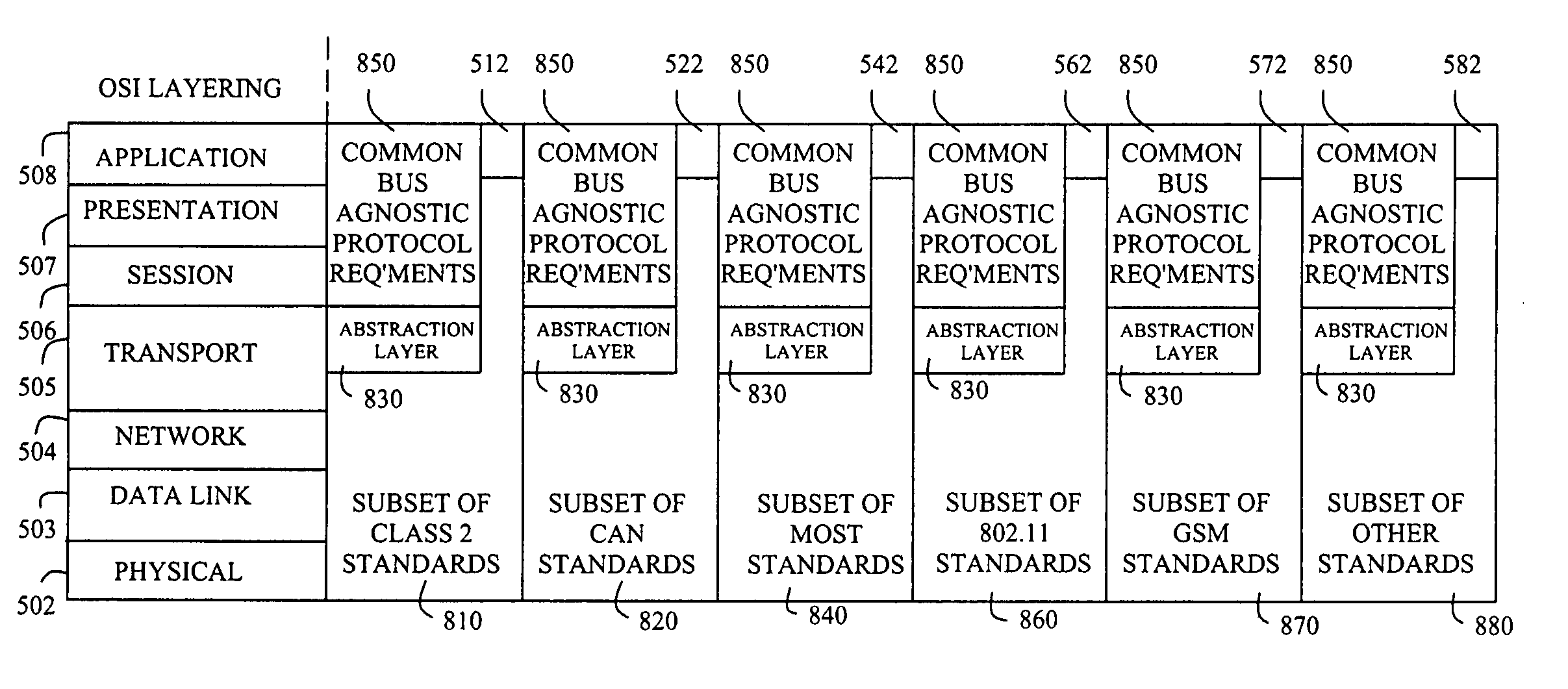
[0040] In one form of the present invention, a computer
data signal is provided, the computer
data signal embodied in an electrical
signal represented as a plurality of bits for communicating a message over a network including multiple computer devices coupled to at least one communication bus utilizing a communication bus protocol, the computer
data signal including a transport portion supporting
transport layer functions compatible with the communication bus protocol of the at least one communication bus over which the message is transmitted; and a common transport portion operably connected to the transport portion and supporting
transport layer functions, the common transport portion enabling the message to be abstracted from the communication bus protocol.



 Login to View More
  Login to View More