

Insecticide compositions and process
a technology of insecticide compositions and compositions, applied in the direction of biocide, heterocyclic compound active ingredients, dead animals, etc., can solve the problems of difficult interpretation of existing information, increase in toxicity with increasing alkyl chain length, etc., and achieve the effect of convenient and economic practi
- Summary
- Abstract
- Description
- Claims
- Application Information
AI Technical Summary
Benefits of technology
Problems solved by technology
Method used
Image

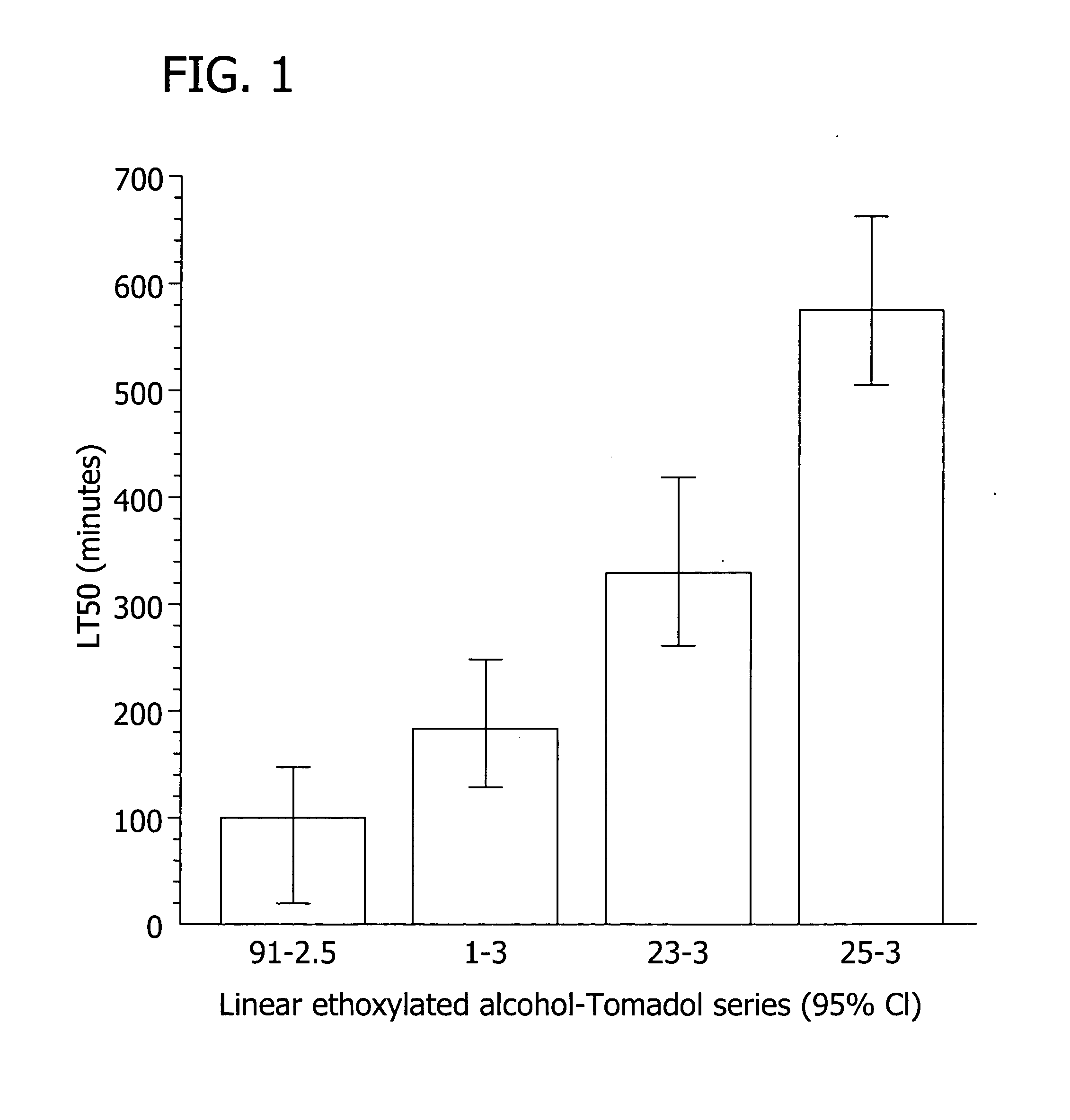
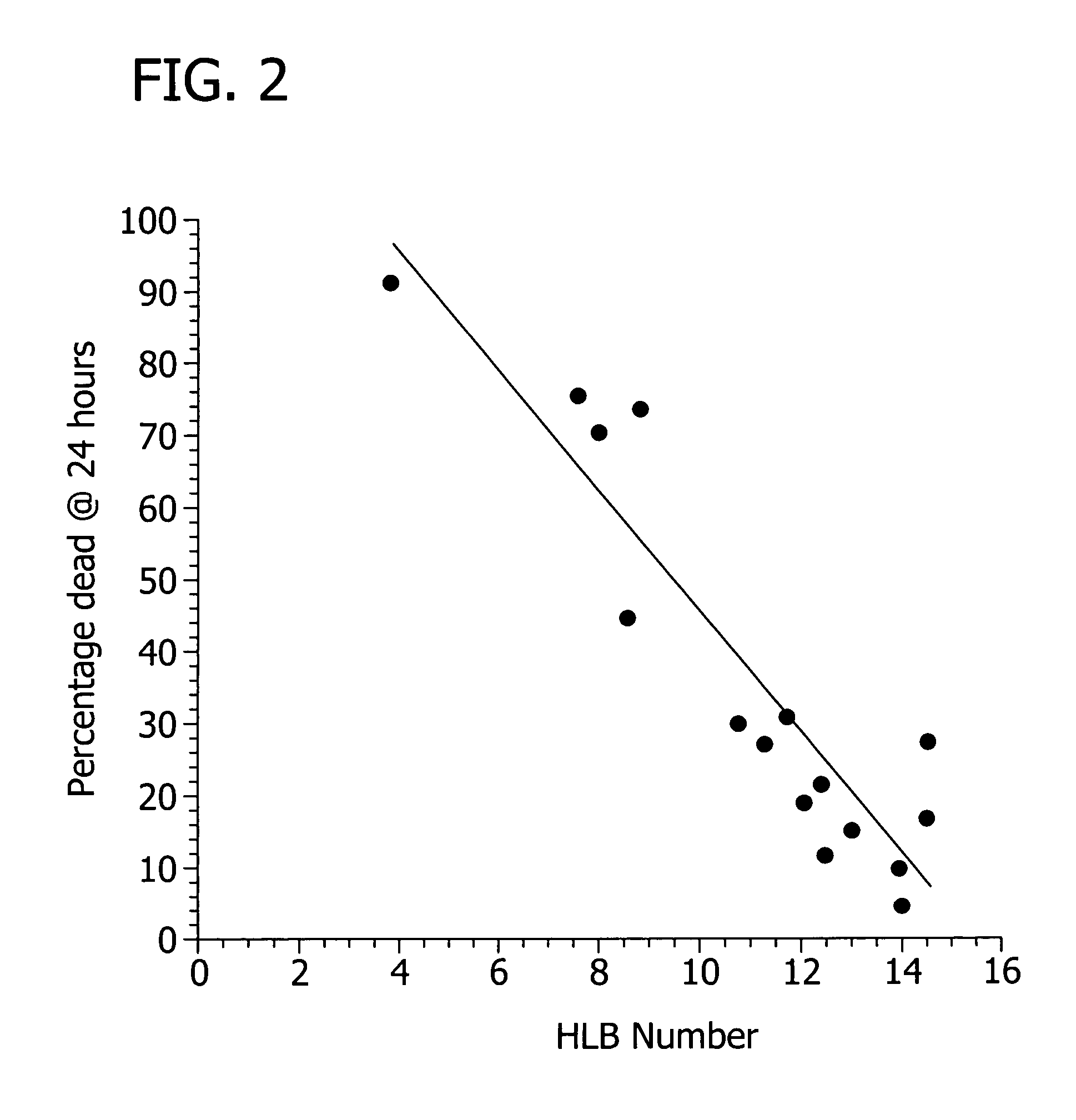
Examples
example 1
[0015] Dose-response evaluations were performed on 1-4 week old adults SJC Strain (S. C. Johnson & Son, Racine, Wis.) German cockroaches, Blattella germanica, L. Insects were individually transferred using a 7″ (18 cm) AESCULAP forceps to 100×20 mm polystyrene Petri dishes. The inside edge of the dishes was lightly coated with a layer of (1:3) mineral oil+petroleum jelly to minimize insect escape. Approximately 10 cockroaches were transferred to each dish and then anesthetized with a 15-25 second exposure to CO2. Anesthetized cockroaches were positioned with their ventral side up in the bottom of the Petri dish. A 2 μl drop of test solution was applied to the area between the meso—and methathoracic legs using a Rainen L-10 10 μl pipette. Control cockroaches were treated with a 2 μl drop of the solvent, 100% ethyl alcohol.
[0016] Synergy tests used to calculate LC50 value were evaluated after 24 hours. Structure—activity tests used to calculate LT50 values were scored approximately e...
example 2
[0019] Example 1 was repeated in studying the effect of Tomadol 23-1 at 10% combined with commonly used insecticides and the results are presented in Tables 2 and 3.
TABLE 2Response of German cockroaches to insecticides applied incombination with a 10% solution (ETCH) of Tomadol 23-1.Dosage was 2 μl per insect.Compound (chemicalSlopeSynergistclass)LC50 (%) [95% Cl][95% Cl]RatioSignificancechlorfenapyr (pyrrole)0.4062 [0.2662-0.6679]1.1448 [0.8625-1.4270]chlorfenapyr + 10%0.0513 [0.0289-0.0875]0.8438 [0.6099-1.0776]7.9*Tomadol 23-1clothianidin (nicotinoid)0.0020 [0.0010-0.0038]1.6500 [0.6538-2.6462]clothianidin + Tomadol0.0003 [0.0002-0.0005]1.2129 [0.8340-1.5919]6.7*23-1imidacloprid (nicotinoid)0.0219 [0.0145-0.0337]3.1103 [1.9613-4.2594]imidacloprid + 10%0.0065 [0.0042-0.0098]1.3353 [0.9198-1.7507]3.3*Tomadol 23-1thiamethoxam (nicotinoid)0.0038 [0.0027-0 / 0059]1.2698 [0.9121-1.6276]thiamethoxam + 10%0.0015 [0.0010-0.0022]1.2097 [0.8031-1.6163]26.5*Tomadol 23-1pyrethrum (pyrethrins0...
example 3
[0022] Using the procedure set forth in Example 1, the biological activity of linear alcohol ethoxylates of the above-noted formula against a taxonomically wide range of insect species was studied. The results are set forth on Table 4.
TABLE 4Susceptibility of insect species to the linear ethoxylated alcohol,Tomadol 21-1.SPECIESTomadal 23-1 test dose (uL) ofTest duration-Percent mortality(adults unless specified)50% solution (ETCH)minutes(sample size)Apis mellifera390100 (25)Artogeia rapae11150 50 (8)Blattella germanica21440 91 (163)Camponotus pennsylvanicus1205100 (23)Ctenocephalides feils 5% soln. in H2O-spray to wet120100 (21)Diabrotica undecimpunctata130100 (9)Drosophila melanogaster10% soln. in H2O-spray to wet1440100 (32)Galleria mellonella41440 7 (15)Harmonia axyridis11440 95 (20)Harmonia axyridis21440100 (20)Lucilia sp.1210100 (10)Melanoplus sp.345100 (7)Musca domestica0.5285100 (11)Myzus persicae 5% soln. in H2O-spray to wet120100 (10)Oncopeltus fasciatus21397 14 (14)Oryza...
PUM
 Login to View More
 Abstract
Description
Claims
Application Information
 Login to View More