Vehicle surveillance and control system

a control system and vehicle technology, applied in the field of visual surveillance and control system, can solve the problems of reducing the economic loss of people, compromising affecting the safety of people's lives, so as to reduce the loss of life and reduce the loss of potential economic losses

US20060170770A1Inactive Publication Date: 2006-08-03INVENTEL PROD LLC
27 Cites 59 Cited by

Patent Information

Authority / Receiving Office
US · United States
Patent Type
Applications(United States)
Current Assignee / Owner
Publication Date
2006-08-03
Estimated Expiration
Not applicable · inactive patent

Smart Images

  • Figure 1
    Figure 1
  • Figure 2
    Figure 2
Patent Text Reader

Abstract

A vehicle surveillance and control system is provided which has a camera for creating video data and a transmitter coupled to the camera for transmitting the video data to a receiver. The surveillance system can also have a microphone for providing audio data for transmission. The receiver is then coupled to a recorder and possibly a monitor. If the operator of the vehicle is not authorized to operate the vehicle (a thief) or to perform an activity (operation of the vehicle recklessly or while intoxicated) then the activities of the operator can be recorded or monitored and the data can be utilized to convict, penalize, or fine an individual or to implement remote control of the vehicle. The camera can also monitor activity outside the vehicle such as a hit and run, a parking lot impact or theft of a tire. In one embodiment, the receiver can be coupled to a monitor and the video data can be viewed in real-time. The system can also include an Input / Output module and a vehicle system control module, wherein the Input / Output module can receive and display video and send a control signal having an identification code to the vehicle system control module wherein the vehicle system control module can control the operation of a vehicle system such as the ignition system or the fuel system thereby stopping dangerous operation of the vehicle and reducing potential economic losses and loss of life.
Need to check novelty before this filing date? Find Prior Art

Description

CROSS REFERENCE TO A RELATED APPLICATION

[0001] The present application claims priority to U.S. Provisional Patent Application Ser. No. 60 / 538,034 entitled “Video Thief” filed on Jan. 21st 2004.TECHNICAL FIELD

[0002] The present invention relates in general to a visual surveillance and control system and more particularly to a visual surveillance system for monitoring human activities and restricting a human's ability to cause vehicular damages. BACKGROUND OF THE INVENTION

[0003] Trucks, automobiles, motorcycles, boats or any motorized apparatus, collectively referred to herein as vehicles, are a significant component of the American society. Billions of dollars are spent insuring vehicles, fixing vehicles and on damages caused by vehicles. Vehicles are a major cause of property damage and personal injury. Millions of additional dollars are spent on vehicle theft and theft of vehicle parts. When a vehicle is stolen or “car jacked” personal property and human lives are often at stake...

Examples

Embodiment Construction

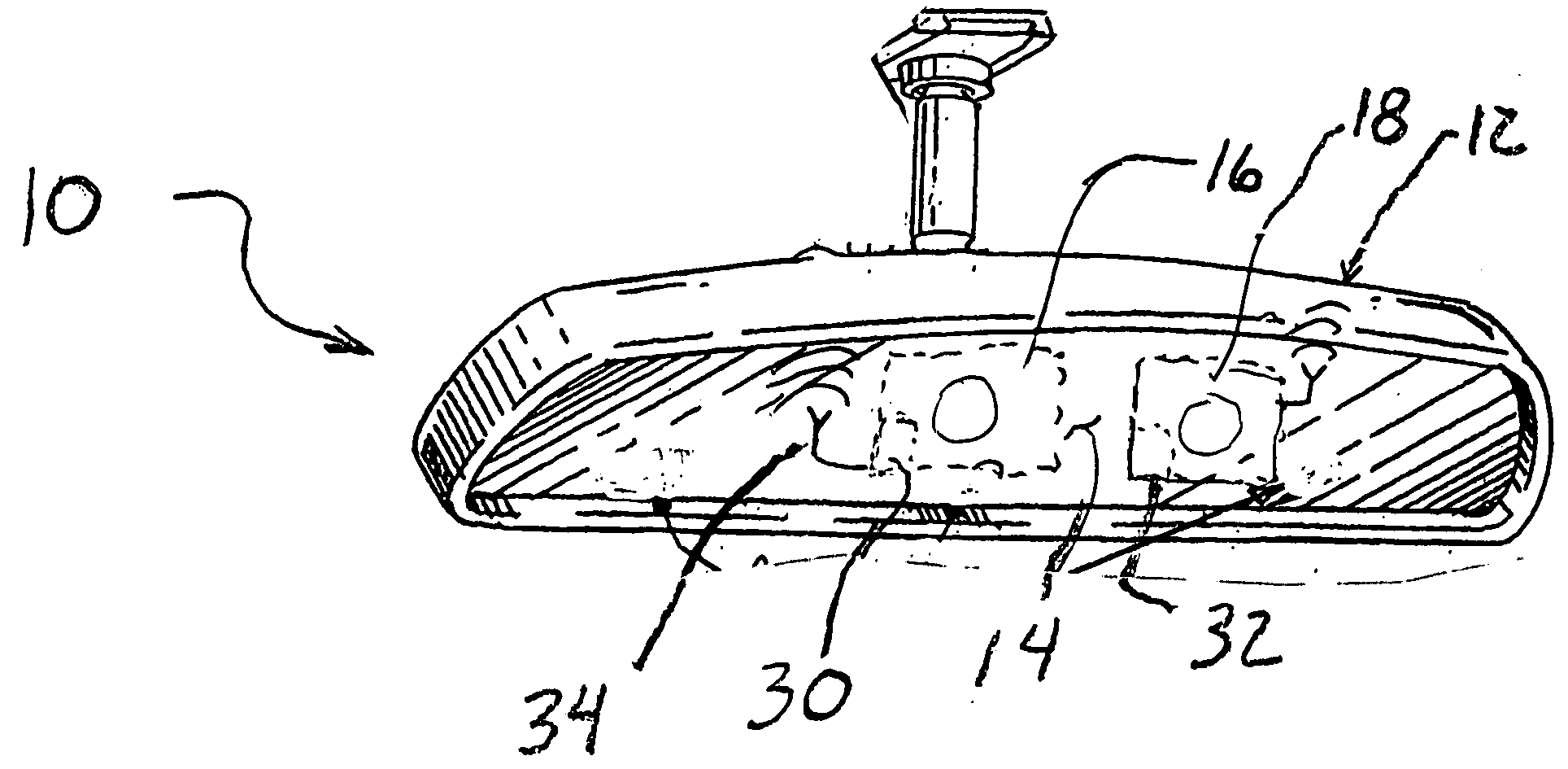
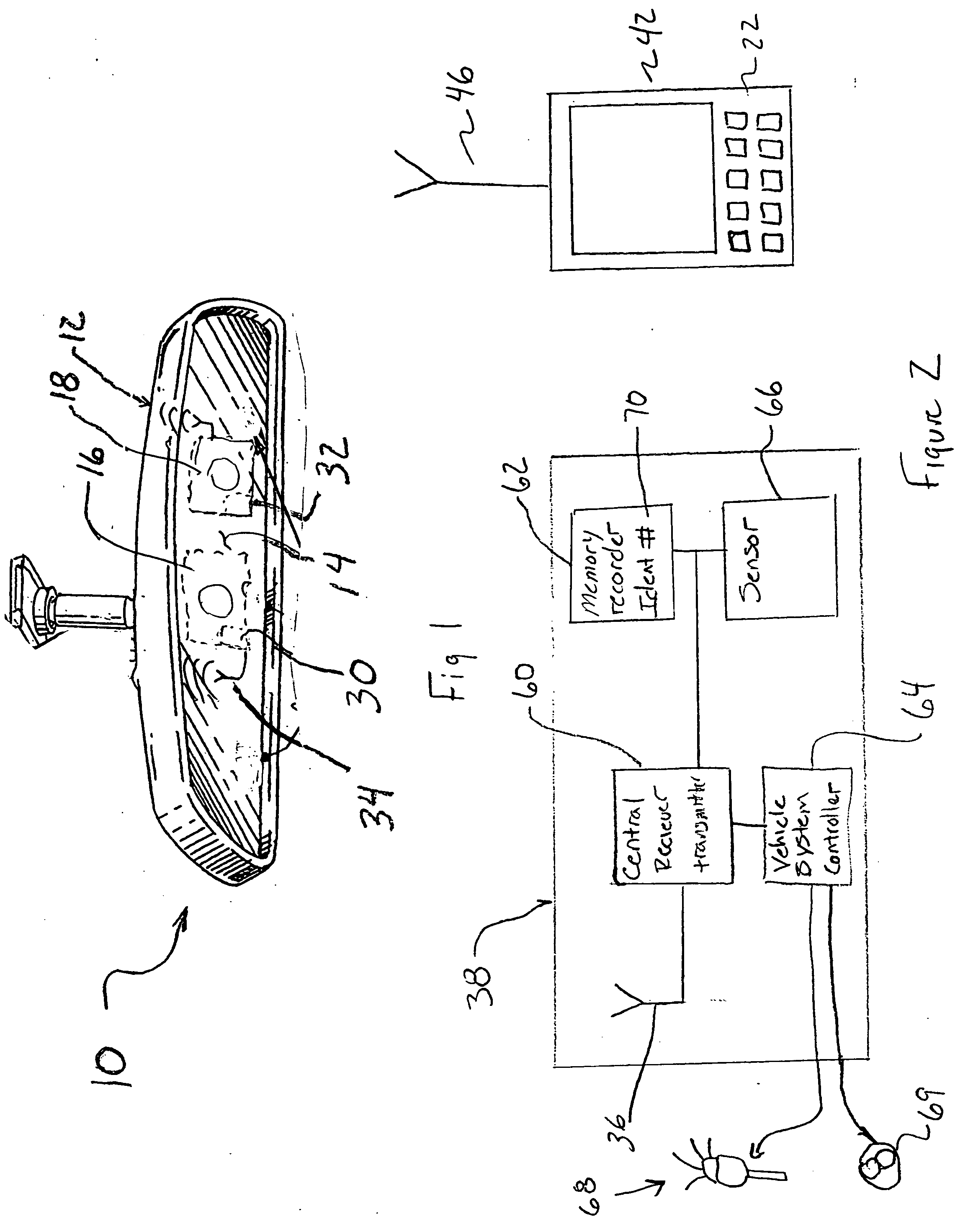
[0008] With reference now to the figures and in particular with reference to FIG. 1, a rear view mirror assembly in accordance with the present disclosure is depicted. Rear view mirror assembly 10 has a housing 12, which is coupled to reflective surface 14 and first camera 16 (illustrated between reflective surface 14 and housing 12), and a second camera 18 (also illustrated between reflective surface 14 and housing 12). A reflective surface, which allows viewing from one direction, is often called a 1-way mirror. A one-way mirror could be utilized in cooperation with the cameras. First camera 16 and second camera 18 can produce still photos or they can produce streaming video. First camera 16 and second camera 18 can utilize wireless communication or they can be hard wired together with other components of the system. In one embodiment first camera 16 and second camera 18 have wide-angle lenses. First camera 16 can point towards the rear of the vehicle and can provide coverage for ...