Unlock instant, AI-driven research and patent intelligence for your innovation.

Apparatus, system, and method for trace insertion

a trace statement and trace technology, applied in error detection/correction, instruments, computing, etc., can solve the problems of manual trace statement insertion requires a significant amount of development time and effort, and manual trace statement insertion is also subject to human error, so as to reduce clutter in the code base, facilitate use, and save time and effort

Inactive Publication Date: 2006-09-07
IBM CORP
View PDF11 Cites 39 Cited by
  • Summary
  • Abstract
  • Description
  • Claims
  • Application Information

AI Technical Summary

Benefits of technology

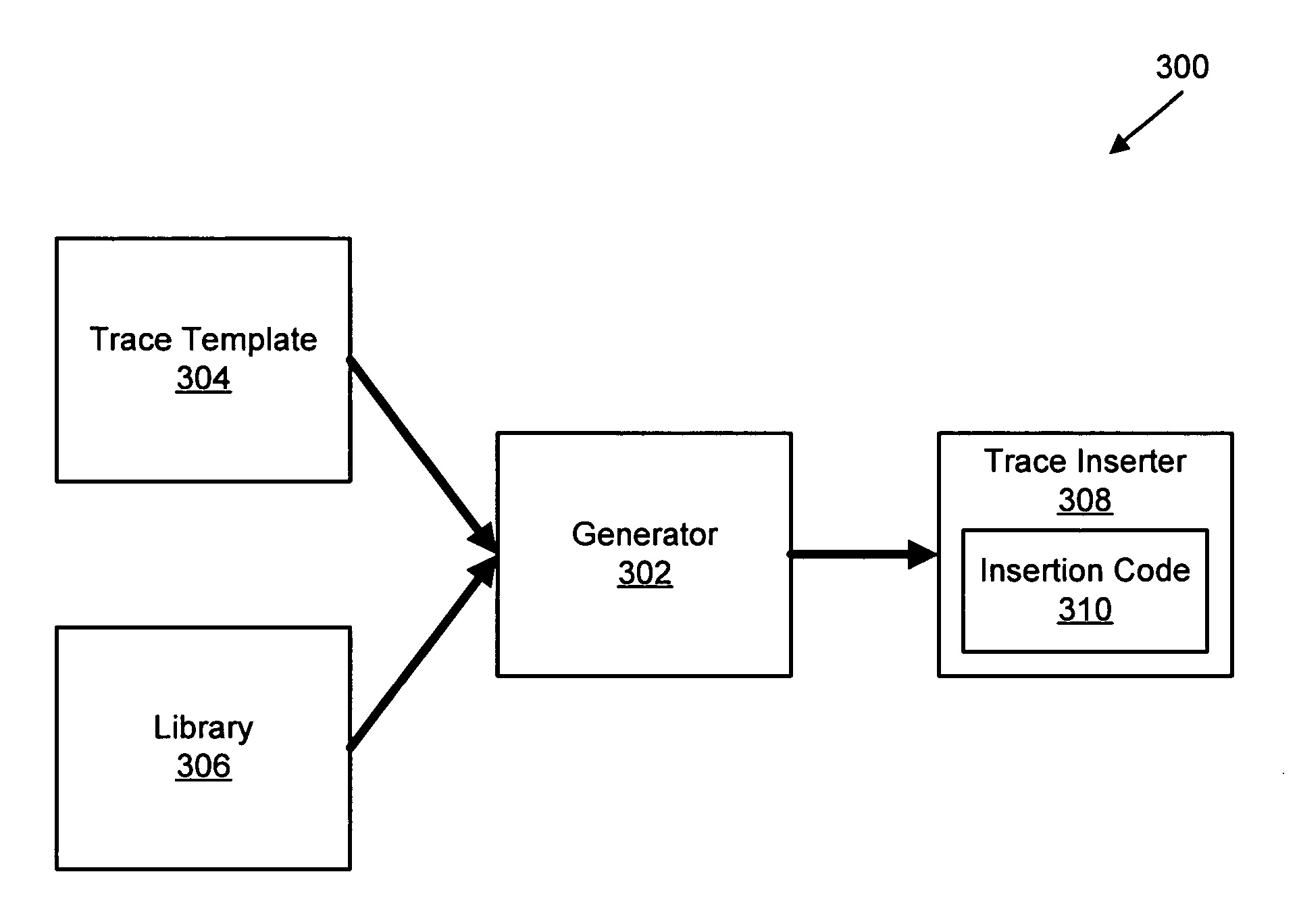
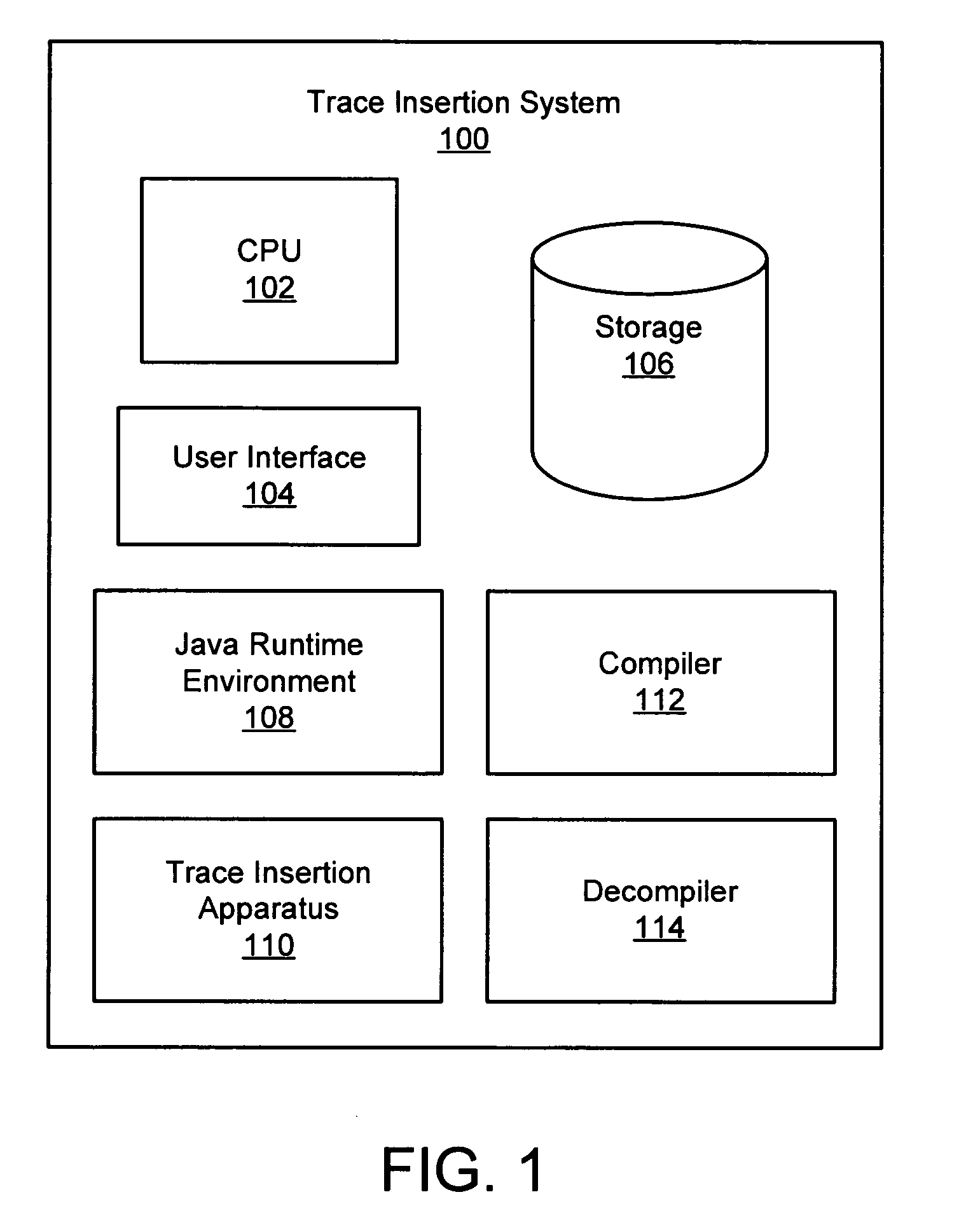
[0010] Embodiments of this invention facilitate making entry, exit, and exception trace statement insertion an automated build-time operation. Certain embodiments employ custom Ant extensions and modified Byte Code Engineering Library (BCEL) utilities to perform template-based code injection into compiled binaries. Ant is a java-based build tool. The BCEL allows users to analyze, create, and manipulate binary class files.
[0018] The presented embodiments of the apparatus, system, and method advantageously apply byte code modification to the task of trace statement insertion and also may use a template to drive the trace insertion. Using a template masks complexity and enables ease of use. Byte code injection is performed on behalf of the user without the user having to know how byte code actually works.
[0019] Relative to the conventional trace insertion technologies, using template-based, build-time trace insertion presents several advantages. In certain embodiments, for example, an application developer may save time and effort without having to manually insert the trace statements. Development efforts can be allocated to more important issues. Additionally, by inserting trace statements following compilation of the source code, the trace statements do not need to appear in the source code, reducing clutter in the code base. The automated nature of the trace statement insertion may significantly reduce the potential for human error, which may increase the serviceability of the resulting product. Tracking which files contain tracing is reduced to examining invocations of the custom Ant task in the XML build script. Additionally, it becomes possible to both alter the manner in which tracing is performed and change which set of classes contain tracing by recompiling the source code.
[0020] In additional embodiments, the product overhead is minimized by eliminating the need to ship custom libraries, making it possible to integrate with existing logging infrastructures. Furthermore, from a developer's perspective, using the approach described herein is simplified to implementation of an interface. Alternative embodiments also offer additional advantages, such as run-time trace insertion using modified class loaders and the use of an existing logging infrastructure to add entry, exit, and exception trace statements to third party libraries.

Problems solved by technology

Manual insertion of entry, exit, and exception trace statements typically requires significant time and effort on the part of the programmer.
Even with the use of tools to aid in the process (for example, the Eclipse / WebSphere Application Developer (WSAD) Reusable Asset (RAS) plug-in), manual trace statement insertion requires a significant amount of development time and effort.
Manual insertion of trace statements is also subject to human error.
Minor mistakes can significantly impact product serviceability.
Manual trace insertion also requires substantial code management and maintenance.
Changes in method names or the addition of new classes or methods makes it difficult to track which portions of the program code contain tracing and to what extent.
Manual trace insertion also generates undesirable clutter in the source code.
The addition of trace statements increases the size of the source code and makes it more difficult to later review the source code, if necessary.
Additionally, products that facilitate automated trace statement insertion place limitations on the resulting program.
For example, AutoTrace limits the program flexibility in terms of how tracing is performed and the format of the generated output.
Also, a product using AutoTrace must ship with specific AutoTrace libraries, increasing the size of the product.
Furthermore, both ANTLR and AutoTrace increase the complexity of trace insertion because these programs can be difficult to learn and use effectively.

Method used

the structure of the environmentally friendly knitted fabric provided by the present invention; figure 2 Flow chart of the yarn wrapping machine for environmentally friendly knitted fabrics and storage devices; image 3 Is the parameter map of the yarn covering machine
View more

Image

Smart Image Click on the blue labels to locate them in the text.
Viewing Examples
Smart Image
  • Apparatus, system, and method for trace insertion
  • Apparatus, system, and method for trace insertion
  • Apparatus, system, and method for trace insertion

Examples

Experimental program
Comparison scheme
Effect test

Embodiment Construction

[0032] Many of the functional units described in this specification have been labeled as modules, in order to more particularly emphasize their implementation independence. For example, a module may be implemented as a hardware circuit comprising custom VLSI circuits or gate arrays, off-the-shelf semiconductors such as logic chips, transistors, or other discrete components. A module may also be implemented in programmable hardware devices such as field programmable gate arrays, programmable array logic, programmable logic devices or the like.

[0033] Modules may also be implemented in software for execution by various types of processors. An identified module of executable code may, for instance, comprise one or more physical or logical blocks of computer instructions which may, for instance, be organized as an object, procedure, or function. Nevertheless, the executables of an identified module need not be physically located together, but may comprise disparate instructions stored i...

the structure of the environmentally friendly knitted fabric provided by the present invention; figure 2 Flow chart of the yarn wrapping machine for environmentally friendly knitted fabrics and storage devices; image 3 Is the parameter map of the yarn covering machine
Login to View More

PUM

No PUM Login to View More

Abstract

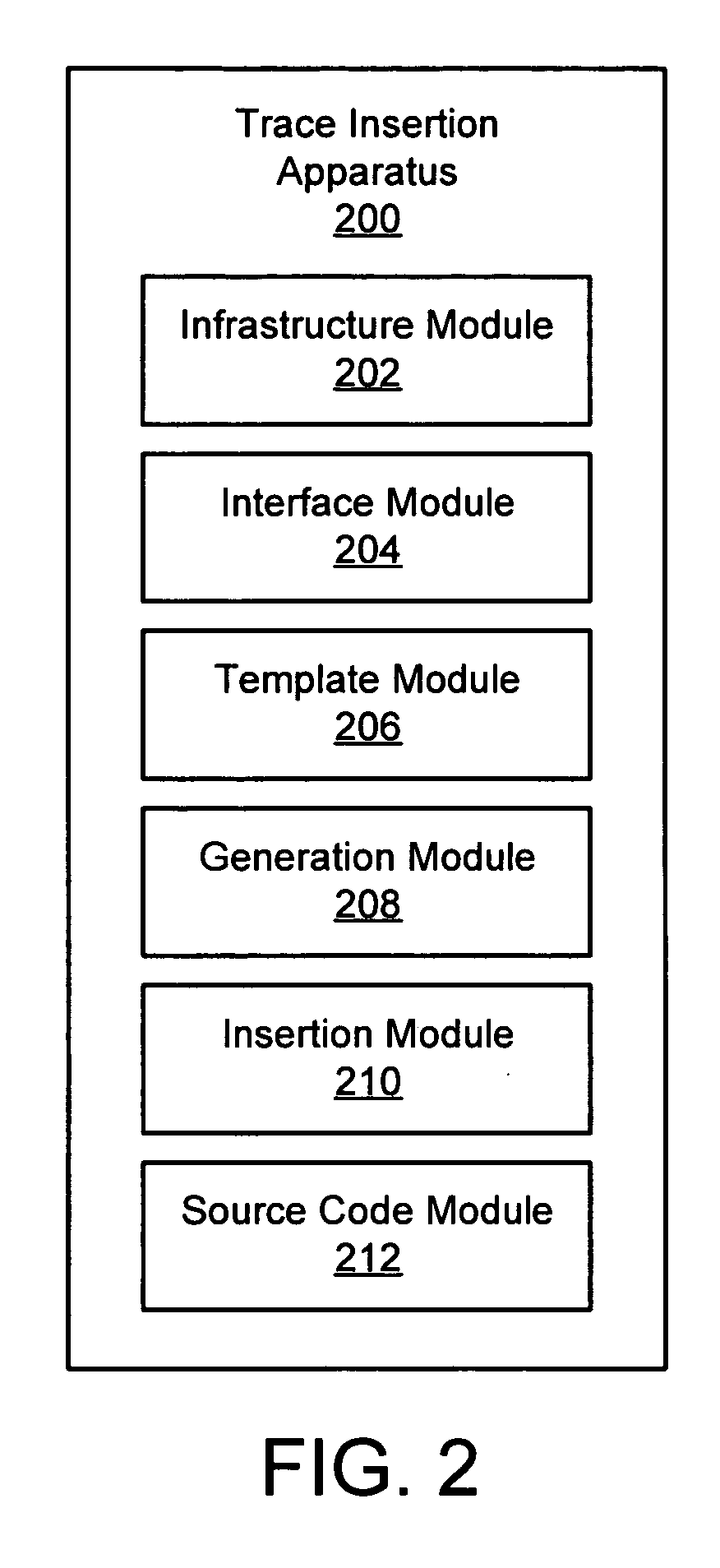
An apparatus, system, and method are disclosed for inserting a trace statement into a compiled class file. A trace statement may be an entry, exit, exception, or other type of trace statement. The apparatus includes a source code module, a generation module, and an insertion module. The source code module identifies compiled source code. The generation module generates an insertion code to facilitate insertion of trace statement byte code into the compiled source code. The insertion module executes the insertion code and inserts the trace statement byte code into the compiled source code. The insertion module may insert the trace statement byte code at build time or at run time. Additionally, a template may define where to insert the trace statement byte code within the compiled source code.

Description

BACKGROUND OF THE INVENTION [0001] 1. Field of the Invention [0002] This invention relates to software development and more particularly relates to template-based, byte code insertion of trace statements. [0003] 2. Description of the Related Art [0004] Tracing is an important part of software development. Conventional tracing allows an application programmer or user to analyze the flow of data through the processing logic of the software. In particular, tracing statements may be added to the program source code to indicate the status of variables and other indicators at the entry and exit of a function. Tracing may also indicate the status of variables when an exception occurs. By including tracing options in a product, the product offers a level of serviceability to its customers. [0005] There are two general, conventional approaches to Java trace insertion. First, there is a manual approach, which involves going through source code and manually inserting trace statements. Second, ...

Claims

the structure of the environmentally friendly knitted fabric provided by the present invention; figure 2 Flow chart of the yarn wrapping machine for environmentally friendly knitted fabrics and storage devices; image 3 Is the parameter map of the yarn covering machine
Login to View More

Application Information

Patent Timeline
no application Login to View More
IPC IPC(8): G06F9/44
CPCG06F11/3624G06F11/3636
Inventor TASINGA, KHAN MULUH
Owner IBM CORP