Secure multicast transmission

a multicast transmission and secure technology, applied in the field of communication networks, can solve the problem of reducing the time available for users to illegally distribute keys, and achieve the effect of reducing the amount of bandwidth

US20070028099A1Inactive Publication Date: 2007-02-01BAMBOO MEDIACASTING
98 Cites 88 Cited by

Patent Information

Authority / Receiving Office
US · United States
Current Assignee / Owner
Publication Date
2007-02-01
Estimated Expiration
Not applicable · inactive patent

Smart Images

  • Figure 1
    Figure 1
  • Figure 2
    Figure 2
  • Figure 3
    Figure 3
Patent Text Reader

Abstract

A method of multicasting data. The method includes providing a data block for multicasting, generating a plurality of segments that represent the data block, such that a receiver needs to receive fewer than all the generated segments in order to reconstruct the data block, encrypting at least a portion of the generated segments, so as to generate encrypted data units encrypted with a plurality of different keys or encryption methods and transmitting the encrypted data units over one or more multicast channels.
Need to check novelty before this filing date? Find Prior Art

Description

RELATED APPLICATIONS

[0001] The present application is a continuation in part (CIP) of PCT / IL2004 / 000806 filed on Sep. 7, 2004 and PCT / IL2004 / 000805, filed on Sep. 7, 2004, which designate the U.S., the disclosures of both of which are incorporated herein by reference.FIELD OF THE INVENTION

[0002] The present invention relates generally to communication networks and particularly to methods of preventing unauthorized dissemination of multicast data. BACKGROUND OF THE INVENTION

[0003] Cellular phones can be used for receiving video clips and other data, in addition to their use for point to point telephone communication. Multicasting the data to the cellular phones or to other mobile stations allows efficient use of the available bandwidth, such that large amounts of data can be provided to the cellular phones without requiring prohibitive amounts of bandwidth. In some cases, users are required to subscribe and pay for the multicast data if they desire to receive the data. In order to...

Examples

Embodiment Construction

System

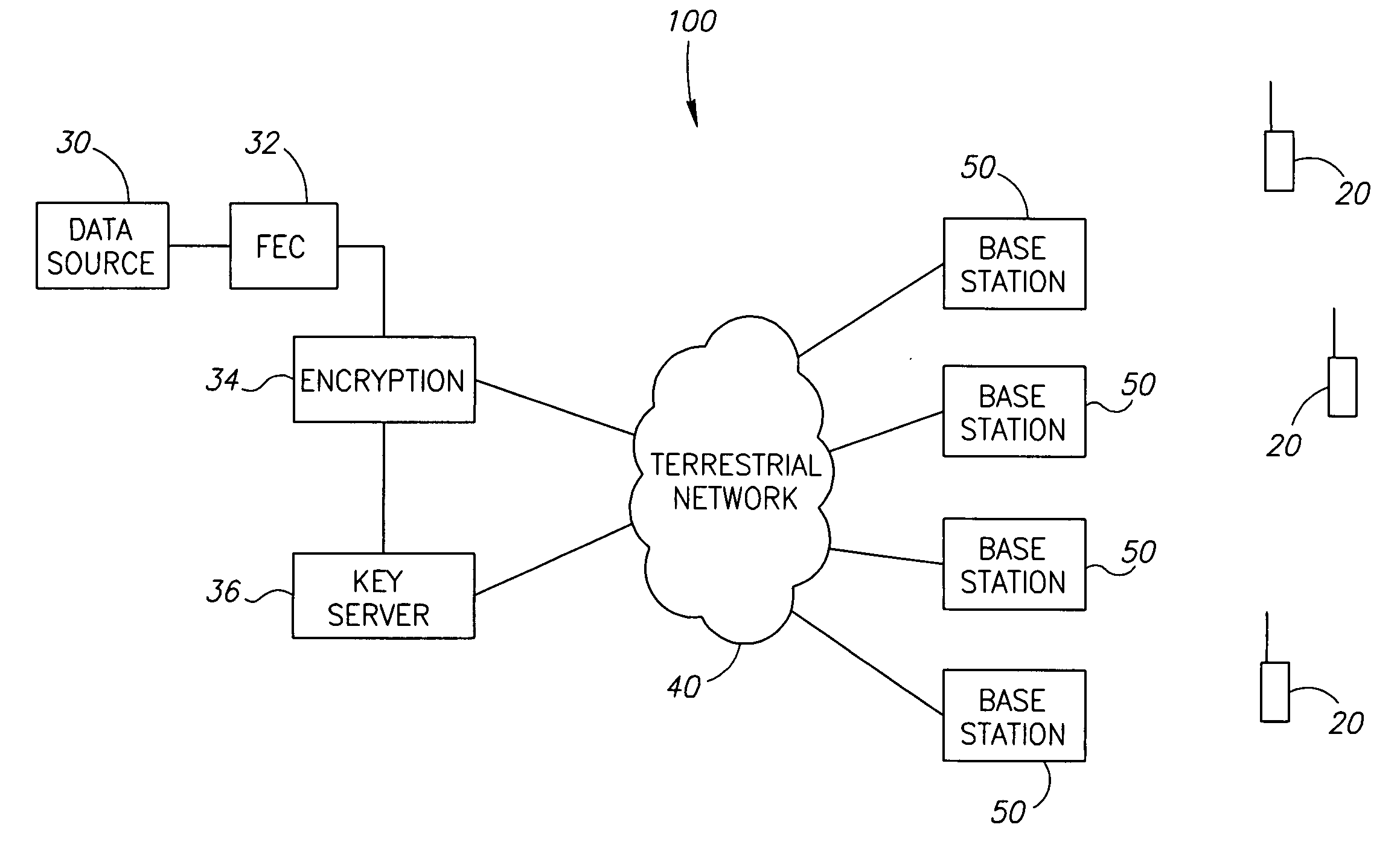
[0065]FIG. 1 is a schematic illustration of a cellular network 100, in accordance with an exemplary embodiment of the present invention. Network 100 includes a plurality of base stations 50, which transmit signals to mobile stations 20 in their vicinity. In transmission of multicast data to mobile stations 20, a data source 30 generates files which are to be multicast to subscribing mobile units 20. Optionally, the generated files are broken into blocks of predetermined size, suitable for processing. The blocks are optionally passed to a forward error correction (FEC) unit 32, where a plurality of segments are prepared to represent the block. Optionally, N segments are prepared, such that any M (M2 segments, 94% chance of reconstruction with M-1 segments and 100% chance of reconstruction with M segments. In some embodiments of the invention, each block requires at least 10 or even at least 20 segments for reconstruction. Possibly, at least 50 segments are required for recons...