Check patentability & draft patents in minutes with Patsnap Eureka AI!

Method for making polyetherimides

a polyetherimide and polyetherimide technology, applied in the field of dianhydride purification, can solve the problems of adverse effect of residual phase transfer catalyst on the thermal stability of polymers prepared, and achieve the effect of improving the thermal stability of polymers

Active Publication Date: 2007-03-29
SHPP GLOBAL TECH BV
View PDF7 Cites 25 Cited by
  • Summary
  • Abstract
  • Description
  • Claims
  • Application Information

AI Technical Summary

Benefits of technology

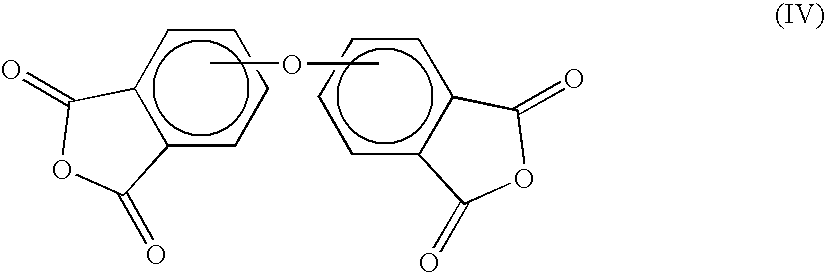
[0021] The present invention provides new and useful methodology for the purification of dianhydrides and related bisimides. It is believed that almost any dianhydride or related bisimide containing one or more organic phase transfer catalysts may be purified efficiently using the method of the present invention. By purified, it is meant that the dianhydride and / or the related bisimide may be separated from the phase transfer catalyst contaminant in such a manner such that the purified dianhydride and / or the related bisimide is substantially free of residual phase transfer catalyst.

Problems solved by technology

Residual phase transfer catalyst has been shown to have an adverse effect on the thermal stability of polymers prepared using ODPA as a monomer or comonomer.

Method used

the structure of the environmentally friendly knitted fabric provided by the present invention; figure 2 Flow chart of the yarn wrapping machine for environmentally friendly knitted fabrics and storage devices; image 3 Is the parameter map of the yarn covering machine
View more

Image

Smart Image Click on the blue labels to locate them in the text.
Viewing Examples
Smart Image
  • Method for making polyetherimides
  • Method for making polyetherimides
  • Method for making polyetherimides

Examples

Experimental program
Comparison scheme
Effect test

example 1

[0064] This Example describes the general procedure used for batch adsorption experiments using C-930 silica (available from PQ Corporation) as the adsorbent material.

[0065] The required amounts of ODPA containing a known amount of HEGCl and pre-dried silica samples were weighed out separately so as to achieve a desired ODPA / silica weight ratio. The silica sample was added to pre-dried ODCB solvent to provide approximately a 5 weight percent slurry. The slurry was heated and maintained at a constant temperature of 140° C., 150° C., or 160° C. with stirring for 1-2 hours to allow for temperature equilibration prior to adding ODPA. To this slurry was added the ODPA as a dry solid. When all the ODCB had dissolved, the resulting slurry of silica in ODPA / ODCB solution was equilibrated for 3 hours by stirring at the desired temperature, 140° C., 150° C., or 160° C. The slurry was hot filtered using a 0.5-micron sintered metal filter heated to about 170° C. This removed the adsorbent from...

examples 14-17

[0068] Examples 14-17 illustrate regeneration of “spent” solid inorganic adsorbent material. The procedures are illustrated for Silica C-930 adsorbent that contained HEGCl and ODPA. The “Spent” Silica C-930 was boiled in an excess of water, 2-propanol, water containing 4 weight percent of phosphoric acid, or ODCB (maintained at 170° C.) for 2 hours. In each case, the slurry was filtered and the amount of HEGCl and ODPA present in the filtrate was measured. Then the amount of HEGCl desorbed from the silica was calculated. The data is shown in table 4. “NA” stands for “not applicable.” The data shows that all the solvents are capable of desorbing HEGCl and ODPA from the silica, however, water and aqueous phosphoric acid are relatively more effective.

TABLE 4Wt % HEGCl / Mass DesorbedExampleRegenerationTODPA loaded(wt %NumberSolution(° C.)silica in solventpHof initial)14ODCB17019.75NA5.715H3PO4 / H2O1008.511.326.216H2O1009.146.027.4172-propanol828.93˜710.1

[0069] Thermo-gravimetric analysi...

example 18

Preparation of Polyetherimide from Purified 4,4′-ODPA.

[0070] A 1-liter glass reactor equipped with a mechanical agitator and an overhead condenser system adapted for removing a distillate was charged with 1,2-dichlorobenzene (565 grams), 4,4′-ODPA (purified by treating 4,4′-ODPA having 1086 ppm HEGCl with C-930 silica to a purified 4,4′-ODPA having 6 ppm of HEGCl, 74.6 grams), bisphenol A dianhydride (6.5 grams), meta-phenylene diamine (18.2 grams), para-phenylene diamine (7.8 grams), and aniline (1.8 grams). The reactor flask was immersed in a hot oil bath and the contents of the reactor were heated with stirring to a temperature of 180° C. to 190° C. 1,2-ODCB solvent and water from imidization were collected as a distillate over a period of about 12 hours. No stoichiometric adjustments of the various reactants were needed. After the reaction flask was cooled, the polymer was isolated by filtration and oven-dried. The final polymer material had 0.21 mole percent of net anhydride ...

the structure of the environmentally friendly knitted fabric provided by the present invention; figure 2 Flow chart of the yarn wrapping machine for environmentally friendly knitted fabrics and storage devices; image 3 Is the parameter map of the yarn covering machine
Login to View More

PUM

PropertyMeasurementUnit
Temperatureaaaaaaaaaa
Fractionaaaaaaaaaa
Login to View More

Abstract

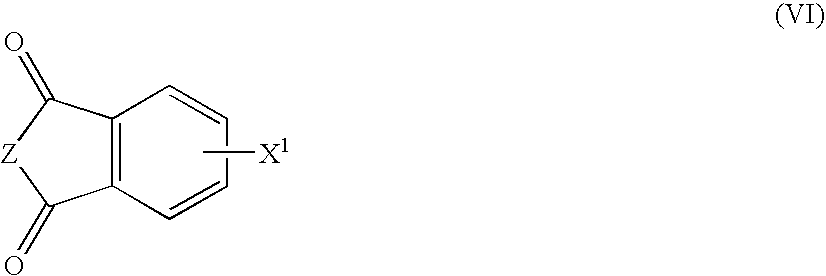
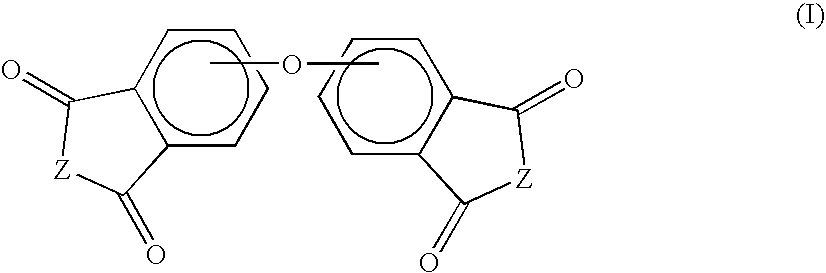
A method for making polyetherimides is provided by reacting a high purity dianhydride with an aromatic diamine under condensation polymerization conditions. The dianhydrides employed are purified by a method comprising contacting a first solution containing a dianhydride compound, a solvent, and a phase transfer catalyst, with a solid inorganic adsorbent material having a total pore volume of about 0.5 milliliters / gram or greater and a cumulative pore volume distribution of about 20 percent or greater of particles having a pore diameter in a range between about 3 nanometers and about 20 nanometers. The solution containing the dianhydride compound is then separated from the solid inorganic adsorbent material to provide a purified dianhydride compound which is substantially free of the phase transfer catalyst. The purified dianhydrides are then condensed with aromatic diamines to provide polyetherimide compositions which are substantially free of residual phase transfer catalyst.

Description

[0001] This application is a Continuation-In-Part of U.S. patent application Ser. No. 11 / 234,022 entitled “Methods For Purifying Oxybisphthalic Compounds”, filed Sep. 23, 2005.BACKGROUND [0002] The invention relates generally to the purification of dianhydrides and related bisimides. In one aspect the invention relates to the purification of dianhydrides and bisimides which are oxybisphthalic compounds. In a particular aspect, the invention relates to the purification of oxybisphthalic anhydrides. [0003] Oxybisphthalic compounds, such as for example, oxybisphthalic anhydride (ODPA) are key raw materials used in preparation of polyetherimides. Bisimides related to ODPA, for example the N,N′-dimethylbisimide of ODPA, are useful intermediates in ODPA preparation. ODPA itself is a key monomer useful in the preparation of high temperature polyetherimides by condensation polymerization reaction with a diamine. In general, condensation polymerization processes require that the component mo...

Claims

the structure of the environmentally friendly knitted fabric provided by the present invention; figure 2 Flow chart of the yarn wrapping machine for environmentally friendly knitted fabrics and storage devices; image 3 Is the parameter map of the yarn covering machine
Login to View More

Application Information

Patent Timeline
no application Login to View More
IPC IPC(8): C08G69/26
CPCC07C51/573C08G73/1007C08G73/1014C08G73/1028C08G73/105C07C65/24
Inventor STELLA, ALBERT SANTOHALL, DAVID BRUCE
Owner SHPP GLOBAL TECH BV
Features
  • R&D
  • Intellectual Property
  • Life Sciences
  • Materials
  • Tech Scout
Why Patsnap Eureka
  • Unparalleled Data Quality
  • Higher Quality Content
  • 60% Fewer Hallucinations
Social media
Patsnap Eureka Blog
Learn More