
Picture Coding Method, Picture Decoding Method, Picture Coding Apparatus, Picture Decoding Apparatus, and Program Thereof
a picture coding and picture technology, applied in the field of picture coding methods, picture coding methods picture coding apparatuses, and program thereof, can solve the problems of not being able to transmit pictures captured on the tv screen or shot by a tv camera directly through the isdn, imposing a lot of calculations, and not being able to realize the processing of information media mentioned above, so as to reduce the amount of calculations required.
- Summary
- Abstract
- Description
- Claims
- Application Information
AI Technical Summary
Benefits of technology
Problems solved by technology
Method used
Image

Examples
first embodiment
[0071]FIG. 4 is a block diagram showing the structure of a picture coding apparatus according to the first embodiment of the present invention.
[0072]A picture coding apparatus 1 is an apparatus that outputs a coded picture signal Str which is obtained by performing compression coding on an inputted picture signal Vin and then converting the coded picture signal to a bitstream, e.g., variable length codes. Such picture coding apparatus 1 is comprised of a motion estimation unit ME, a motion compensation unit MC, a subtractor Sub, an orthogonal transformation unit T, a quantization unit Q, an inverse quantization unit IQ, an inverse orthogonal transformation unit IT, an adder Add, a picture memory PicMem, a switch SW, and a variable length coding unit VLC.
[0073]The picture signal Vin is inputted to the subtractor Sub and the motion estimation unit ME. The subtractor Sub calculates a residual image between each image in the inputted picture signal Vin and each predictive image, and out...
second embodiment
[0155]The following describes a second embodiment of the present invention.
[0156]
[0157]To reduce computational complexity, quantization with q-matrix is desirable to employ multiplication and shift operations only. In other words, the computationally intensive division operations shall be avoided in practice. The proposed method for efficient integer-based division-free non-uniform quantization is applicable in general to any size of block transform and quantization in video coding systems.
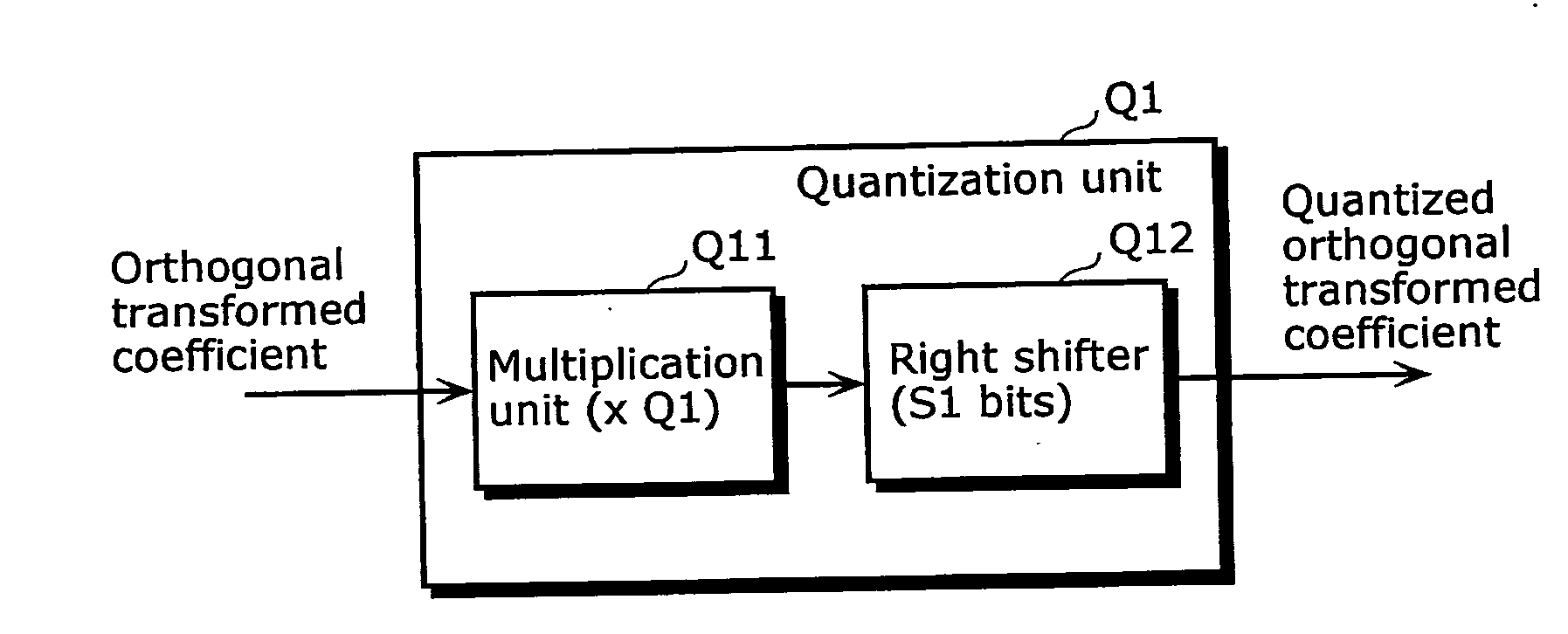
[0158]In FIGS. 16A and 16B, the operations for quantization and de-quantization of a transform coefficient are illustrated, where only multiplication and shift operations are used. For a given QP, the values of S1 and S2 are fixed for all coefficients, while the values of Q1 and Q2 depend on QP value and the coefficient position (See reference to Ref. 1: Joint Video Team (JVT) of ISO / IEC MPEG & ITU-T VCEG, “Draft of ITU-T Recommendation and Final Draft International Standard of Joint Video Specifi...
third embodiment
[0179]The following describes a third embodiment of the present invention.
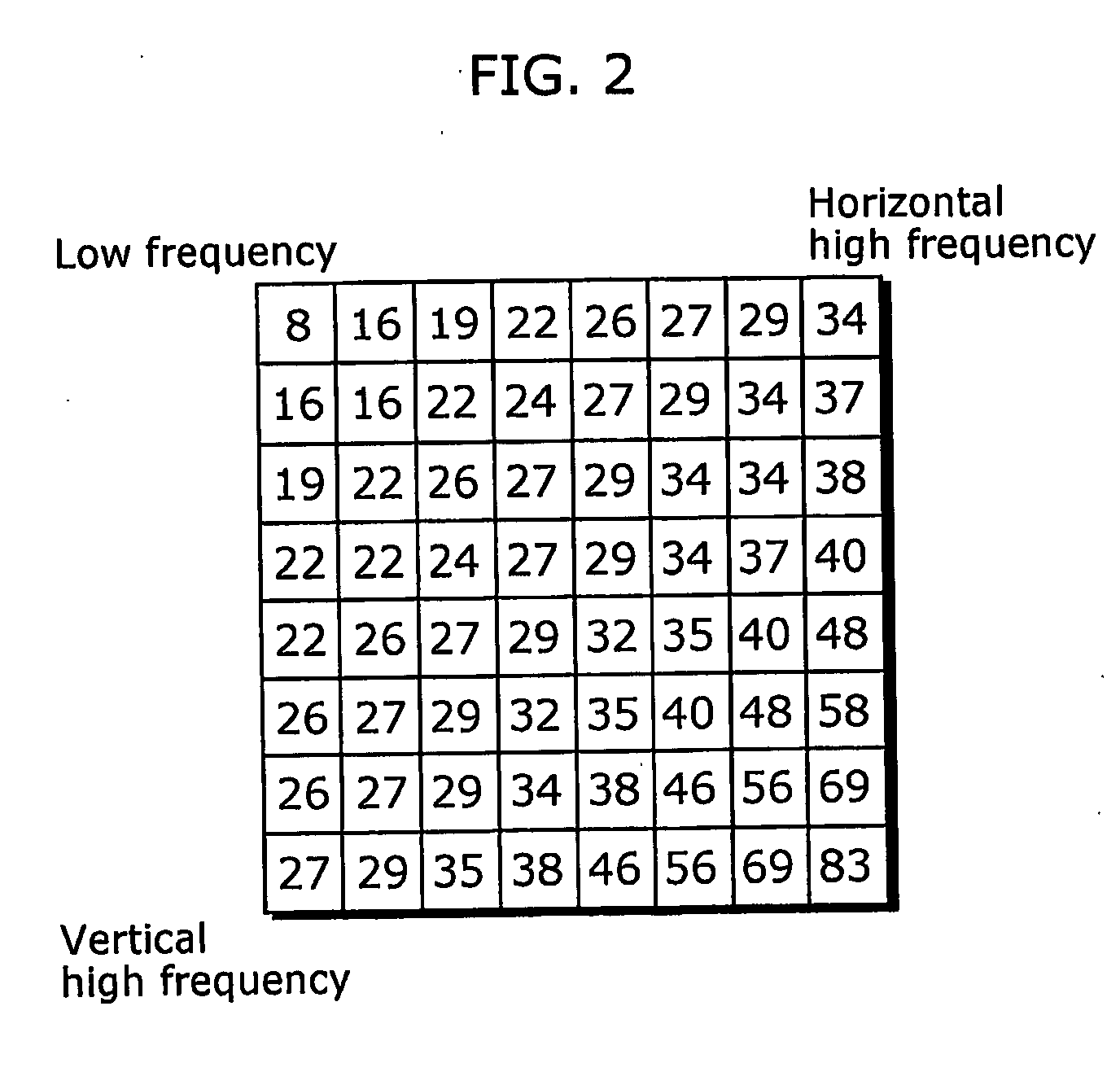
[0180]In the video coding systems, a set of quantization matrices are defined by default so that decoders implement the quantization schemes and the matrices. They will be used for decoding when encoded bit-streams use the quantization weighting schemes. User can define their own quantization matrices and transmit them to decoder. This innovation will specify how the quantization matrices are transmitted to decoders.
[0181]This innovation also defines the choices of transforms in various coding mode selections.
[0182]In the quantization weighting scheme, we described the following major features:
[0183]1. Specification of the quantization weighting scheme using completely integer based, division free, requiring only 16-bit memory operation at decoder, which introduces no complexity increase compared to uniform quantization scheme.
[0184]2. The non-uniform quantization scheme proposed is based on 8×8 transform on l...
PUM
 Login to View More
 Abstract
Description
Claims
Application Information
 Login to View More