
Surfactant-stabilized organoalkoxysilane composition
a technology of organoalkoxysilane and stabilized organic acid, which is applied in the field of organic alkoxysilane, can solve the problems of precipitation or hazing, difficulty in practice, etc., and achieve the effects of less sensitive to effect, massive cost advantage, and increased storage stability of organoalkoxysilane compositions
- Summary
- Abstract
- Description
- Claims
- Application Information
AI Technical Summary
Benefits of technology
Problems solved by technology
Method used
Image

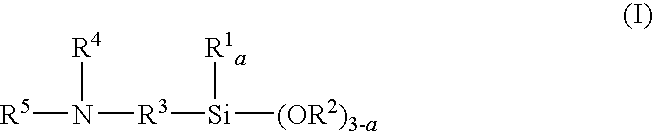
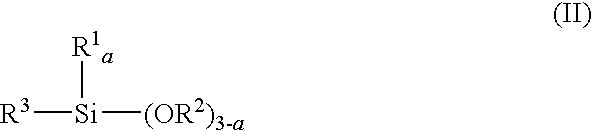
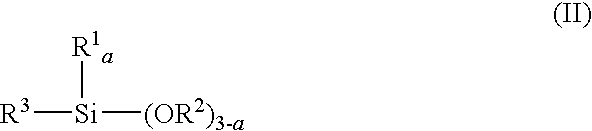
Examples
Embodiment Construction
[0061]
TABLE 1Organoalkoxysilanes used.AbbreviationOrganoalkoxysilaneA11103-AminopropyltrimethoxysilaneA1120N-(2-Aminoethyl)-3-aminopropyltrimethoxy-silaneA11303-[2-(2-Aminoethylamino)ethylamino]propyltri-methoxysilaneA1170Bis(trimethoxysilylpropyl)amineA1873-GlycidyloxypropyltrimethoxysilaneMTMSMethyltrimethoxysilane
[0062]Furthermore, the reaction product RP1 was prepared from 3-glycidyloxypropyltrimethoxysilane and N-(2-aminoethyl)-3-aminopropyltrimethoxysilane, by mixing 1 mol of A1120 with 3 mol of A187. Immediately after mixing, it was possible to check the conversion by IR. Although the band characteristic of the epoxy group, at about 910 cm−1, is still detectable immediately after mixing, it quickly disappears.
TABLE 2Surfactants used.AbbreviationSurfactantSupplier“Surfynol”Surfynol ® 61Air Products“Soprophor”Soprophor BSURhodia, Germany“FM33”Antarox FM33Rhodia, Germany“AE 01”EnviroGem ® AE 01Air Products“AE 02”EnviroGem ® AE 02Air Products“Hydropalat 120”Hydropalat ® 120Cognis...
PUM
| Property | Measurement | Unit |
|---|---|---|
| weight fraction | aaaaa | aaaaa |
| weight fraction | aaaaa | aaaaa |
| length | aaaaa | aaaaa |
Abstract
Description
Claims
Application Information
 Login to View More