

Non-volatile memory storage system with two-stage controller architecture
Patent Information
- Authority / Receiving Office
- US · United States
- Current Assignee / Owner
- Publication Date
- 2010-01-21
- Estimated Expiration
- Not applicable · inactive patent
Smart Images
Figure 1 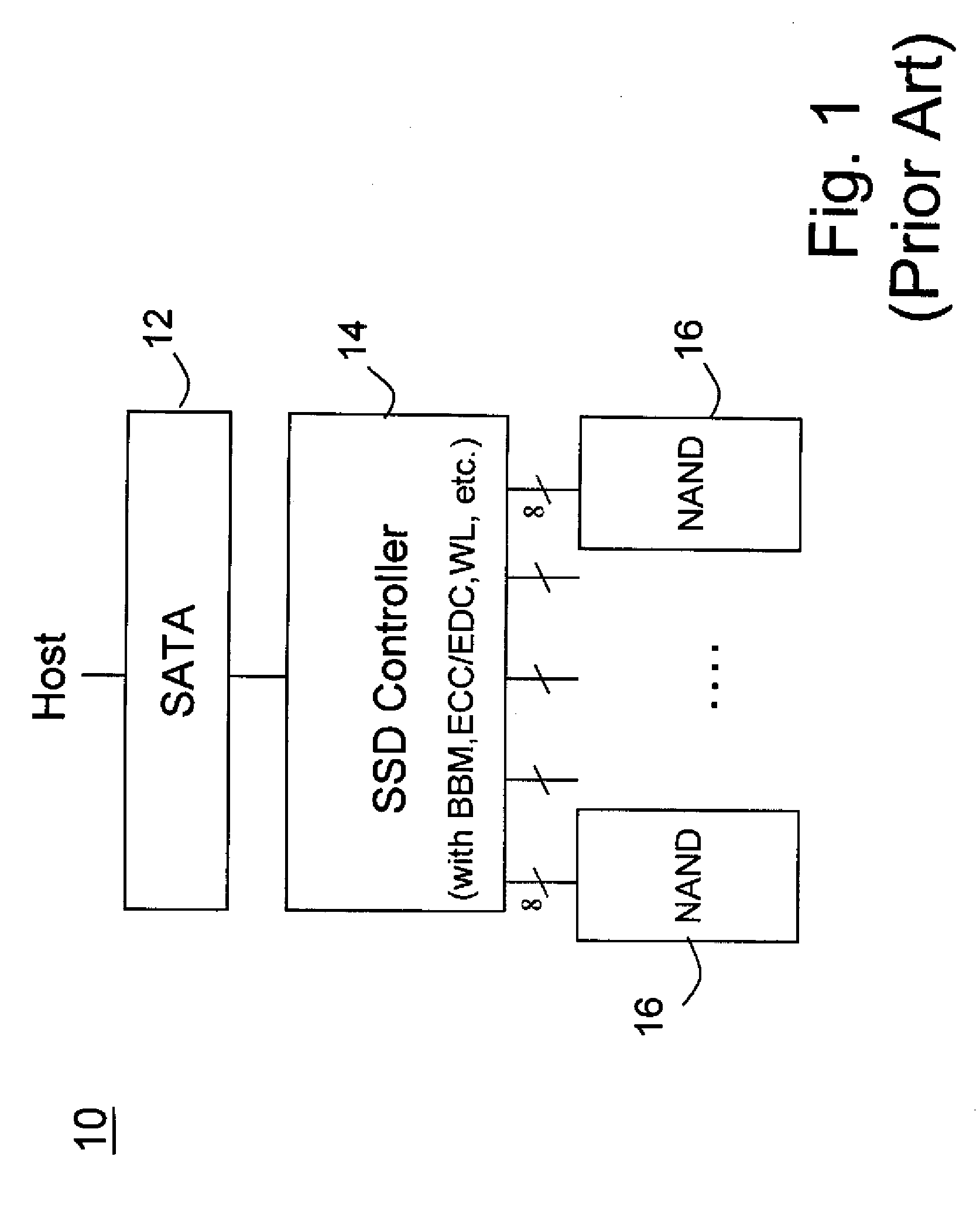
Figure 2 
Figure 3
Abstract
Description
CROSS REFERENCE TO RELATED APPLICATIONS
[0001] The present invention is a continuation-in-part application of U.S. Ser. No. 12 / 218,949, filed on Jul. 19, 2008, and of U.S. Ser. No. 12 / 271,885, filed on Nov. 15, 2008.BACKGROUND OF THE INVENTION
[0002] 1. Field of the Invention
[0003] The present invention relates to a non-volatile memory (NVM) storage system, such as solid state drive (SSD) utilizing two-stage controller architecture to provide a high performance and reliable storage system. The system provides wear-leveling, RAID control and other data integrity management functions as desired, and preferably includes a shared cache memory.
[0004] 2. Description of Related Art
[0005] Hard disk drive (HDD) has been the standard secondary storage device in computer system for many years. However, NAND Flash memory, a solid-state device having lighter weight, faster speed and lesser power consumption over disk, is being used in some applications to replace HDD. The only concern that hinders SSD ...
Examples
Embodiment Construction
[0043]The present invention will now be described in detail with reference to preferred embodiments thereof as illustrated in the accompanying drawings.
[0044]The first embodiment of the present invention is shown in FIG. 2. The solid state data storage system 100 employs two-stage controller architecture. As shown in the figure, the system 100 includes a host interface 120 for communication between the system 100 and a host; a two-stage controller 140 including a storage adapter 142 and a plurality of first stage controllers 144; and a plurality of non-volatile memory devices 160, such as NAND flash devices as shown but can be other types of NVM devices such as SONOS or CTF (Charge Trapping Flash). The host interface 120 may communicate with the host through, e.g., IDE, SATA, USB, PCI or PCIe protocol. The storage adapter 142 has a plurality of internal interfaces 1420, and it may communicate with the plurality of first stage controllers 144 through any designated protocol, such as ...