[0009]An
advantage of some aspects of at least one embodiment of the invention is that it provides an image
processing apparatus, an image processing method, an image processing program, and a printing apparatus capable of producing an appropriate correction effect for a dark portion in a backlight image while keeping the colors of a bright portion and adjusting the
color balance of the entire image, thereby obtaining a high-quality image as a whole.
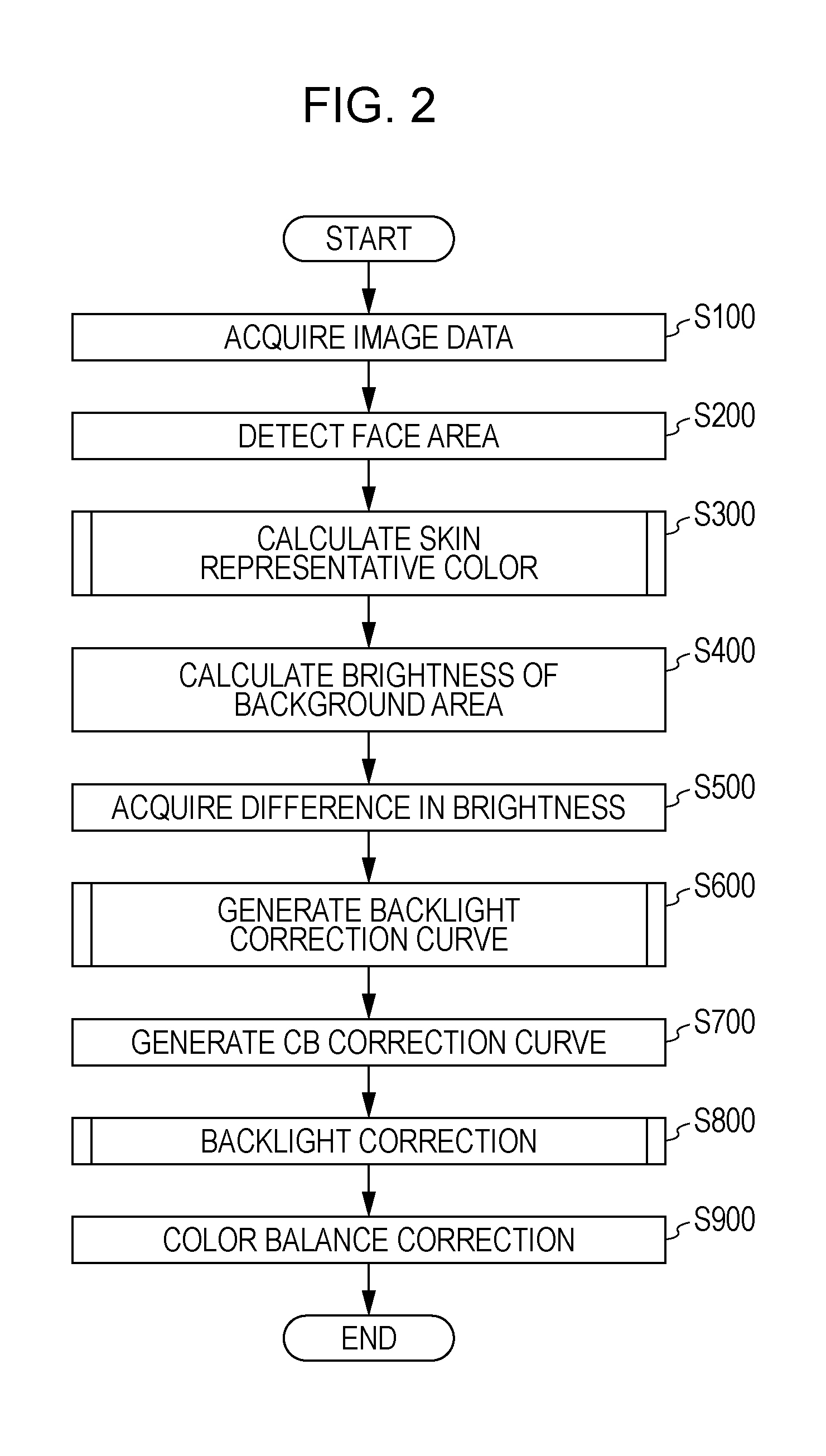
[0011]According to this aspect of at least one embodiment of the invention, the dark portion of the input image is corrected by the first correction curve, which is acquired on the basis of brightness of the representative color, and each element color of the input image is corrected by the second correction curve for every element color, in which a degree of correction is determined in accordance with each element color constituting the representative color after correction by the first correction curve. Therefore, when the input image is a backlight image or the like, the brightness of an intrinsically dark portion appropriately increases, and a balance between the element colors of the image is adjusted. As a result, a high-quality image is obtained. Specifically, for all the pixels of the input image including pixels corrected by the first correction unit, the second correction unit may correct the gradation value for every element color in each pixel by using the second correction curve. That is, the second correction curve is applied to the entire image after the dark portion of the input image is subjected to correction by the first correction curve and the brightness of the dark portion is corrected. As a result, backlight correction and balance correction between the element colors in the entire image can be appropriately realized.
[0012]The image processing apparatus may further include a preliminary correction unit calculating the maximum value for every element color in the input image before correction by the first correction unit and the second correction unit, and correcting each element color in the input image before correction by the first correction unit and the second correction unit so as to suppress a variation in the maximum value. With this configuration, before correction by the first correction unit and the second correction unit, the white balance of the input image is adjusted. For this reason, an image with a broken white balance is prevented from being output as the result of correction by the first correction unit or the like.
[0018]The first correction unit may specify a gradation value corresponding to a trough in the
luminance distribution on a low gradation side lower than a predetermined gradation value within a predetermined input gradation range with a low change rate of the output gradation value by the first correction curve. In the first correction curve, a range in which the change rate of the output gradation value is slower than the change rate of the input gradation value may occur near the intermediate gradation area due to the shape characteristic of the first correction curve, and for the pixels belonging to such a gradation area, in terms of maintenance of the gradation property, it should suffice that the first correction curve is not applied, if possible. With the above-described configuration, even if a plurality of troughs exist in the
luminance distribution, the upper limit in the gray axis direction of the color
gamut is determined in accordance with the gradation value of the trough on the low gradation side lower than the predetermined gradation value within the input gradation range with the low change rate of the output gradation value in the first correction curve. For this reason, correction of the dark portion can be performed without damaging the gradation property of the image.
[0019]The first correction unit may change the degree of correction for the pixels in accordance with a distance between a center axis in the gray axis direction of the color
gamut and a pixel subject to correction. With this configuration, for pixels further away from the center axis of the color
gamut from among the pixels belonging to the color gamut defining the dark portion, the degree of correction by the first correction unit is weakened. Therefore, the gradation property in the input image after correction can be appropriately maintained.



 Login to View More
  Login to View More