
Communication Control Method, Base Station Device, Terminal Device, and Communication Control System Using TDD-OFDMA Communication Method
a communication control and terminal device technology, applied in multiplex communication, transmission path division, synchronisation arrangement, etc., can solve the problems of inter-carrier interference and further increase in timing spread, so as to prevent interference with adjacent carriers due to timing differences from terminal devices, delay dispersion, and interference with other cells.
- Summary
- Abstract
- Description
- Claims
- Application Information
AI Technical Summary
Benefits of technology
Problems solved by technology
Method used
Image

Examples
first embodiment
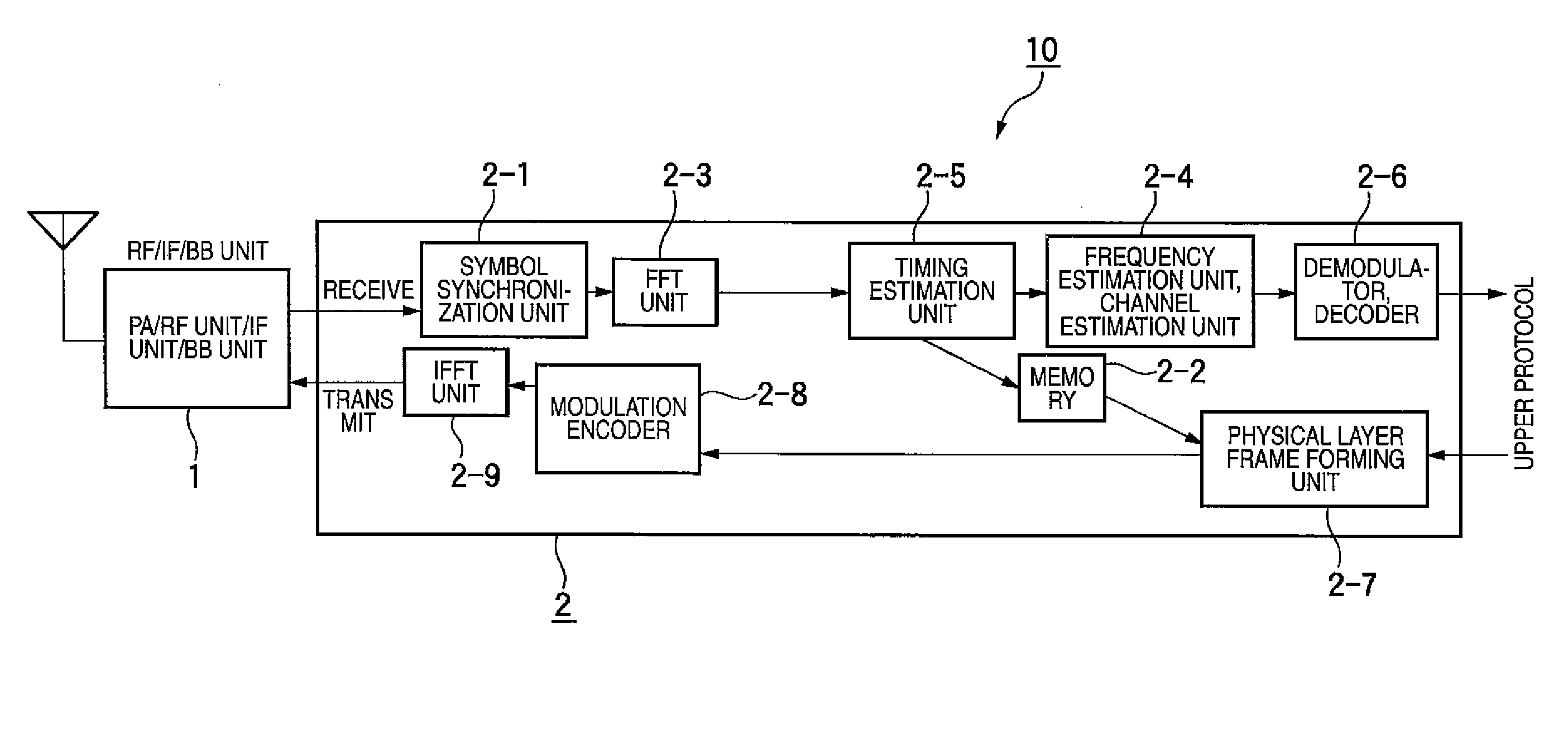
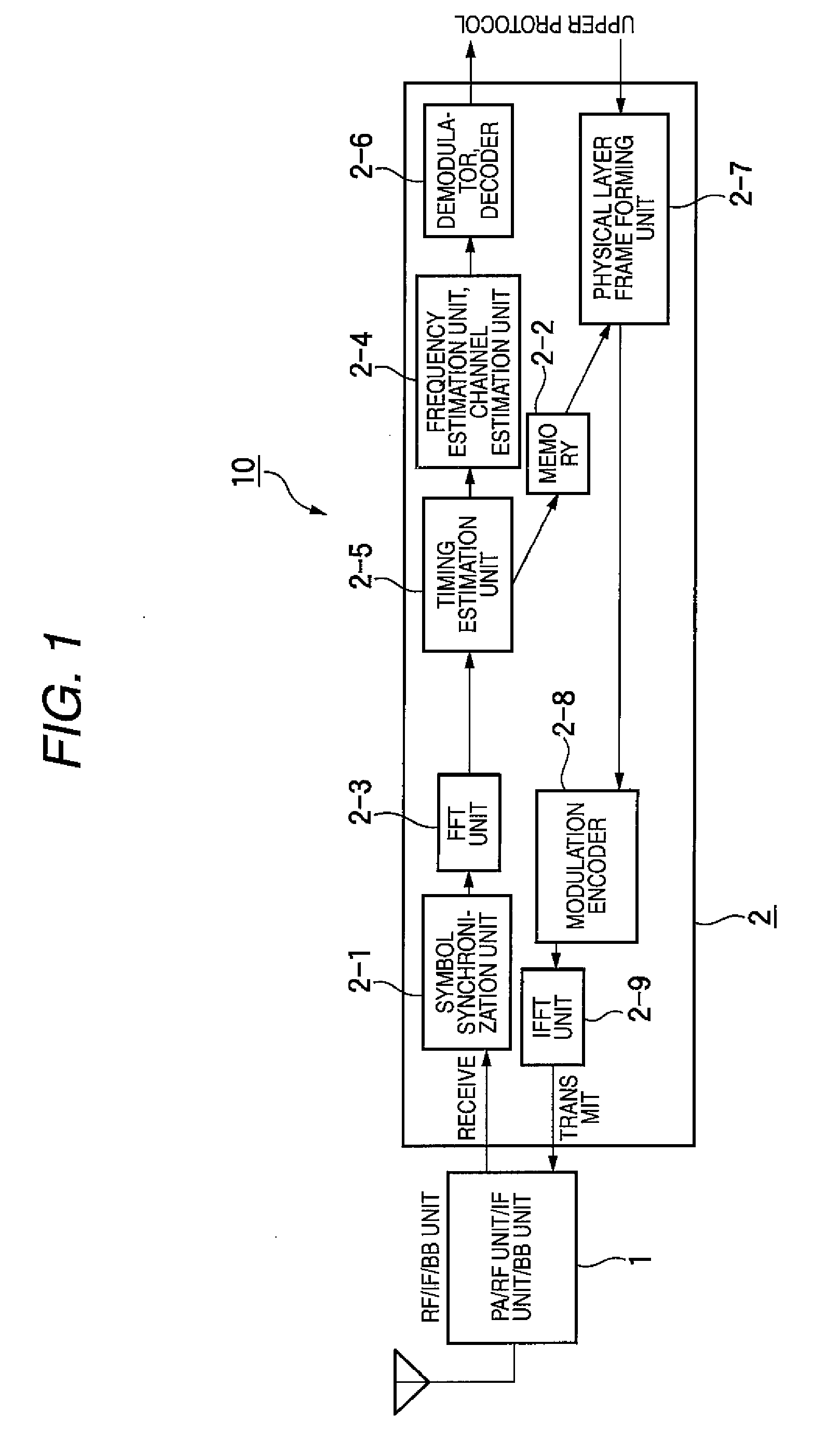
[0095]Hereinafter, a first embodiment of a communication control method, a base station device, a terminal device, and a communicating control system using a TDD-OFDMA communication method of the present invention will be described in detail with reference to the drawings. FIG. 1 is a functional block diagram of a base station device of an embodiment of the present invention.
[0096]The base station device 10 of the present embodiment includes a transceiver 1 (PA / RF unit / IF unit / BB unit) and a signal processor 2 which processes received signals.
[0097]In the transceiver 1, a signal received from an antenna passes through the RF unit and the IF unit, and an OFDMA signal of a base band signal can be obtained.
[0098]The signal processor 2 includes a symbol synchronization unit 2-1, a memory 2-2, an FFT unit 2-3, a frequency estimation unit (channel estimation unit) 2-4, a timing estimation unit 2-5 (timing estimating unit), a demodulator (decoder) 2-6, a physical layer frame forming unit 2...
second embodiment
Exemplary Variation of Second Embodiment
[0150]Next, second timing control processing to be performed between the base station device 10 and the terminal device 30 of the present embodiment will be described. FIG. 7 is a flowchart describing second timing control processing.
[0151]In the second timing control processing, steps which are the same as in the first timing control processing are not described, and different processing steps are described.
[0152]In Step S25, when the base station device 10 confirms a channel assignment request from the terminal device 30, at this timing, the base station device 10 does not issue permission of state transition to the communication channel (does not output a channel assignment response), but transmits a channel assignment rejection to the terminal device 30 (Step S31). At this time, the base station device measures a difference between the received timing of the channel assignment request received in Step S25 and the reference timing, adds it ...
PUM
 Login to View More
 Abstract
Description
Claims
Application Information
 Login to View More