Because the nurse or other hospital staff cannot see the distal end of the
feeding tube during advancement, the
feeding tube can be incorrectly positioned during the process.
More commonly, misplacement of the
feeding tube results in other serious complications including
lung placement or puncture or esophageal puncture.
Additionally, providing any feeding solution through the feeding tube into the lungs results in pneumonia with increased morbidity and mortality.
Unfortunately, many common methods for during so leave patients at substantial risk.
However, these tests only attempt to confirm position after placement when complications may have already occurred.
Moreover, X-
ray or fluoroscopic confirmation does not clearly confirm placement in the small bowel rather than the
stomach.
Additionally, some of these techniques have additional limitations and drawbacks.
If a patient is pregnant, or a child,
exposure to such
radiation is highly undesirable.
Additionally, the use of such
verification procedures significantly prolongs the period of time that a patient must wait after a feeding tube is placed before feeding can begin.
If the tube is placed improperly, the wait to begin feeding can take even longer as the process must be repeated.
During this time, the patient is unable to obtain nourishment and any medications which may be delivered via a feeding tube.
Another complication which is common with patients receiving a patient tube is that the patients are often not coherent.
The patient may be partially sedated or may be delirious.
This requires repetition of the procedure, again subjecting the patients to the risks set forth above.
First using an
endoscope usually takes considerable skill and is typically performed by physicians, often requiring a wait until a properly trained physician is available to place the feeding tube.
Second, because the
endoscope is typically placed through the mouth, an
additional procedure must be used if the feeding tube is to be used nasoenterically.
Lastly the procedure usually requires conscious
sedation which increases the risk and cost of the procedure.
Each of the above-referenced methods for placing a feeding tube also has the problem of subsequently confirming proper placement of the feeding tube.
Of course, it is often difficult to tell if the situation has been fully alleviated, if the device has become misplaced, or if the symptoms have simply been reduced.
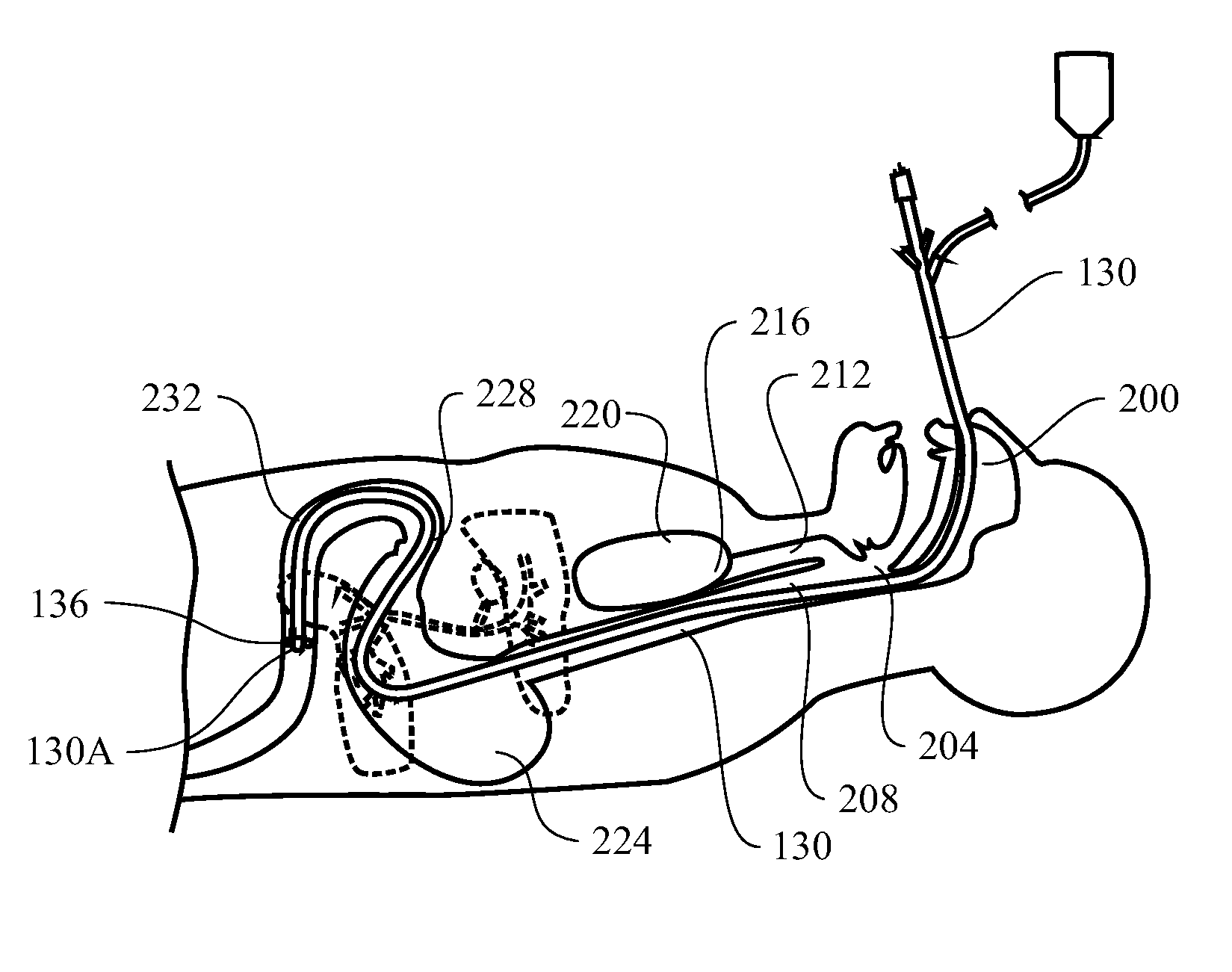
For example, rather than requiring a patient to be transported to a hospital for placement of a feeding tube, a nurse at a
nursing home to place a feeding tube in an
elderly patient who was suffering from an illness which made it difficult to keep food down.
Likewise, with very little training a pediatrician, nurse, or physician's assistant to place feeding tubes in a pediatric clinic where a child is suffering from the flu and cannot hold down liquids.


 Login to View More
  Login to View More