[0004]The setting of the standby pressure applied to the
clutch while the engine is stationary can be considered as an important issue for further improving the starting performance of a vehicle by quickly transferring power of the engine to drive wheels when the engine is started. Meanwhile, when the engine is started, torque variations may be generated, and may cause a shock to the vehicle when the torque variations are transferred to the drive wheels. Therefore, it is desirable to suppress such torque variations as much as possible.
[0005]It is a main object of a power transfer mechanism control device and a power transfer device according to the present invention to suppress a shock generated when an automatically stoppable and automatically startable internal combustion engine is automatically started.
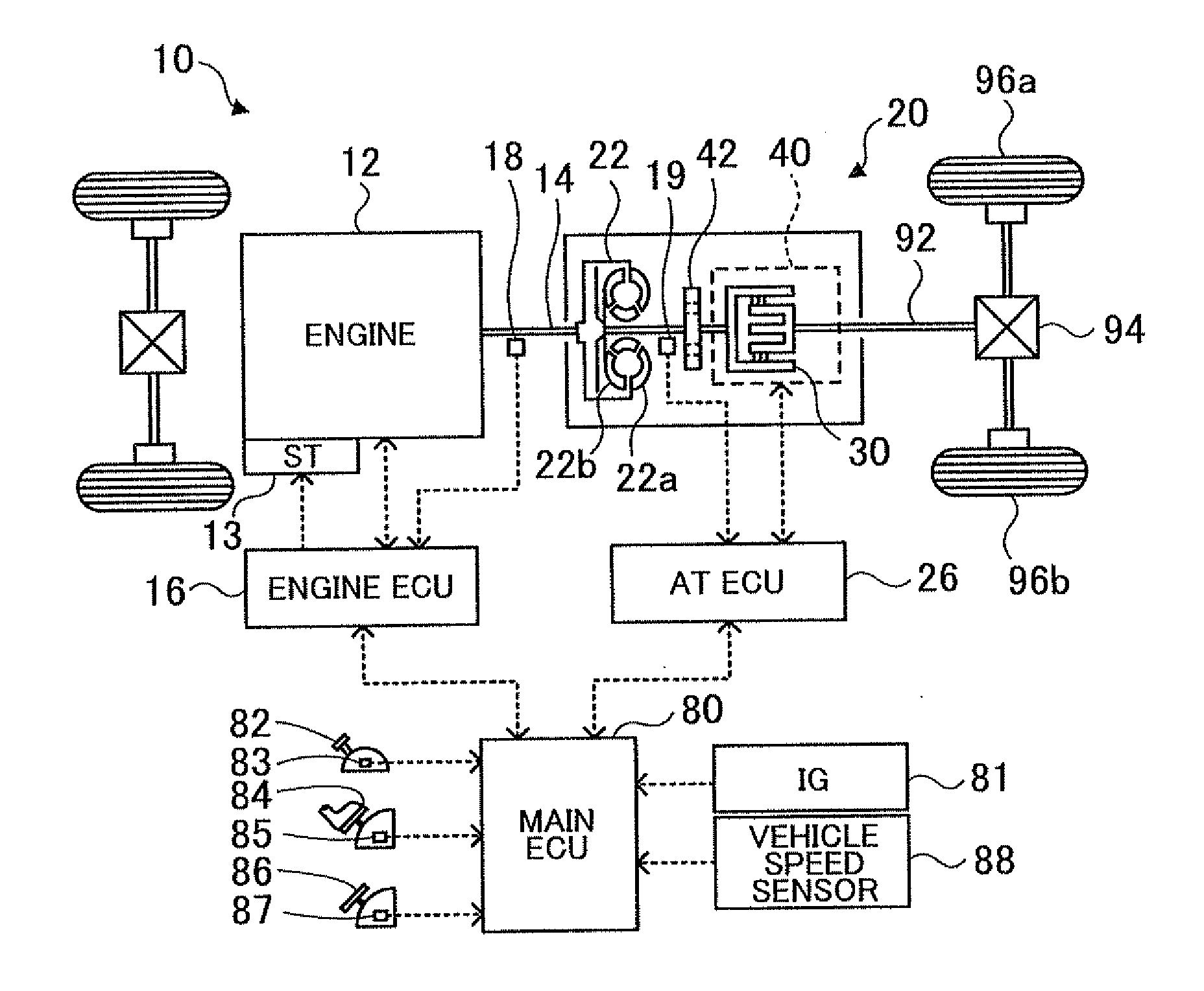
[0008]According to the power transfer mechanism control device of the first aspect of the present invention, in the case where the internal combustion engine which has been automatically stopped is to be automatically started, the second fluid pressure actuator is controlled such that, before complete combustion occurs in the internal combustion engine, the friction engagement element stands by in a low-pressure state in which a fluid pressure is lower than a fluid pressure for torque transfer, and the first fluid pressure actuator is controlled such that the friction engagement element transfers torque at the predetermined timing after the complete combustion occurs in the internal combustion engine. Accordingly, transfer of torque variations due to initial combustion that occurs when the internal combustion engine is automatically started to an axle side can be suppressed, which allows the vehicle to start smoothly immediately after the internal combustion engine is started.
[0011]In the power transfer mechanism control device in a sixth aspect of the present invention in which the power transfer mechanism control device includes a switch actuated by the fluid pressure from the first pump to switch between a state in which connection is established between an output port of the
pressure regulator and the fluid pressure
servo for the friction engagement element and a state in which such connection is blocked, while the internal combustion engine is automatically stopped, the second fluid pressure actuator may be controlled such that the friction engagement element stands by in the low-pressure state and the
pressure regulator may be caused to stand by with the same control amount as a control amount for the second fluid pressure actuator, and when the internal combustion engine is automatically started, the
pressure regulator may be driven such that the
hydraulic pressure to be applied to the fluid pressure
servo for the friction engagement element is increased at the predetermined timing after the complete combustion occurs in the internal combustion engine. In this way, abrupt changes in fluid pressure to be applied to the friction engagement element can be suppressed even if the switch establishes connection between the output port of the pressure
regulator and the fluid pressure
servo for the friction engagement element while the internal combustion engine is automatically started. In the power transfer mechanism control device according to a seventh aspect of the present invention, the second pump may be an
electromagnetic pump that reciprocates a
piston by repeatedly turning on and off an electromagnetic force to generate a fluid pressure.
[0016]Because the power transfer device according to the present invention includes the power transfer mechanism control device according to any one of the aspects of the present invention discussed above, the power transfer device according to the present invention can achieve the effect achieved by the power transfer mechanism control device according to the present invention. For example, the power transfer device according to the present invention can suppress transfer of torque variations due to initial combustion that occurs when the internal combustion engine is automatically started to an axle side, can appropriately manage the engagement state of the friction engagement element when the internal combustion engine is automatically stopped, can bring the friction engagement element to a more appropriate engagement state irrespective of secular changes, and so forth.



 Login to View More
  Login to View More