[0006]Degeneration of the ECM (leading to decreased disc flexibility) is believed to benefit from the application of
red light irradiation of the disc, which helps the disc regain its flexibility. Since there is evidence for anti-inflammatory effects of LLLT, as well as beneficial effects on
fibroblast function and acceleration of connective-
tissue repair, the treatment is believed to affect both the nerve endings surrounding the disc as well as the disc itself. In an exemplary embodiment, the
red light has a
wavelength of between 600 nm and 1000 nm. It is believed that
red light having a
wavelength of between 600 nm and 1000 nm delivered to the
lumbar spine will provide a useful therapy to treat pain and / or degeneration of the disc, for example, in the lower
lumbar region.
[0016]In another exemplary embodiment, the
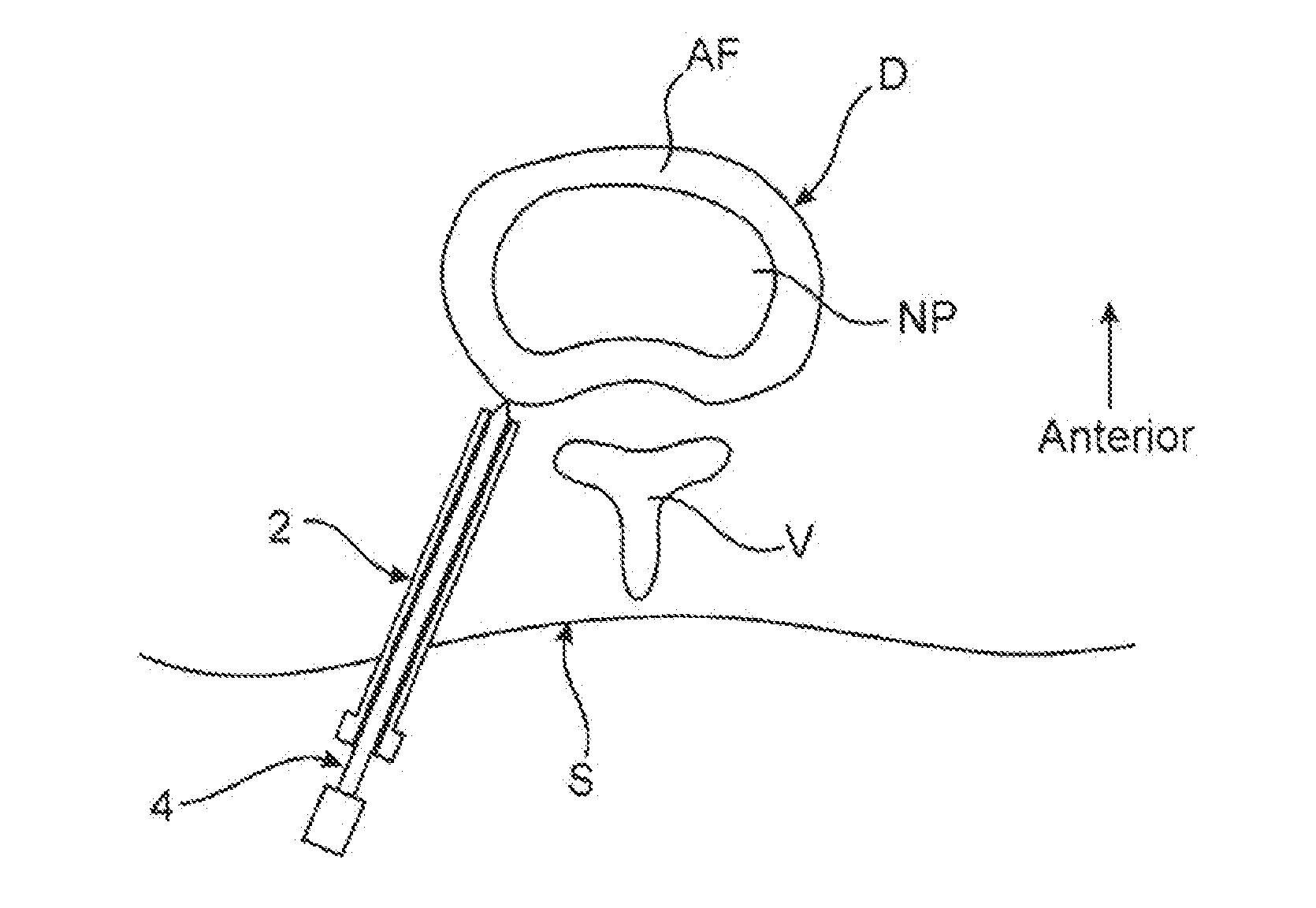
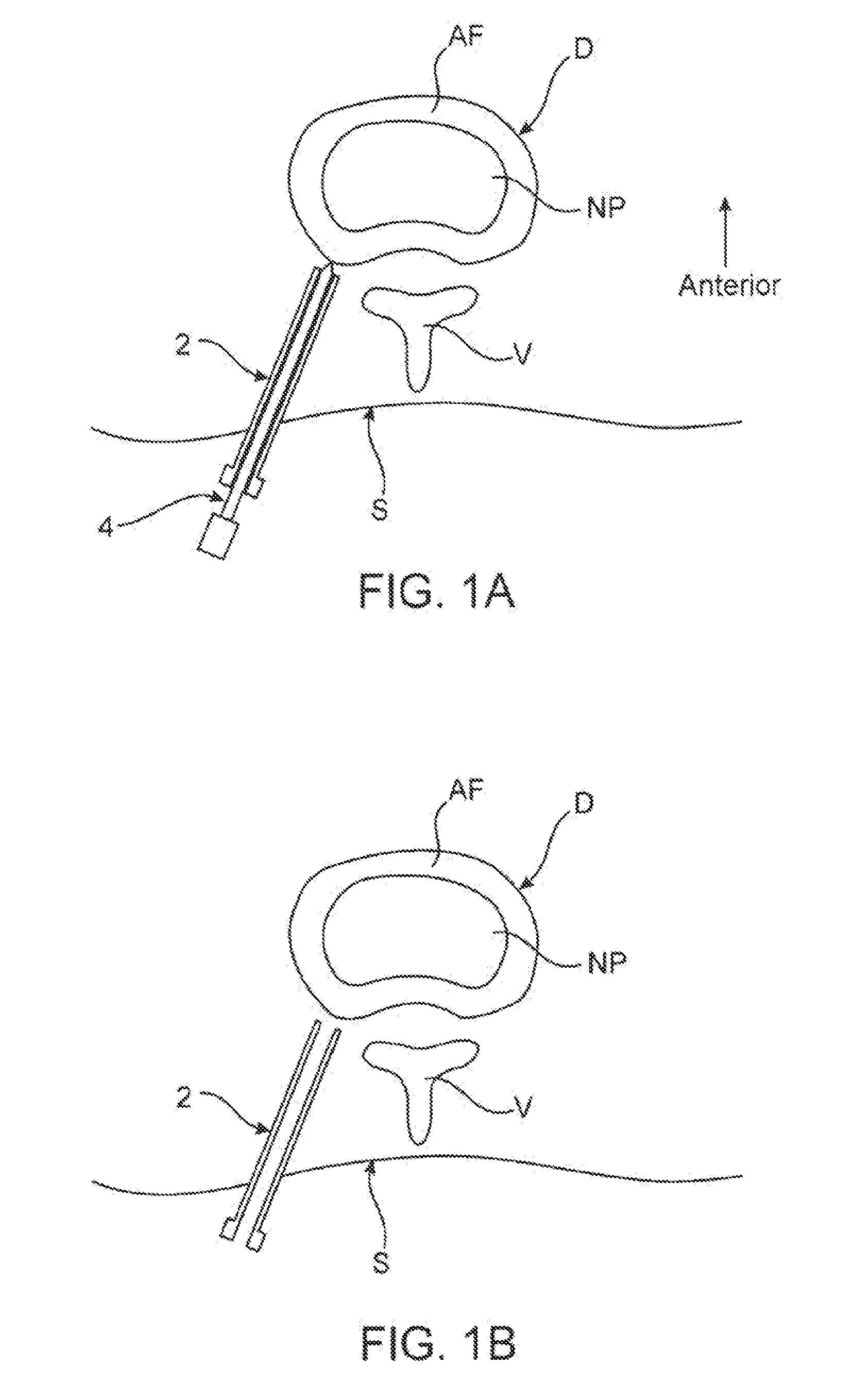
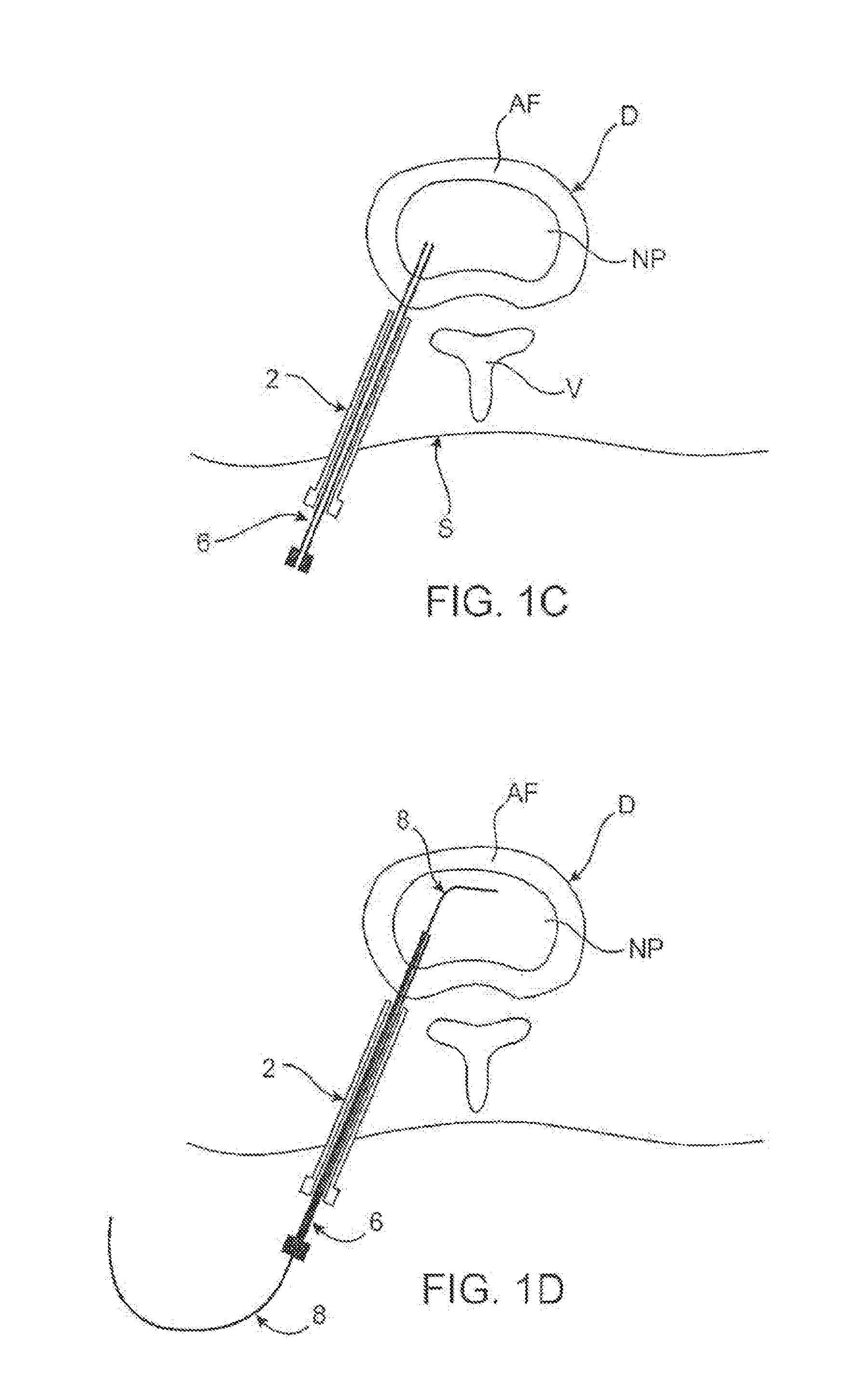
catheter device may either be advanced to a position within the disc or to a position just outside the disc. In either case, the
catheter device may have a distal end or portion configured to facilitate advancement of the distal end through the annulus
fibrosis. In some embodiments, the
catheter device is passed over a guidewire. In some cases, the catheter is passed over the guidewire within the needle, while in alternative embodiments an introducer is removed over the guidewire before the catheter device is passed over the guidewire. In some embodiments, positioning the
distal portion is facilitated by visualizing at least one radiopaque marker or material at or near the
distal portion to assess its location.
[0025]Optionally, the catheter body may also include an outer surface having one or more markings for indicating depth of
insertion of the catheter device into a patient's body. In other embodiments, the catheter body may include an outer surface having two or more different colors for indicating depth of
insertion of the catheter device into a patient's body. The catheter body may further include at least one radiopaque marker or material for facilitating
visualization of the catheter device in a patient.
[0026]In an exemplary embodiment, the catheter device includes an injection tube extending through at least part of the lumen of the catheter body for introducing one or more substances into the disc, an inflation tube extending through at least part of the lumen for expanding the deployable anchoring member and a therapeutic energy conduit extending through at least part of the lumen for delivering therapeutic energy to a therapeutic delivery surface. The catheter body, therapeutic energy conduit and / or injection tube may be made of any suitable material or combination of materials, such as but not limited to, stainless steel, tempered stainless steel, annealed stainless steel, polymers, flexible plastics,
optical fiber, an electrical wire or conduit, superelastic alloys and / or other suitable materials. In some embodiments, the therapeutic energy conduit, injection tube and / or inflation tube exit a proximal end of the catheter body and are removably coupled with at least one adapter to provide for application of therapeutic energy, injection and inflation. In some embodiments, the therapeutic energy conduit, injection tube and inflation tube extend through at least part of the catheter body lumen coaxially. Alternatively, the therapeutic energy conduit, injection tube and inflation tube may extend through at least part of the catheter body lumen side-by-side. In other embodiments, the therapeutic energy conduit, injection tube and inflation tube may extend through part of the catheter body lumen coaxially and through another part of the lumen side-by-side. In an alternative embodiment, the catheter body comprises the therapeutic energy conduit and may optionally include one or more surface coatings to prevent
discharge of the energy in undesired locations along the catheter body. In another embodiment, the catheter comprises a single
extrusion having an injection lumen for introducing one or more substances into the disc and an inflation lumen for expanding the at least one anchoring member, with the therapeutic energy conduit located within the lumen, within the catheter body or outside of the catheter body.
[0028]In various embodiments, the catheter device may have any suitable proximal end configurations for providing connection to one or more therapeutic energy sources, injection, inflation, suction,
irrigation or other devices, for providing guidewire access and / or the like. In one embodiment, for example, a proximal end of the proximal portion of the catheter body is trifurcated into three separate catheter body proximal ends. In some embodiments, each of the three proximal ends is removably coupled with an adapter for facilitating
energy delivery, injection or inflation.


 Login to View More
  Login to View More