
Joining sheet, electronic component, and producing method thereof
a technology of electronic components and joints, applied in the direction of printed circuit assembling, thermoplastic polymer dielectrics, metallic pattern materials, etc., can solve the problems of reduced reliability of electronic components to be obtained, heavy industrial burden, and need for printing technology refinement, and achieve excellent solder melting
- Summary
- Abstract
- Description
- Claims
- Application Information
AI Technical Summary
Benefits of technology
Problems solved by technology
Method used
Image

Examples
example 1
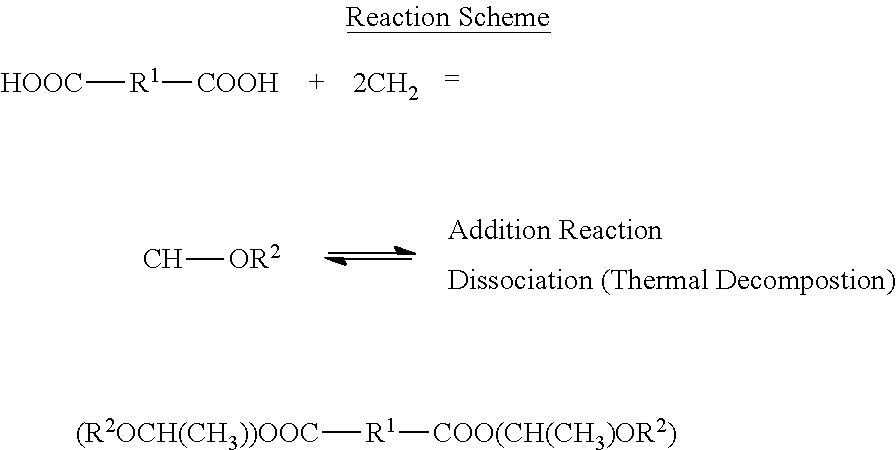
[0112]30 parts by volume of an epoxy resin (manufactured by NIPPON STEEL CHEMICAL CO., LTD., a thermosetting resin, YSLV-80XY, a curing temperature of 150° C.), 40 parts by volume of an acrylic resin (manufactured by KURARAY CO., LTD., a thermoplastic resin, LA polymer, a softening temperature of 110° C.), and 30 parts by volume of a phenol resin (manufactured by MEIWA PLASTIC INDUSTRIES, LTD., a curing agent, MEH-7851SS) were mixed, so that a resin composition was obtained. The obtained resin composition and solder particles (Sn / Bi=42 mass % / 58 mass %, the melting point of 139° C., a sphere shape, an average particle size of 35 μm) were mixed at a volume ratio of the resin composition:the solder particles=25:75. Furthermore, a blocked carboxylic acid (manufactured by NOF CORPORATION, Santacid H, a monoalkyl vinyl ether-blocked bifunctional low molecular weight carboxylic acid, a dissociation temperature of 160° C.) was added to the obtained product at a ratio of 1 part by mass of t...
example 2
[0113]A joining sheet was fabricated in the same manner as in Example 1, except that the blocked carboxylic acid (manufactured by NOF CORPORATION, Santacid H, a monoalkyl vinyl ether-blocked bifunctional low molecular weight carboxylic acid, a dissociation temperature of 160° C.) was changed to a blocked carboxylic acid (manufactured by NOF CORPORATION, Santacid I, a monoalkyl vinyl ether-blocked bifunctional carboxylic acid, a dissociation temperature of 170° C.).
example 3
Performance Test of Solder Melting B of Joining Sheet in Example 1
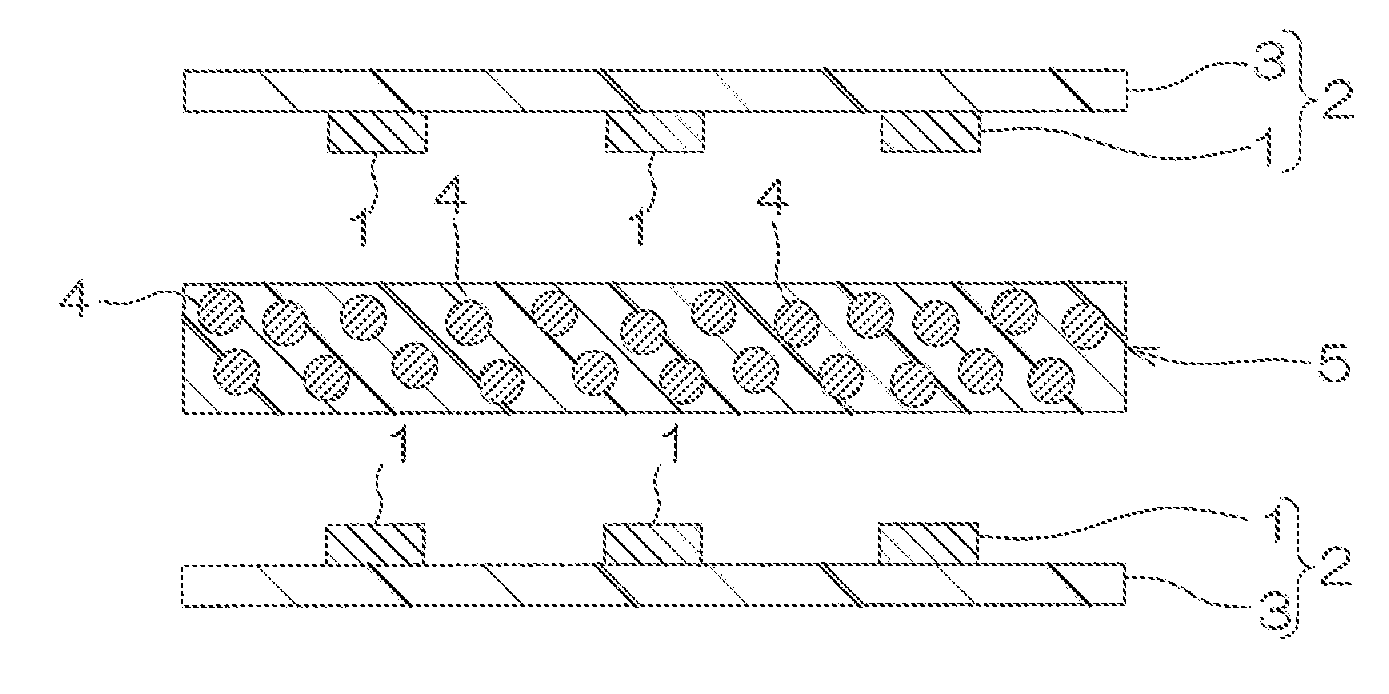
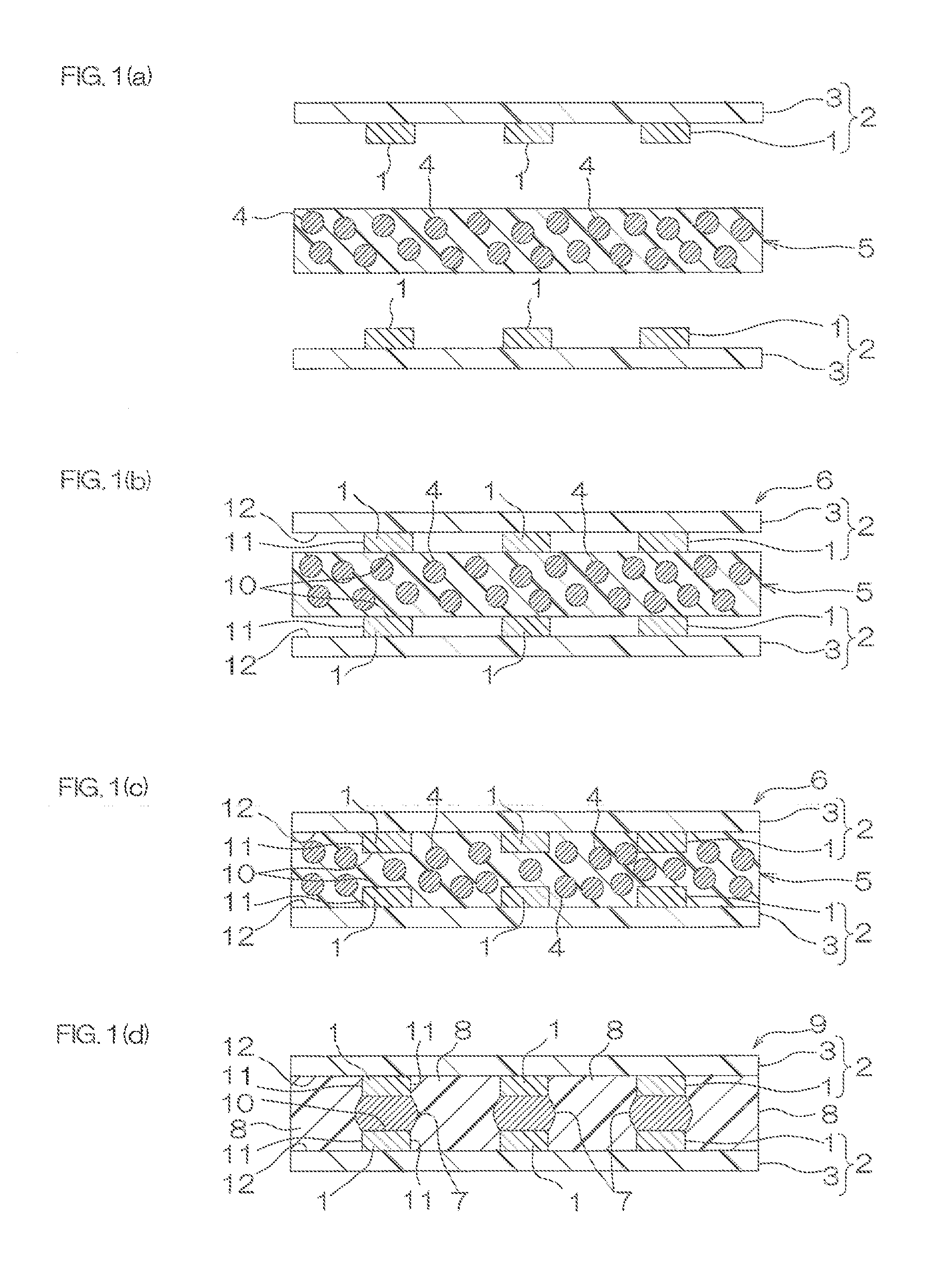
[0138]Two pieces of wired circuit boards each of which was provided with a board and a wired circuit that was formed on the surface of the board, was made of copper, and had terminals (an interval of 100 μm between the terminals) were prepared (ref: FIG. 1 (a)). The two pieces of wired circuit boards were arranged so that corresponding terminals thereof were spaced in opposed relation to each other. Thereafter, the joining sheet of Example 1 was interposed between the two pieces of wired circuit boards so as to be brought into contact therewith, so that a laminate was obtained (ref: FIG. 1 (b)). Next, the obtained laminate was subjected to a thermal compression bonding at 125° C. and 1 MPa (ref: FIG. 1 (c)) to be then heated at 170° C. for 30 minutes, so that an electronic component was fabricated (ref: FIG. 1 (d)).
[0139]The solder melting of the electronic component was examined and the solder melting was confirmed.
PUM
| Property | Measurement | Unit |
|---|---|---|
| dissociation temperature | aaaaa | aaaaa |
| melting point | aaaaa | aaaaa |
| melting point | aaaaa | aaaaa |
Abstract
Description
Claims
Application Information
 Login to View More