

Mirror for use in humid environments, and/or method of making the same
a technology for mirrors and humid environments, applied in the direction of instruments, optical elements, vacuum evaporation coatings, etc., can solve the problems of not being particularly durable, subject to corrosion, and quite expensive silver, and achieve the effect of efficient aluminum deposit and less expensiv
- Summary
- Abstract
- Description
- Claims
- Application Information
AI Technical Summary
Benefits of technology
Problems solved by technology
Method used
Image

Examples
example 1
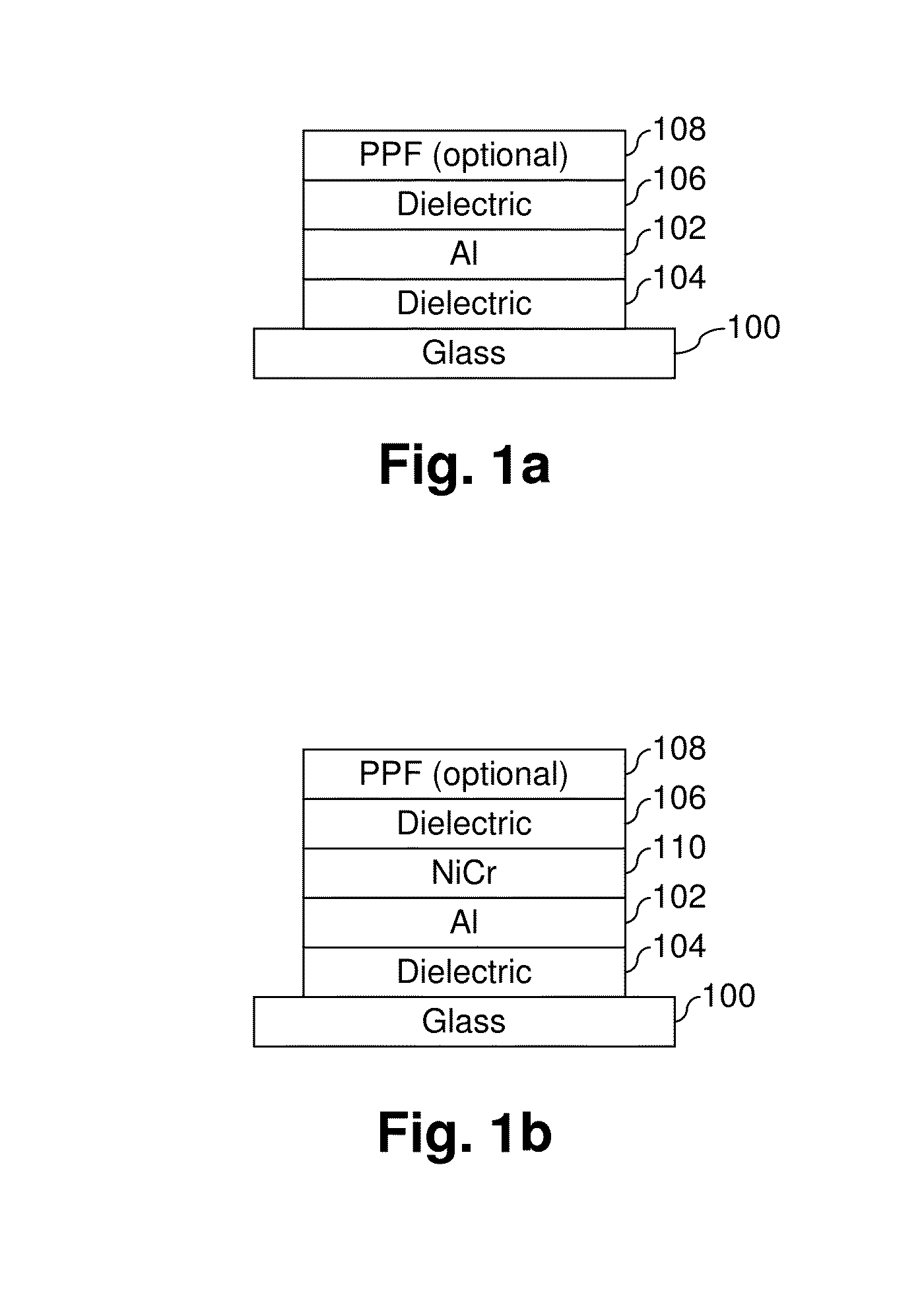
[0040]Glass / Si3N4 (40 angstroms) / Al (400 angstroms) / NiCr (50 angstroms) / Si3N4 (80 angstroms). RgY (C / 2): 82.32%
example 2
[0041]Glass / Si3N4 (40 angstroms) / Al (400 angstroms) / Cr (50 angstroms) / Si3N4 (80 angstroms). RgY (C / 2): 81.83%. It will be appreciated that the presence of Ni together with Cr in the layer “behind” the Al improves reflectivity.
example 3
[0042]Glass / Si3N4 (40 angstroms) / NiCr (5 angstroms) / Al (400 angstroms) / NiCr (50 angstroms) / Si3N4 (80 angstroms). RgY (C / 2): 78.87%. While the presence of a layer comprising Ni and / or Cr interposed between the Al and the glass substrate may help with adhesion, it nonetheless may reduce reflectance, possibly because of increased absorption on the part of the front layer comprising Ni and / or Cr.
PUM
| Property | Measurement | Unit |
|---|---|---|
| contact angle | aaaaa | aaaaa |
| thick | aaaaa | aaaaa |
| thick | aaaaa | aaaaa |
Abstract
Description
Claims
Application Information
 Login to View More