Rubber composition and pneumatic tire

a technology of composition and rubber, applied in the direction of special tyres, tyre parts, transportation and packaging, etc., can solve the problems of difficult dispersibility of silica and insufficient improvement of either of these properties, and achieve excellent performance properties in these performance properties, improve fuel economy and wet grip performan

US20140187707A1Inactive Publication Date: 2014-07-03SUMITOMO RUBBER IND LTD
0 Cites 12 Cited by

Patent Information

Authority / Receiving Office
US · United States
Current Assignee / Owner
Publication Date
2014-07-03
Estimated Expiration
Not applicable · inactive patent

Smart Images

  • Figure 1
    Figure 1
  • Figure 2
    Figure 2
  • Figure 3
    Figure 3
Patent Text Reader

Abstract

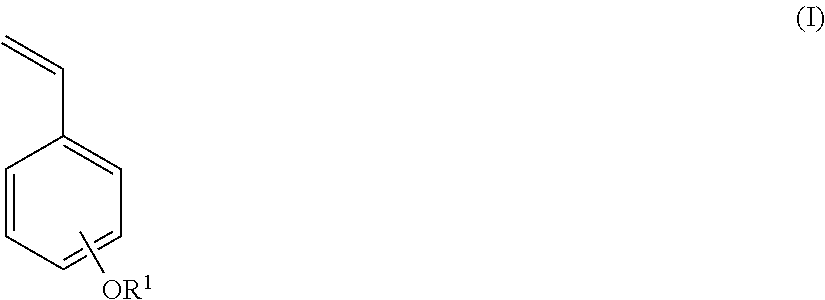
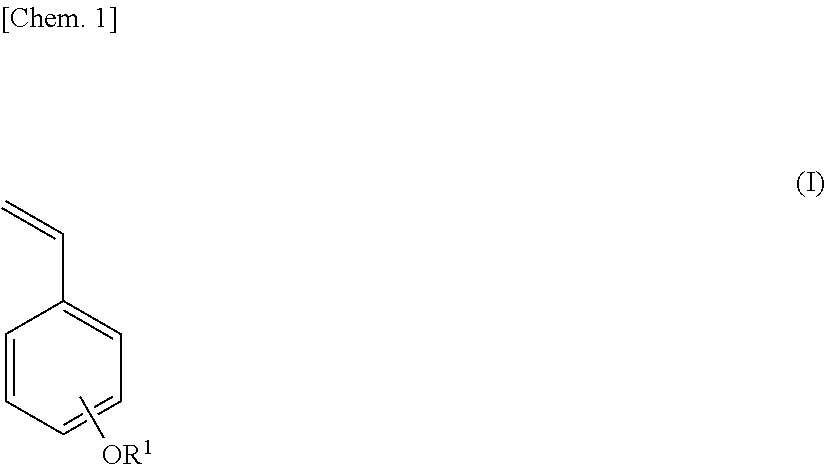
Provided are: a rubber composition that improves fuel economy and wet grip performance together while maintaining the balance between them; and a pneumatic tire whose component (in particular tread) includes the rubber composition. The invention relates to a rubber composition containing: a rubber component containing a copolymer; silica; and a diene rubber gel bearing a hydroxyl group, wherein the copolymer is obtained by copolymerization of 1,3-butadiene, styrene, and a compound represented by formula (I) below, has an amino group at a first chain end and a functional group containing at least one atom selected from the group consisting of nitrogen, oxygen, and silicon at a second chain end, and has a weight average molecular weight of 1.0×10⁵-2.5×10⁶, and the diene rubber gel has a Tg of −40 to −10° C., and is present in an amount of 10-30 parts by mass per 100 parts by mass of the rubber component;
Need to check novelty before this filing date? Find Prior Art

Description

TECHNICAL FIELD

[0001] The present invention relates to a rubber composition and a pneumatic tire formed using the composition.BACKGROUND ART

[0002] Recent concerns about resource or energy saving and environmental protection created a growing social demand for reducing carbon dioxide emissions. In the automotive industries, various strategies to reduce carbon dioxide emissions, such as weight reduction of vehicles and use of electric energy, have been attempted.

[0003] A common goal to be achieved by all vehicles is improved fuel economy, which can be achieved by improvement of the rolling resistance of tires. Another growing need for vehicles is improved driving safety. The fuel economy and safety of vehicles largely depend on the performance of tires used. The vehicle tires are increasingly required to have improved fuel economy, wet grip performance, handling stability, and durability. These properties of tires depend on various factors, such as the structure of tires and materials co...

Examples

examples

[0124]The present invention is more specifically described with reference to examples, but the present invention is not limited to these examples.

[0125]The chemical agents used in synthesis and polymerization reactions are described below. These agents were purified in accordance with common methods, if necessary. n-Hexane: product of Kanto Chemical Co., Inc. Styrene: product of Kanto Chemical Co., Inc. 1,3-Butadiene: product of Tokyo Chemical Industry Co., Ltd. p-Methoxystyrene: product of Kanto Chemical Co., Inc. (a compound represented by the formula (I)) p-(tert-Butoxy) styrene: product of Wako Pure Chemical Industries, Ltd. (a compound represented by the formula (I)) Tetramethylethylenediamine: product of Kanto Chemical Co., Inc.

Modifier A-1: dimethylamine available from Kanto Chemical Co., Inc.

Modifier A-2: pyrrolidine available from Kanto Chemical Co., Inc.

Modifier A-3: AI-200 available from FMC Lithium (a compound represented by the following formula (s=2))

n-Butyllithium: 1....