
Touch screen, touch panel, display device and electronic device
a display device and touch screen technology, applied in the field of touch screen, can solve the problems of reducing power consumption, reducing requiring a relatively large amount of light, so as to reduce the luminance of an image or picture on the back surface of the touch screen, suppress the effect of broken lines, and increase the density of wires including column wires and row wires
- Summary
- Abstract
- Description
- Claims
- Application Information
AI Technical Summary
Benefits of technology
Problems solved by technology
Method used
Image

Examples
first embodiment
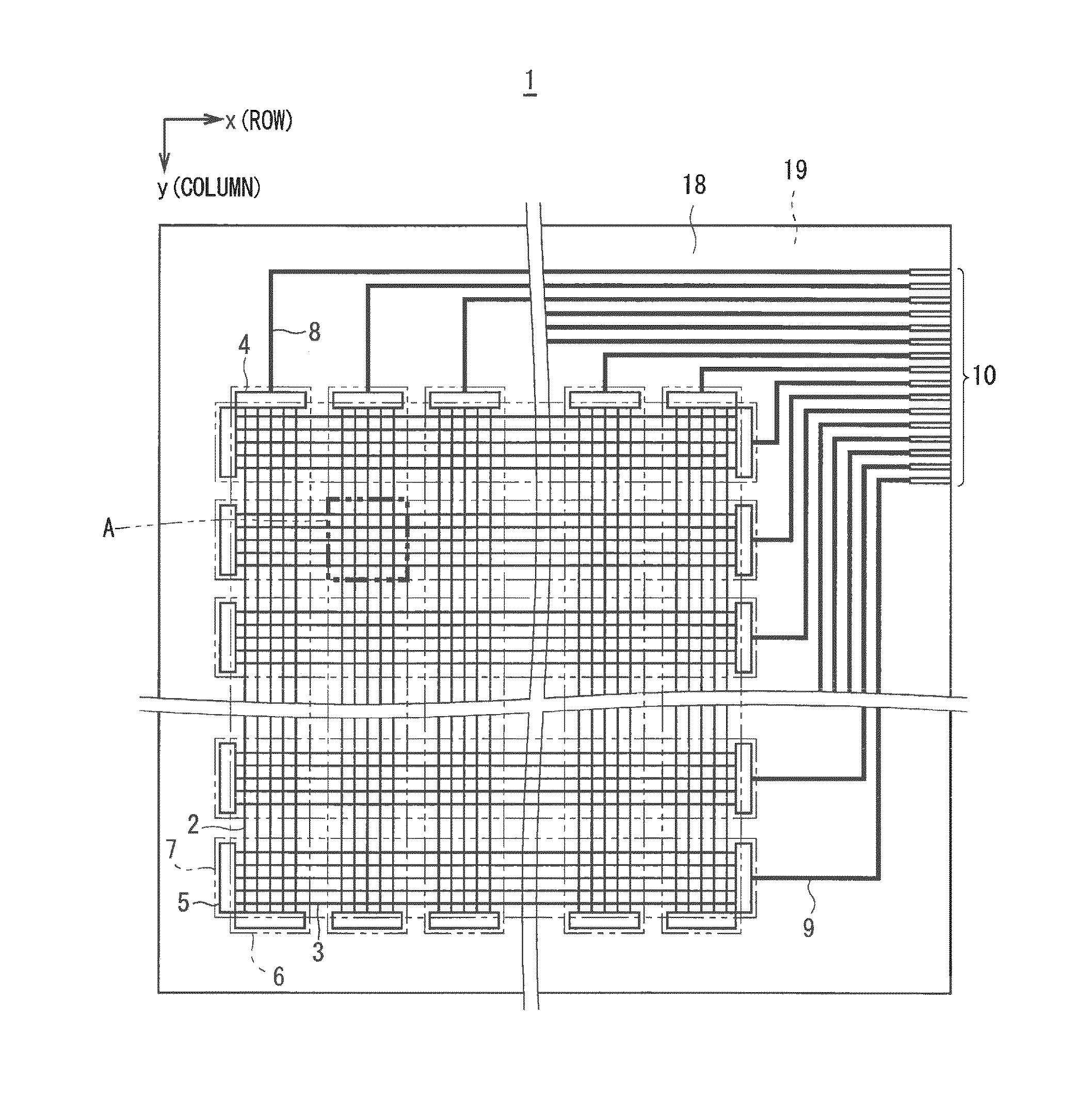
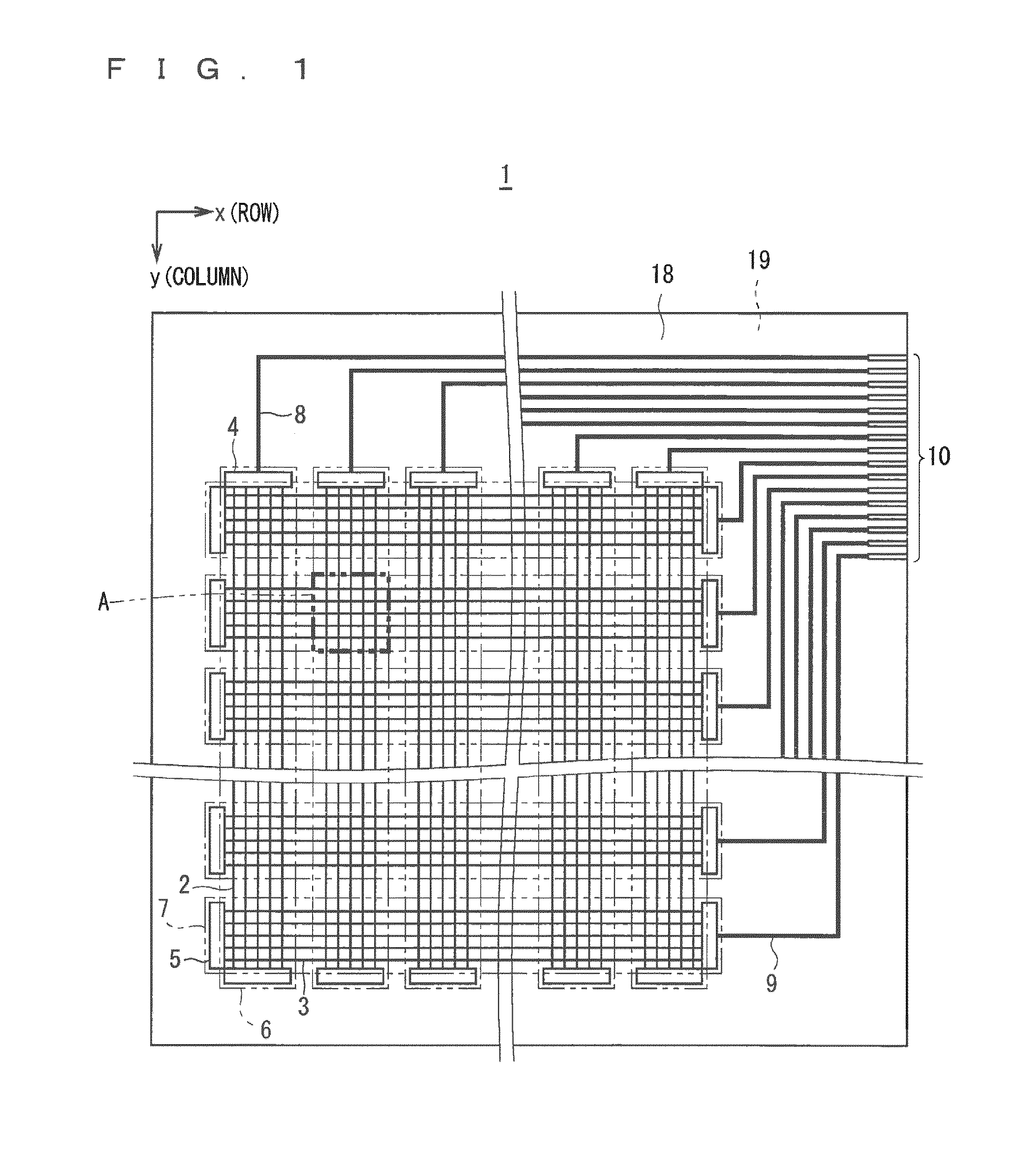
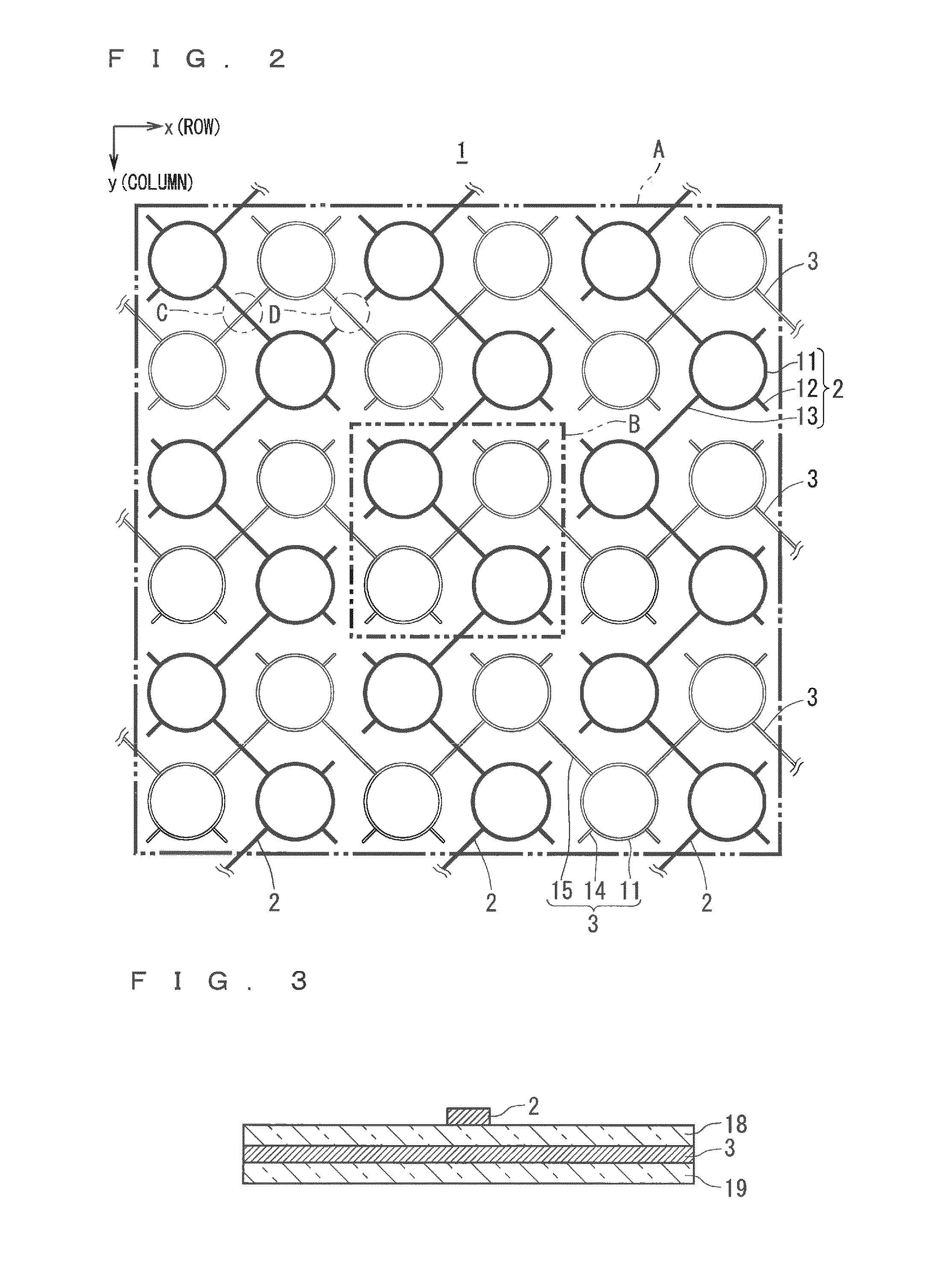
[0064]FIG. 1 is a projection view showing a configuration of a touch screen 1 in accordance with First embodiment of the present invention. FIG. 1 is a projection view when viewed in the direction of a normal line from a front surface side of a transparent base 19. The front surface of the transparent base 19 is a surface facing a user of the transparent base 19, and the direction of the normal line from the front surface of the transparent base 19 is the direction perpendicular to the surface facing the user of the transparent base 19. The “projection view” will be hereinafter referred to a projection view when viewed in such a direction, that is, the direction of the normal line from the front surface side of the transparent base 19. It is assumed that the surface of the transparent base 19, on which detection wires 2 and 3 are disposed is planar. In the case where the surface of the transparent base 19 is curved, projection on a plane perpendicular to the normal line of the surfa...
second embodiment
[0186]FIG. 17 is a projection view showing a wiring pattern of a touch screen 30 in Second embodiment of the present invention. In the touch screen 30 in this embodiment, thin wires constituting the detection column wires 32 and the detection row wires 33 are curved lines including the closed reflected-light distribution pattern 11.
[0187]Specifically, as shown in FIG. 17, in this embodiment, the linear thin wire connecting the reflected-light distribution pattern of the touch screen 1 in First embodiment in FIG. 2 is replaced with a corrugated thin wire. This can further decrease the inter-wire capacitance.
[0188]Since merely replacement of the linear thin wire with the corrugated thin wire increases the resistance of the detection wires 32, 33, measures for reducing the resistance, such as increasing the thickness of the thin wire and the use of a low resistance material may be also adopted to balance the increase in resistance and the effect of reducing capacitance.
[0189]When the p...
third embodiment
[0199]FIG. 19 is a projection view showing a wiring pattern of a touch screen 40 in Third embodiment of the present invention. Also in this embodiment, detection wires 42 and 43 are configured to function as the reflected-light distribution pattern. In this embodiment, as shown in FIG. 19, the detection wires 42 and 43 do not use the closed thin wire, that is, the thin wire having the closed median line.
[0200]Specifically, the detection wires 42 and 43 are not straight line, but corrugated curved thin wires connecting 90 degrees arc-shaped thin wires having projections and depressions. The projection is opposed to the depression. When the selection procedure of the reflected-light distribution pattern in First embodiment is applied to wires in the region B in FIG. 19, two corrugated thin wires connected in a substantially cross gammadion shape at the center of the region B are selected according to the case (d) with four end points. Further, four 90 degrees arc-shaped thin wires tha...
PUM
 Login to View More
 Abstract
Description
Claims
Application Information
 Login to View More