Check patentability & draft patents in minutes with Patsnap Eureka AI!

Producing a Separation Medium Using Grayscale Mask

Active Publication Date: 2016-09-08
RGT UNIV OF CALIFORNIA
View PDF7 Cites 3 Cited by
  • Summary
  • Abstract
  • Description
  • Claims
  • Application Information

AI Technical Summary

Benefits of technology

This patent describes a method for producing a separation medium for use in microfluidic devices. The method involves exposing a solution containing a polymerizable monomer, a crosslinker, and a photoinitiator to light through a photomask with varying light transmittance. The resulting separation medium has regions with different polymerization degrees, which can be linear or semi-transparent. The method can be performed using a light source and a light diffuser. The separation medium can be used in microfluidic devices to detect analytes in fluid samples. The patent also includes a system for producing the separation medium and a kit for use with the microfluidic device. The technical effects of this patent include improved separation and detection of analytes in microfluidic devices.

Problems solved by technology

Specifically, non-uniform hydrogels provide an avenue for integration of both preparative and analytical functions (e.g., sample enrichment, high-resolution biomolecular separations, sample immobilization / capture).
These protocols are inherently slow and constrained to a limited subset of low-to-moderate complexity geometries.

Method used

the structure of the environmentally friendly knitted fabric provided by the present invention; figure 2 Flow chart of the yarn wrapping machine for environmentally friendly knitted fabrics and storage devices; image 3 Is the parameter map of the yarn covering machine
View more

Image

Smart Image Click on the blue labels to locate them in the text.
Viewing Examples
Smart Image
  • Producing a Separation Medium Using Grayscale Mask
  • Producing a Separation Medium Using Grayscale Mask
  • Producing a Separation Medium Using Grayscale Mask

Examples

Experimental program
Comparison scheme
Effect test

example 1

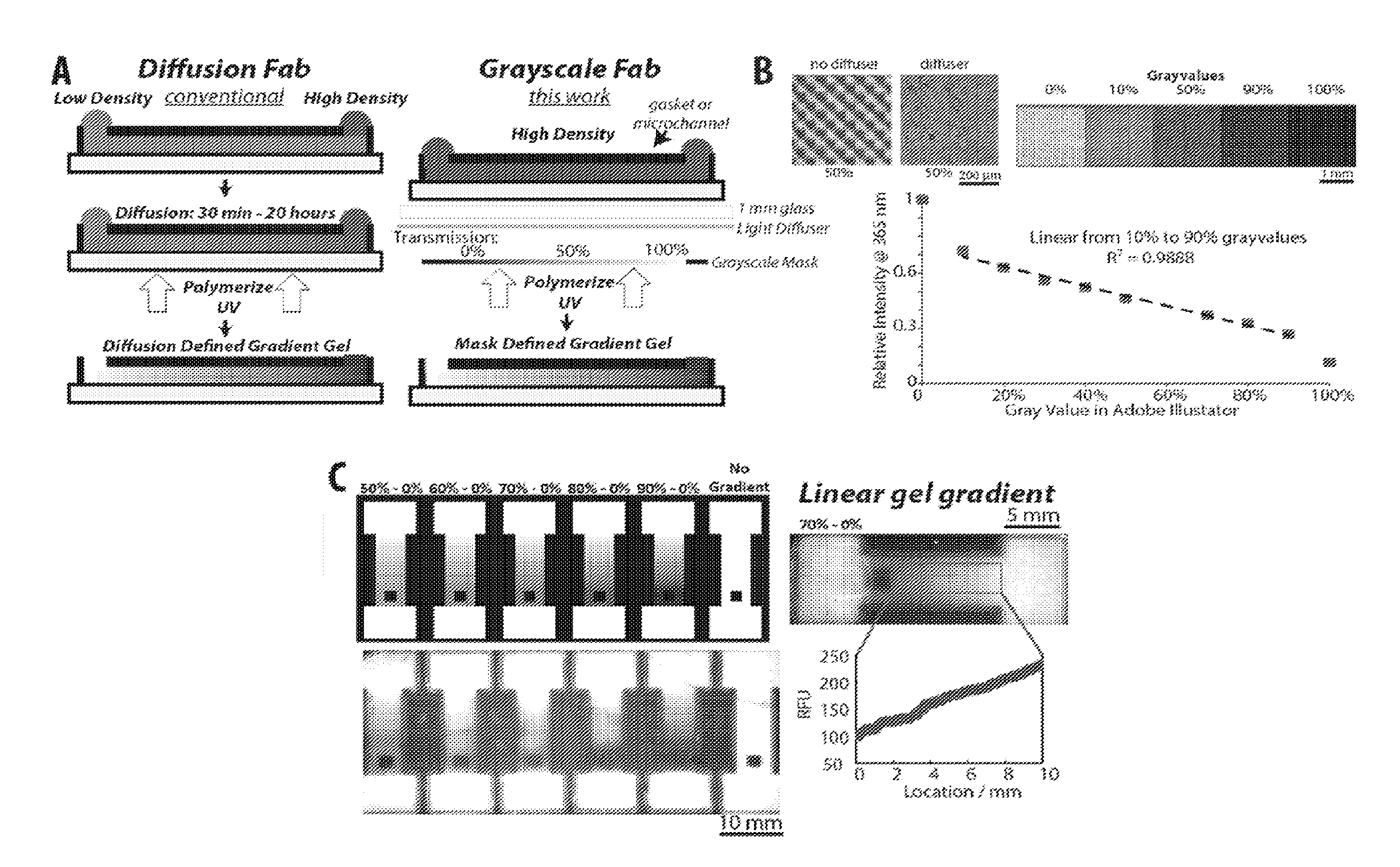
[0136]Experiments were performed to produce, characterize, and test a grayscale mask photopatterning process for producing complex lab-on-a-chip devices for performing protein measurement assays. Non-uniform hydrogels provide an avenue for integration of both preparative and analytical functions (e.g., sample enrichment, high-resolution biomolecular separations, and sample immobilization / capture).

[0137]Hydrogel photopatterning via laser-printed grayscale masks was used to controllably define non-uniform pore-size distributions from a single <60 s UV exposure and acrylamide precursor solution. Grayscale photopatterning was used to produce bioanalytical electrophoresis gels. The process allowed a rapid-turnaround of 15 min from device concept to production. (See, e.g., FIGS. 1A-1C). In some cases, the resolution limit of the printed grayscale dot patterns on the photomask itself was about 30-80 μm dots. (FIG. 1B). A light diffuser was included in the UV light path, thus allowing for t...

example 2

[0138]Experiments were performed using two analytical electrophoresis devices. The first was a 24-plex electrophoresis screening assay (FIGS. 2A-2D). From a single injection, a sample was assayed under 24 discrete gel conditions in a lab-on-a-chip device. The second device included a 96-plex gradient gel-based protein sizing assay (FIGS. 3A-3D) in a free-standing polyacrylamide gel platform. FIG. 12 shows a schematic drawing of a 96-plex gradient gel-based separation device that includes an array of 8 parallel lanes of 12 gradient separation media arranged in series. The black squares of each gradient separation gel represent the sample loading well.

[0139]The 24-plex electrophoresis screening assay was a small circular chip (diameter of a US dime) containing 24 radial channels with a shared central reservoir. For operation, a sample was injected from the central reservoir as a discrete zone into all 24 radial channels using transient isotachophoresis. To produce different gel condit...

example 3

Fabrication of a Chrome Grayscale for 1 mm or Less Spatial Patterning

[0142]To produce a grayscale mask for controllably attenuating light over short length scales (e.g., 1 mm or less), a mask with small binary features was used to produce the desired UV pattern. A chrome mask was produced using the grayscale production strategy (see FIG. 13) to produce masks that minimized the largest feature of the mask (i.e., to minimize the largest opaque feature of the mask). Minimization of the largest feature of the mask facilitated a reduction in micro-patterning (i.e., pixilation) from the grayscale mask instead of UV attenuation. The opaque features of the mask include chrome.

[0143]FIG. 13 (top) shows drawings and accompanying formulae for determining the size of opaque features of a grayscale mask for 0% to 25% grayscale, 25% to 45% grayscale, 45% to 75% grayscale, and 75% to 100% grayscale, according to embodiments of the present disclosure. FIG. 13 (bottom) shows a drawing of an example ...

the structure of the environmentally friendly knitted fabric provided by the present invention; figure 2 Flow chart of the yarn wrapping machine for environmentally friendly knitted fabrics and storage devices; image 3 Is the parameter map of the yarn covering machine
Login to View More

PUM

No PUM Login to View More

Abstract

Provided are methods for producing a separation medium, where the method includes exposing a separation medium precursor solution to light from a light source through a photomask that includes a region with varied light transmittance to produce the separation medium. Systems that find use in performing the methods, microfluidic devices that include the separation medium, as well as methods of using the microfluidic devices, are also provided. Embodiments of the present disclosure find use in a variety of different applications, including detecting whether an analyte is present in a fluid sample.

Description

CROSS-REFERENCE TO RELATED APPLICATION[0001]Pursuant to 35 U.S.C. §119(e), this application claims priority to the filing date of U.S. Provisional Application No. 61 / 881,879, filed on Sep. 24, 2013, the disclosure of which is incorporated herein by reference.REFERENCE TO GOVERNMENT SUPPORT[0002]This invention was made with government support under grant number 1056035 awarded by the National Science Foundation. The government has certain rights in the invention.INTRODUCTION[0003]SDS-PAGE (sodium dodecyl sulfate polyacrylamide gel electrophoresis) is a basic tool widely used in biochemistry, cell and molecular biology, and clinical diagnosis to separate proteins on the sole basis of their size. Protein size determination is achieved through binding of SDS molecules to protein, which covers different proteins with identical negative charges per unit mass.[0004]To achieve diverse functions, lab-on-a-chip devices often include hydrogels with spatially varying properties. Integration of ...

Claims

the structure of the environmentally friendly knitted fabric provided by the present invention; figure 2 Flow chart of the yarn wrapping machine for environmentally friendly knitted fabrics and storage devices; image 3 Is the parameter map of the yarn covering machine
Login to View More

Application Information

Patent Timeline
no application Login to View More
IPC IPC(8): G01N27/447G03F1/32B01L3/00G03F7/20
CPCG01N27/4476G03F7/20G03F1/32B01L3/502753G01N27/44747B01L2200/12G01N27/44726G01N27/44791G01N27/44782B01L2200/10G01N27/44739G03F1/54G03F1/50
Inventor KANG, CHI-CHIHHERR, AMY E.DUNCOMBE, TODD A.
Owner RGT UNIV OF CALIFORNIA
Features
  • R&D
  • Intellectual Property
  • Life Sciences
  • Materials
  • Tech Scout
Why Patsnap Eureka
  • Unparalleled Data Quality
  • Higher Quality Content
  • 60% Fewer Hallucinations
Social media
Patsnap Eureka Blog
Learn More