They are subject to fatigue because the rotor blades are cantilevered from a horizontal generator axis, which subjects them to regular, periodic stresses due to gravity as they rotate.
Fatigue issues are aggravated as the blades get longer and heavier for turbines with
higher power ratings.
Longer rotor blades are also more susceptible to aeroelastic effects, which further contribute to fatigue and can reduce blade life even more.
To counter the effects of fatigue, the blades, and the HAWT
tower carrying them, must be made more robust, which uses more material than would otherwise be necessary and thus increases cost.
Another
disadvantage of HAWTs is that the blade roots have to be mounted at the top of a
tower, sometimes hundreds of feet tall, where they are connected to a generator.
This increases the cost of maintenance and repairs to the generator and its associated machinery.
The elevated location of the generator also complicates HAWT installation offshore because it presents problems in anchoring the base of the
tower, even one of modest height.
Moreover, anchoring a top heavy HAWT tower to the
seabed in relatively shallow water still requires expensive infrastructure that is typically not needed for land-based installations, and is even more challenging in
deep water because the tower must be supported by a free-
floating platform.
The problems encountered with offshore installations, particularly in
deep water locations, are obviously exacerbated as the HAWT is made larger and taller, and thus heavier, to increase power
generating capacity.
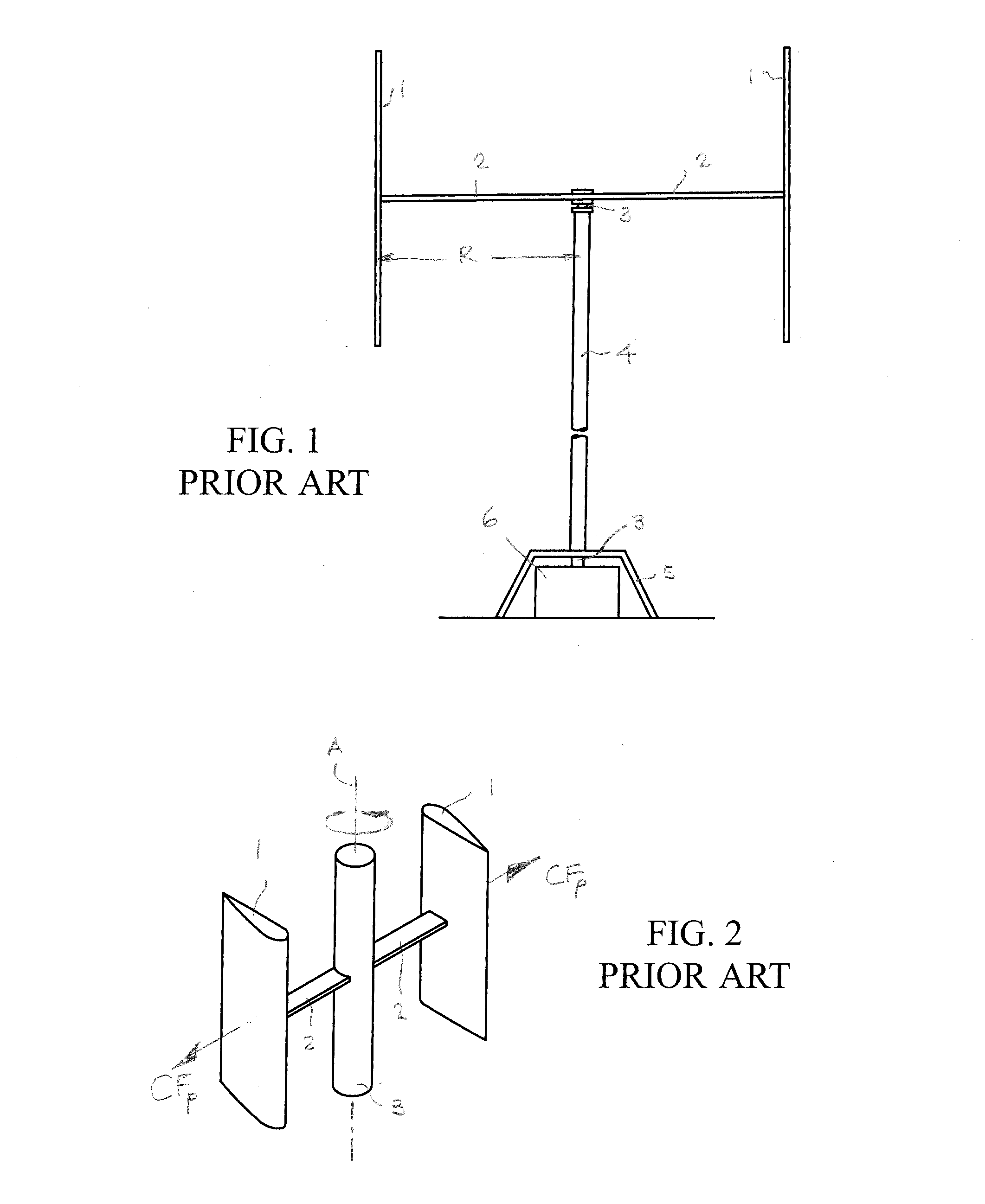
However, lift-driven VAWTs with this type of H-rotor configuration (cantilevered, generally vertical blades rotating about a central axis) present their own design challenges.
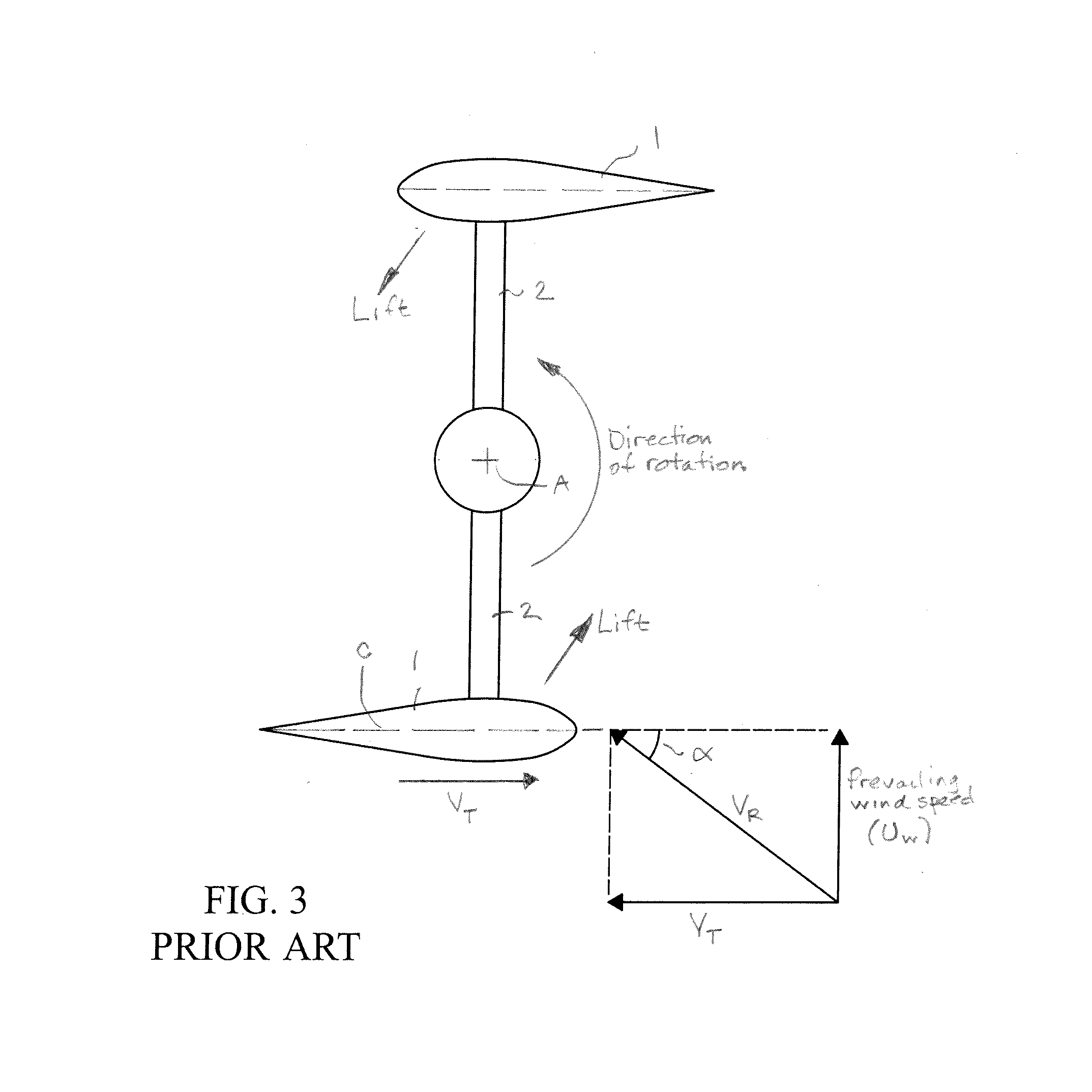
Moreover, the horizontally directed lift generated by the blades varies as they revolve about the axis and present periodically varying angles of
attack to the prevailing wind, thus subjecting them to periodic lift forces that can cause the blades to fatigue.
Making the blades stronger to
resist fatigue failure means also making them heavier, so that the struts supporting the blades against the force of gravity must also be made stronger and thus heavier and more costly.
Additional struts can be used, but that also adds to weight and cost, and complicates the design, particularly if it is desired to incorporate mechanisms to furl the rotor blades.
Large (utility-scale) VAWT technology is not as mature as that for HAWTs, with no systems being offered or produced by existing utility-scale turbine manufacturers.
As a result, VAWTs have not found widespread acceptance for utility scale power generation facilities because a practicable VAWT must be made large enough to approach or exceed the power
generating capacity per
unit cost (including design, construction, and installation) of a comparable HAWT with the same capacity.
This often results in large, costly structures, which may not even be feasible with currently known materials, manufacturing technologies, and construction techniques when applied to the next generation of offshore designs.
However, there are some examples of departures from the traditional design approach.
U.S. Pat. No. 4,293,279 describes a modified H-rotor-type VAWT
system with an oval ring-like blade in which the ring shape is designed to cancel the
bending moment on the blade itself due to
centrifugal force, but it does not address the effects of centrifugal forces on the rest of the structure, nor does it address any design issues relating to weight.
However, this only addresses operational features and does not solve problems, including those discussed above, that have thus far presented a barrier to scaling up VAWTs to sizes which will be more feasible for a wide variety of commercially applications.
The blades are mounted at angles designed to reduce the overturning / tipping moment on the structure and thus improve stability, but this patent does not address structural design problems encountered when attempting to scale up VAWTs to the large sizes required to compete effectively with the presently well entrenched, widespread use of HAWTs.



 Login to View More
  Login to View More