Plasma treatment of liquid surfaces
a technology of liquid surface and plasma treatment, which is applied in the field of plasma treatment of liquid surface, can solve the problems of dramatic change in the wetting behavior of the surface, loss of surface hydrophilicity created by plasma treatment, and undesirable hydrophobic nature of liquid substances such as oils and hydrophobic liquid polymers, etc., and achieves the effects of decreasing the water contact angle, and increasing the surface energy of the liquid
- Summary
- Abstract
- Description
- Claims
- Application Information
AI Technical Summary
Benefits of technology
Problems solved by technology
Method used
Image

Examples
example 1
Exposing Liquid Polydimethylsiloxane to Low-Pressure Plasma
[0300]Sample Preparation:
[0301]Aluminum foil was coated with honeycomb polycarbonate (PC) film, using a fast dip-coating process in a humid environment to obtain a “breath-figures” self-assembly pattern. The Honeycomb PC coating was obtained according to the to procedure described in E. Bormashenko et al., Polym. Adv. Technol. 16 (2005) 299-304 and E. Bormashenko et al., Macromol. Chem. Phys. 209 (2008) 567-576, which are incorporated by reference as if fully set forth herein. The average pore radius was established by AFM to be about 1.5 μm and an average pore depth about 1 μm. The tested liquid polydimethylsiloxane (PDMS) oil was deposited onto the PC porous coating and the thickness of the PDMS layer was established by weighing to be 20±2 μm. An exemplary preparation is depicted in FIGS. 4A and 4B.
[0302]Accurate establishment of the APCA in the case of liquid polymers is not trivial as it has been shown that a water dropl...
example 2
Treatment of Liquids with Atmospheric-Pressure Plasma
[0345]A liquid is applied as a thin layer on a surface, optionally as described in Example 1, and is exposed to atmospheric-pressure plasma jet.
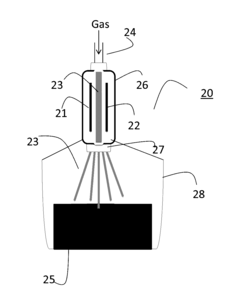
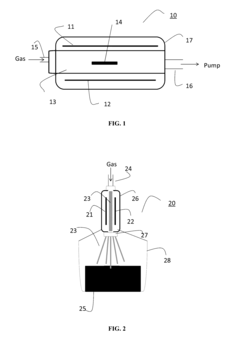
[0346]Atmospheric-pressure cold plasma is applied using a plurality of plasma jets aligned so as to cover a larger area of the liquid surface. The liquid layer is exposed to for a time period ranging from 0.1 seconds to 600 seconds at a temperature in a range of from 0 to 100° C. The plasma is generated by capacitance DC air plasma discharge. An exemplary set-up is depicted in FIG. 2.
[0347]Alternatively, the liquid is placed in a plasma chamber and is exposed to atmospheric-pressure cold plasma for a time period ranging from 0.1 to 600 seconds at a temperature in a range of from 0 to 100° C. The plasma is generated by capacitance air plasma discharge with a power of 0.1-1000 watt.
[0348]APCA measurements of the treated and non-treated liquids are performed as exemplified in Example 1. The e...
example 3
Treatment of liquid Droplets with Atmospheric-Pressure Plasma
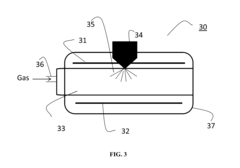
[0349]Aerosol droplets of a liquid is generated, optionally using a nebulizer, and the oil droplets are directed into an atmospheric-pressure plasma chamber, as depicted in FIG. 3, as a non-limiting example.
[0350]The liquid droplets in the chamber are exposed to plasma for approximately 30 seconds at a temperature in a range of from 0 to 100° C., generated by capacitance air plasma discharge with a power of 0.1-1000 watt.
[0351]The effect of plasma on droplets is optionally determined by the comparative measurement of the apparent contact angle of droplets upon contact with a surface (optionally a surface of water, such that the measured contact angle is a water contact angle), before and after the atmospheric-pressure plasma treatment.
PUM
| Property | Measurement | Unit |
|---|---|---|
| time period | aaaaa | aaaaa |
| viscosity | aaaaa | aaaaa |
| Tm | aaaaa | aaaaa |
Abstract
Description
Claims
Application Information
 Login to View More