
Substituted aminoquinazoline compounds as a2a antagonist
a technology of aminoquinazoline and compound, which is applied in the field of substituted aminoquinazoline compounds as a2a antagonist, can solve the problems that the motor complications of parkinson's disease therapy are often progressively more severe with continued treatmen
- Summary
- Abstract
- Description
- Claims
- Application Information
AI Technical Summary
Benefits of technology
Problems solved by technology
Method used
Image

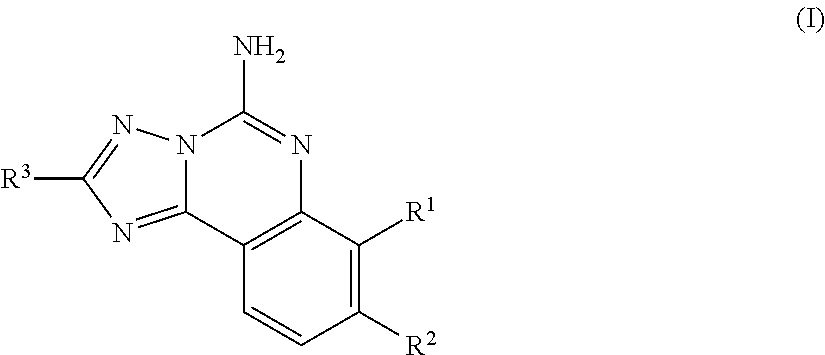
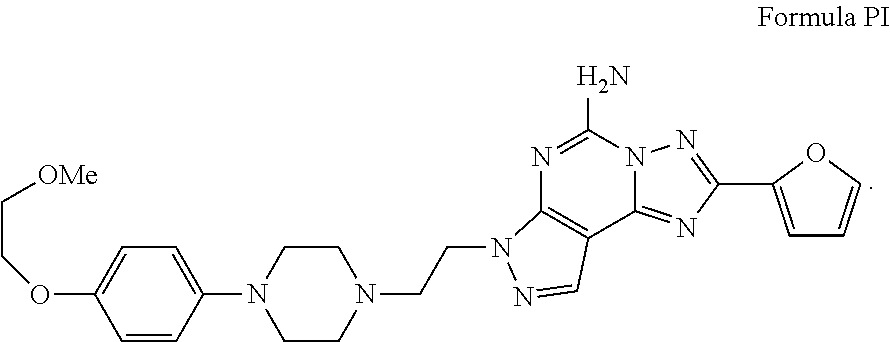
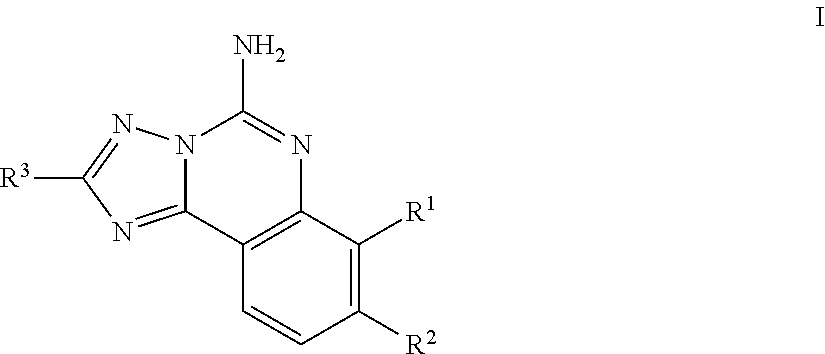
Examples
example 1
[0124]
(R)-7-methoxy-2-(1-(3,3,3-trifluoropropyl)piperidin-3-yl)-[1,2,4]triazolo[1,5-d]quinazolin-5-amine
Step 1: (R)—N-(2,4-dimethoxybenzyl)-7-methoxy-2-(piperidin-3-yl)-[1,2,4]triazolo[1,5-c]quinazolin-5-amine
[0125]To a dichloromethane solution (300 mL) of tert-butyl (R)-3-(5-((2,4-dimethoxybenzyl)amino)-7-methoxy-[1,2,4]triazolo[1,5-c]quinazolin-2-yl)piperidine-1-carboxylate (13.4 g, 24 mmol) at 0° C. was added dropwise trifluoroacetic acid (30 mL). After the addition was completed, the reaction mixture was stirred at room temperature for 4 hours. The solution was washed with aqueous saturated sodium hydrogencarbonate solution (200 mL×3) and brine (200 mL). The organic layer was concentrated. To the residue was added dichloromethane (20 mL) and diethyl ether (100 mL), and then the resulting suspension was stirred at room temperature and filtered to obtain a solid. The solid was washed again using a mixture of dichloromethane (20 mL) and ether (100 mL), and dried in vacuo to afford ...
example 12
[0129]
(S)-7-methoxy-2-(1-(3,3,3-trifluoropropyl)piperidin-3-yl)-[1,2,4]triazolo[1,5-c]quinazolin-5-amine
[0130]The title compound was made by following the procedures described in EXAMPLE 1, substituting a racemic mixture of tert-butyl 3-(5-((2,4-dimethoxybenzyl)amino)-7-methoxy-[1,2,4]triazolo[1,5-c]quinazolin-2-yl)piperidine-1-carboxylate for the (R)-enantiomer in step 1 and separating the enantiomers of the final product through chiral preparative SFC. LC / MS=395 [M+1]. R-enantiomer: RT=3.35 min (AD-H column (4.6*250 mm, 5 m); ethanol (0.1% diethylamine) 0.6 mL / min; supercritical carbon dioxide 2.4 mL / min). S-enantiomer: RT=3.68 min (AD-H column (4.6*250 mm, 5 m); ethanol (0.1% diethylamine) 0.6 mL / min; supercritical carbon dioxide 2.4 mL / min).
example 13
[0131]
(R)-7-methoxy-2-(piperidin-3-yl)-[1,2,4]triazolo[1,5-c]quinazolin-5-amine
[0132]The title compound was made by following the procedures described in Step 3 for EXAMPLE 1, substituting (R)—N-(2,4-dimethoxybenzyl)-7-methoxy-2-(piperidin-3-yl)-[1,2,4]triazolo[1,5-c]quinazolin-5-amine for (R)—N-(2,4-dimethoxybenzyl)-7-methoxy-2-(1-(3,3,3-trifluoropropyl)piperidin-3-yl)-[1,2,4]triazolo[1,5-c]quinazolin-5-amine. LC / MS=299 [M+1]. 1H-NMR (CD3OD-d4, 400 MHz) δ 7.90-7.88 (m, 1H), 7.41 (t, 1H), 7.33-7.31 (m, 1H), 4.04 (s, 3H), 3.77-3.75 (m, 1H), 3.63-3.56 (m, 2H), 3.42-3.37 (m, 1H), 3.24-3.18 (m, 1H), 2.42-2.37 (m, 1H), 2.14-2.03 (m, 2H), 1.97-1.91 (m, 1H).
PUM
 Login to View More
 Abstract
Description
Claims
Application Information
 Login to View More