Apparatus and cosmetic method for treating hyperhidrosis

a technology of cosmetic method and hyperhidrosis, applied in the field of cosmetic method for treating hyperhidrosis, can solve the problems of complex mechanisms, increased probability of necrotic processes, and denature of cellular proteins,

a technology of cosmetic method and hyperhidrosis, applied in the field of cosmetic method for treating hyperhidrosis, can solve the problems of complex mechanisms, increased probability of necrotic processes, and denature of cellular proteins,

US20190022405A1Pending Publication Date: 2019-01-24LUMENIS BE LTD

Image

Smart Image Click on the blue labels to locate them in the text.
Viewing Examples
Smart Image
  • Apparatus and cosmetic method for treating hyperhidrosis
  • Apparatus and cosmetic method for treating hyperhidrosis
  • Apparatus and cosmetic method for treating hyperhidrosis

Examples

Experimental program
Comparison scheme
Effect test

Embodiment Construction

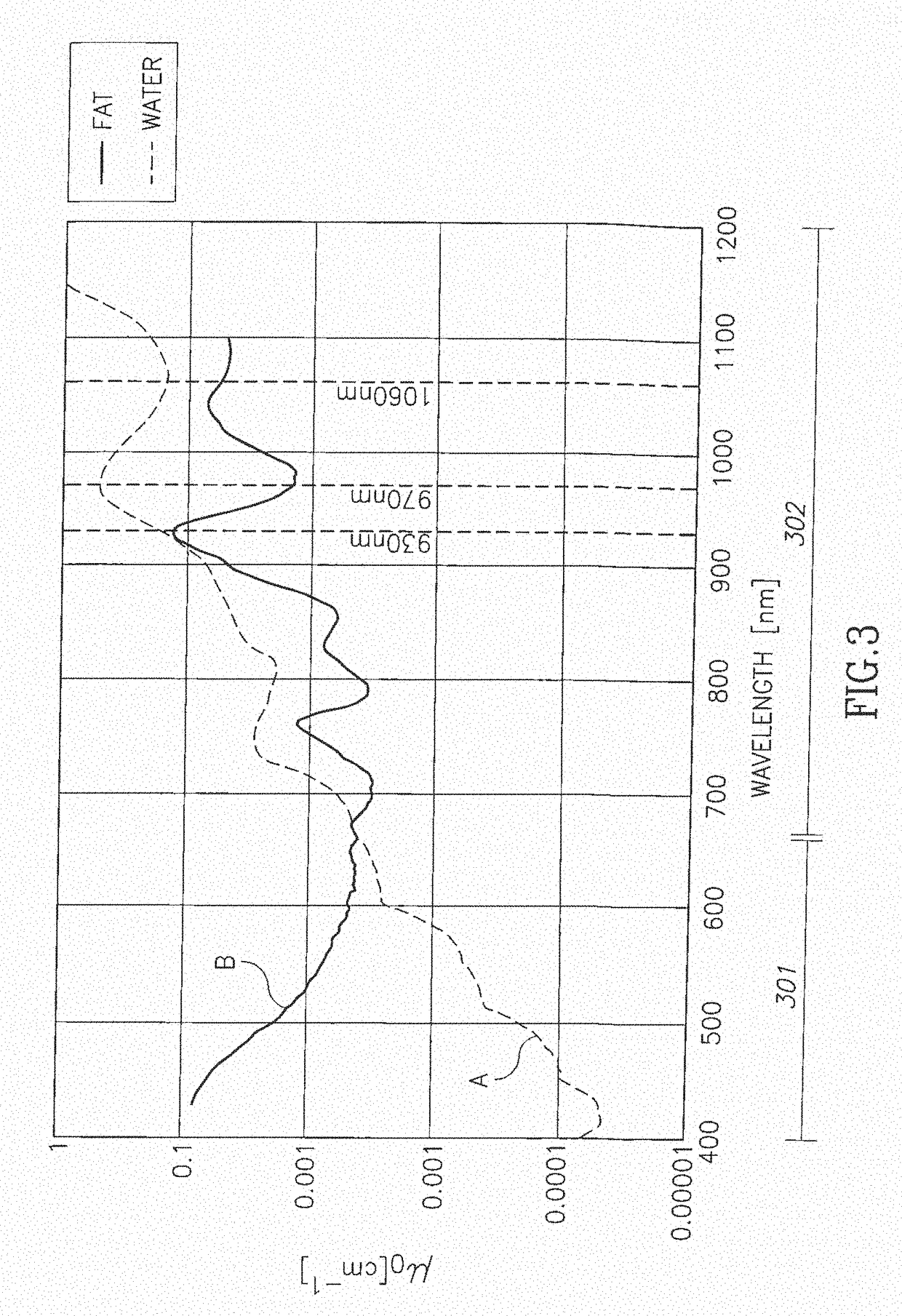
[0042]In the present invention, a non-invasive treatment of hyperhidrosis is accomplished by means of an external laser source. The objective is to cause selective thermally induced necrosis and / or apoptosis of sweat gland while maintain the surrounding tissue intact. As mentioned above, there are several methods to obtain that objective. The key element to proper selective treatment is the relative absorption of electromagnetic radiation by the various tissue components. FIG. 3 presents plots A and B of the spectral behavior of light absorption for fat and water respectively. As can be seen in FIG. 3, around wavelengths 650 nm-660 nm there is an isosbestic point 300 between fat and water. In region 301, at wavelengths shorter than that of the isosbestic wavelengths, fat absorption is higher than water absorption. In region 302, at wavelengths longer than that of the isosbestic wavelengths, water absorption is higher than fat absorption. As will be explained in more detail below, ac...

the structure of the environmentally friendly knitted fabric provided by the present invention; figure 2 Flow chart of the yarn wrapping machine for environmentally friendly knitted fabrics and storage devices; image 3 Is the parameter map of the yarn covering machine
Login to View More

PUM

No PUM Login to View More

Abstract

A cosmetic method for treating a human body to reduce hyperhidrosis includes applying laser light energy to one or more portions of the human body in which the laser light energy is one or more of: about 450 nm, about 930 nm, about 970 nm and about 1060 nm. An apparatus for accomplishing this method includes a source of laser light energy and a controller for controlling the laser light source to apply laser light energy to target and disrupt sweat glands in the human body.

Description

FIELD OF THE INVENTION[0001]The present invention relates to an apparatus and a cosmetic method for treating hyperhidrosis with light-based treatments.BACKGROUND OF THE PRESENT INVENTION[0002]Photothermal Treatment[0003]The treatment of the human body with energy sources (such as IPL, laser, Ultrasound or RF) usually induces an increase in the temperature of selected tissues, causing cellular proteins to denature, aggregate, and lose their biological activity. This in turn leads eventually to cell necrosis and / or apoptosis. The complexity of metabolic and regulatory pathways used by living cells leads to complex mechanisms during the necrotic and / or apoptotic process as well. Some studies conclude that the lipid bilayer, and perhaps some membrane-bound ATPase enzymes, are the macromolecules most likely implicated in thermal damage. (Despa, F., Orgill, D. P., Neuwalder, J., Lee, R. C., “The relative thermal stability of tissue macromolecules and cellular structure in burn injury,” Bu...

Claims

the structure of the environmentally friendly knitted fabric provided by the present invention; figure 2 Flow chart of the yarn wrapping machine for environmentally friendly knitted fabrics and storage devices; image 3 Is the parameter map of the yarn covering machine
Login to View More

Application Information

Patent Timeline
24 Jan 2019
Publication
US20190022405A1
IPC
A61N5/06; A61N7/02; A61N1/40; A61N5/02
CPC
A61N5/0616; A61N7/02; A61N1/403; A61N5/025; A61N5/0625; A61N2005/067; A61N2005/007; A61N2005/0649
Inventors
GREENBAUM, LIOR; SCHUSTER, ISRAEL