Unlock instant, AI-driven research and patent intelligence for your innovation.

Optimal inductor

a technology of inductance and inductance core, applied in the direction of transformer/inductance coil/winding/connection, inductance with magnetic core, etc., can solve the problems of stray fields, hard cooling of hot spots, and harmful harmonic distortion of power electronics, so as to reduce the demand for small mechanical tolerances, reduce stray fields, and increase the magnetic flow

Inactive Publication Date: 2020-07-30
COMSYS
View PDF6 Cites 0 Cited by
  • Summary
  • Abstract
  • Description
  • Claims
  • Application Information

AI Technical Summary

Benefits of technology

The design results in a more efficient, compact, and cost-effective inductor with reduced energy losses and improved performance across frequencies, while maintaining low temperatures to extend insulation life and enhance magnetic permeability.

Problems solved by technology

An especially problematic area has been in applications where the inductor must handle at the same time a fundamental frequency of e.g. 50 Hz while at the same time filter away from the final signal higher frequencies generated by i.e. switch mode power supplies.
Similarly, power electronics often give source to harmful harmonic distortions which have become one of the greatest concerns for the power quality industry today.
This gives source to magnetic leak flow, energy losses and heating of the surrounding metal.
If the coil is wound over the air gaps there will often be considerable fringing losses, resulting in a hot-spot which can be hard to cool.
This inevitably leads to limitations in design freedom resulting in ineffective and un-optimized inductor designs.
In addition, many problems are still present with inductors depending on the material choices in terms of energy losses, heat and hot-spot problems, annoying sound, caused by high currents at audible frequencies, unnecessary and ineffective material usage, lower efficiency at higher frequencies, and saturation at low flux intensity, etc.
High performing inductors are also relatively expensive.
The compression may further lead to plastic deformation of the conducting material.

Method used

the structure of the environmentally friendly knitted fabric provided by the present invention; figure 2 Flow chart of the yarn wrapping machine for environmentally friendly knitted fabrics and storage devices; image 3 Is the parameter map of the yarn covering machine
View more

Image

Smart Image Click on the blue labels to locate them in the text.
Viewing Examples
Smart Image
  • Optimal inductor
  • Optimal inductor
  • Optimal inductor

Examples

Experimental program
Comparison scheme
Effect test

Embodiment Construction

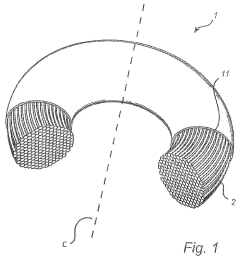
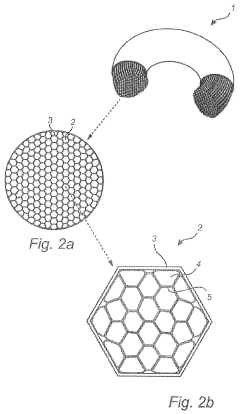
[0038]FIG. 1 shows a perspective view of a coil 1 for an inductor. The coil 1 is torus shaped and is built up by a wounded wire 2, better seen in the cross section of the coil shown in FIG. 2a. The coil is coated or wound with an insulated layer 11. In FIG. 2a it can be seen how the wire 2 has an insulating layer 3, and how the wire laps in the coil 1 have been compressed so that the shape of each inner wire lap is hexagonal, filling substantially all space, so that voids are reduced substantially. FIG. 2a further shows how the external wire layer of the coil is formed after the desired toroidal shape of the total coil so that the external wire layer follows the smooth toroidal torus shape of the coil 1. FIG. 2b shows an enlarged view of the cross sectional view of FIG. 2a showing the strands 4 of the wire 2. The strands 4 of the wire 2 are coated with a thin layer 5 of e.g. a polymer or resin to insulate the strands from one another.

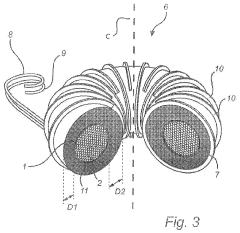
[0039]FIG. 3 is a perspective view of an inductor...

the structure of the environmentally friendly knitted fabric provided by the present invention; figure 2 Flow chart of the yarn wrapping machine for environmentally friendly knitted fabrics and storage devices; image 3 Is the parameter map of the yarn covering machine
Login to View More

PUM

PropertyMeasurementUnit
frequenciesaaaaaaaaaa
isostatic pressureaaaaaaaaaa
thermal heat conductionaaaaaaaaaa
Login to View More

Abstract

A coil may include a metal wire wound circular around a center axis. The wire may have an electrically insulating layer insulating each turn of the wire in the winding from neighbouring turns. The shape of the complete winding, building up the coil, may be toroidal having an elliptic cross section in a plane perpendicular to a wire winding direction. And the wound coil may have a metal volume to total volume at a level so that the thermal heat conduction of the coil is above 0.8 W / m*K. A method for producing such a coil may involve applying the insulating layer to the wire. The wire may be wound around the center axis. The winding may be compressed to a toroidal shape.

Description

[0001]This application is a divisional application of U.S. patent application Ser. No. 14 / 419,516 filed on Feb. 4, 2015, which is a US National Stage Application of International Application No. PCT / EP2013 / 068682 filed on Sep. 10, 2013, which claims priority under 35 USC 119(a)-(d) to EP Patent Application No. filed 12184479.9 filed on Sep. 14, 2012, the entire content of all three of which are incorporated herein by reference.TECHNICAL FIELD[0002]The present invention relates generally to an optimal inductor design. More particularly, the present invention relates to a coil for an inductor, a core for an inductor, and an inductor comprising that coil and that core. The invention further relates to a method for producing said coil and said core.BACKGROUND ART[0003]With the ever growing power electronics industry, inductors have become increasingly important in applications such as power generation, power quality, AC drives, regenerative drives etc. Inductors are often key components...

Claims

the structure of the environmentally friendly knitted fabric provided by the present invention; figure 2 Flow chart of the yarn wrapping machine for environmentally friendly knitted fabrics and storage devices; image 3 Is the parameter map of the yarn covering machine
Login to View More

Application Information

Patent Timeline
no application Login to View More
Patent Type & Authority Applications(United States)
IPC IPC(8): H01F5/06H01F3/08H01F5/00H01F17/04H01F27/255H01F27/28H01F41/02H01F41/12H01F41/073H01F27/32
CPCH01F17/04Y10T29/49071H01F27/2876H01F27/2823H01F5/00H01F5/06H01F41/0273H01F41/12H01F41/073H01F41/0246H01F27/32H01F27/255H01F3/08
Inventor BJARNASEN, ÓSCAR H.CEDELL, TORD
Owner COMSYS