Kit for detecting soluble growth stimulation expressed gene 2 protein
a technology of soluble growth stimulation and kit, which is applied in the field of latex-enhanced turbidimetric immunoassay kit, can solve problems such as the devastation of the immune system of patients
- Summary
- Abstract
- Description
- Claims
- Application Information
AI Technical Summary
Benefits of technology
Problems solved by technology
Method used
Image

Examples
example 1
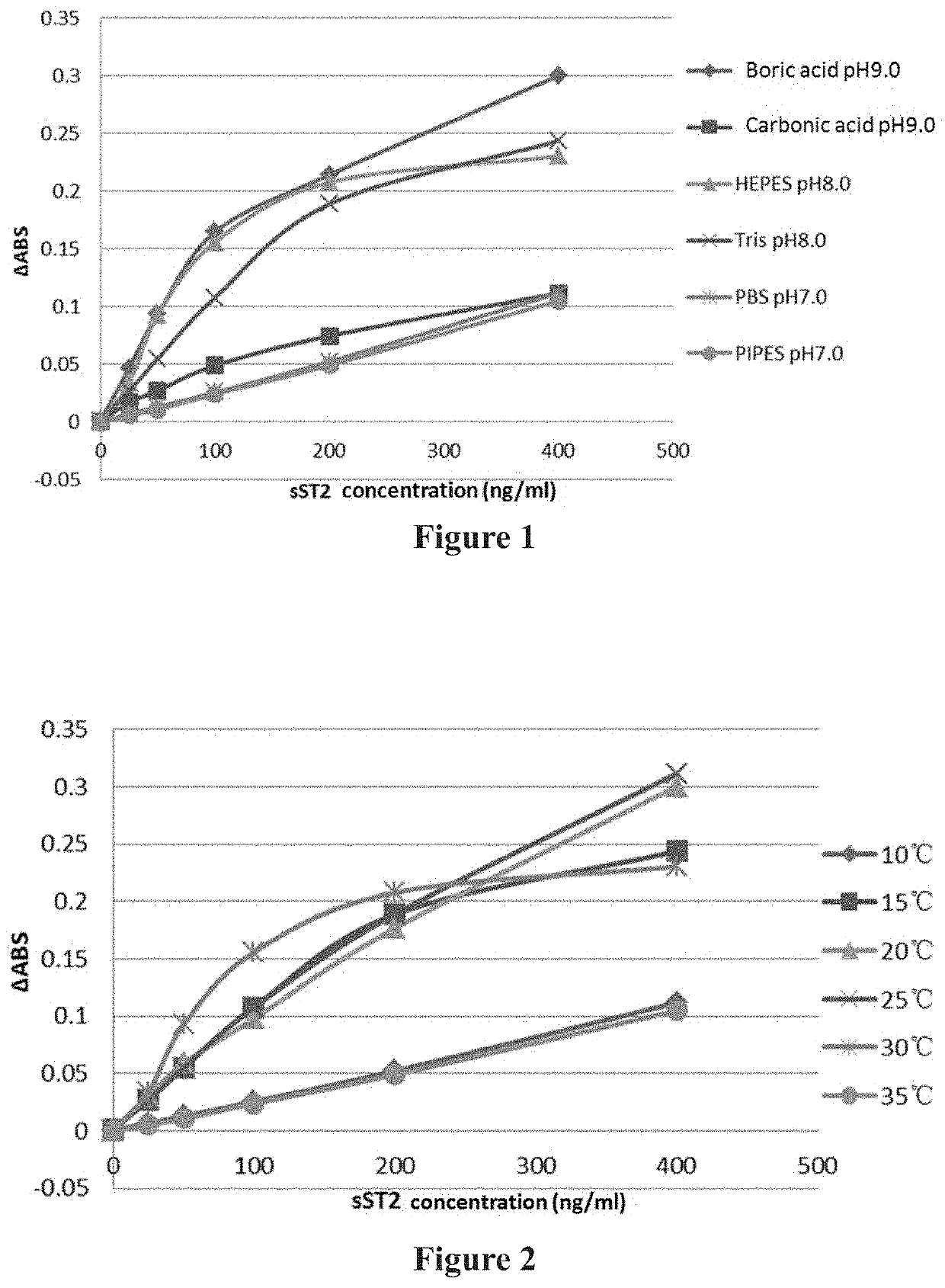
ts of Buffer and pH on the Absorbance of Reagents
[0077]1. The first reagent:[0078]200 mmol / L sodium chloride,[0079]1% surfactant (Triton X 100),[0080]0.1% sodium azide,[0081]100 mmol / l HPEPS buffer, pH 8.0,[0082]the first reagent was a colorless or slightly yellow transparent liquid.
[0083]2. The second reagent:
[0084]Methods of Preparation:
[0085](1) each of 0.5 mL latex microspheres with a particle size of 400 nm was added to 4.5 mL of boric acid pH 9.0, carbonic acid pH 9.0, HEPES pH 8.0, Tris pH 8.0, PBS pH 7.0 or HEPES pH 7.0 buffers, respectively, to obtain latex microsphere suspensions;
[0086](2) each of 1 mg anti-sST2 monoclonal antibody was added to 4.5 mL of boric acid pH 9.0, carbonic acid pH 9.0, HEPES pH 8.0, Tris pH 8.0, PBS pH 7.0 or HEPES pH 7.0 buffers, respectively, to obtain antibody solutions;
[0087](3) the antibody solutions and the latex microsphere suspensions were mixed at 20° C. by mixing and shaking for 8 hours;
[0088](4) 25 mg carbodiimide was dissolved in 8 mL ...
example 2
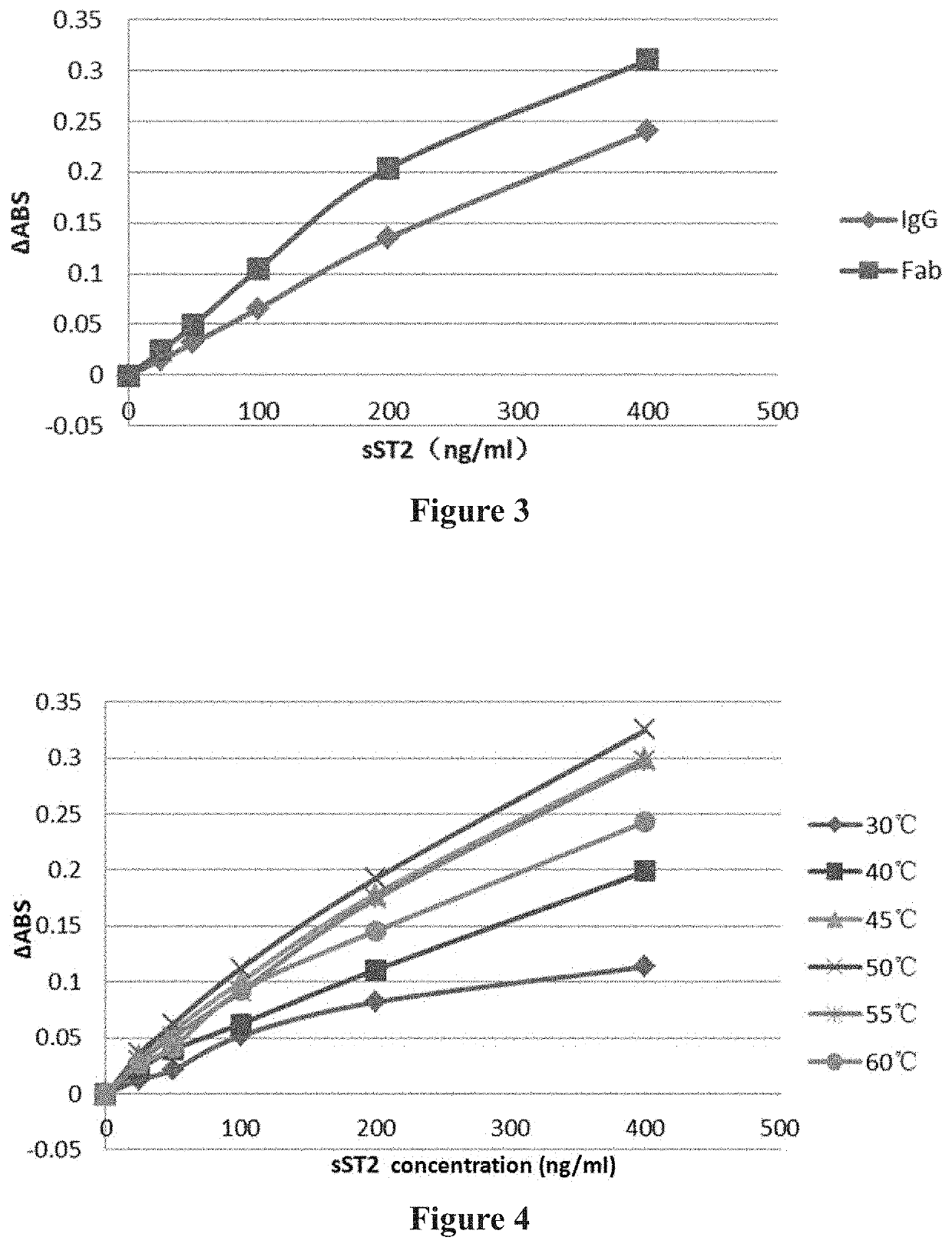
ts of Different Temperatures on the Absorbance of Reagents
[0105]1. The first reagent: same with Example 1.
[0106]2. The second reagent:
[0107](1) each of 0.5 mL latex microspheres with a particle size of 400 nm was added to 4.5 mL boric acid pH 9.0 buffer, respectively, to obtain latex microsphere suspensions;
[0108](2) each of 1 mg anti-sST2 monoclonal antibody was added to 4.5 mL boric acid pH 9.0 buffer, respectively, to obtain antibody solutions;
[0109](3) each of 2 ml of the antibody solutions and the latex microsphere suspensions were mixed at 10° C., 15° C., 20° C., 25° C., 30° C. and 35° C., respectively, by mixing and shaking for 8 hours;
[0110](4) to (7) were the same with Example 1;
[0111](8) the supernatant was removed, and each of 10 ml working solution was added (100 mmol / L HEPES buffer pH 8.0, 0.1% NaCl, 1% sucrose and 0.1% NaN3);
[0112](9) resuspended for later use.
[0113]3. Calibrator(s) and control material(s):
[0114]same with Example 1.
[0115]4. Detection:
[0116]According to...
example 3
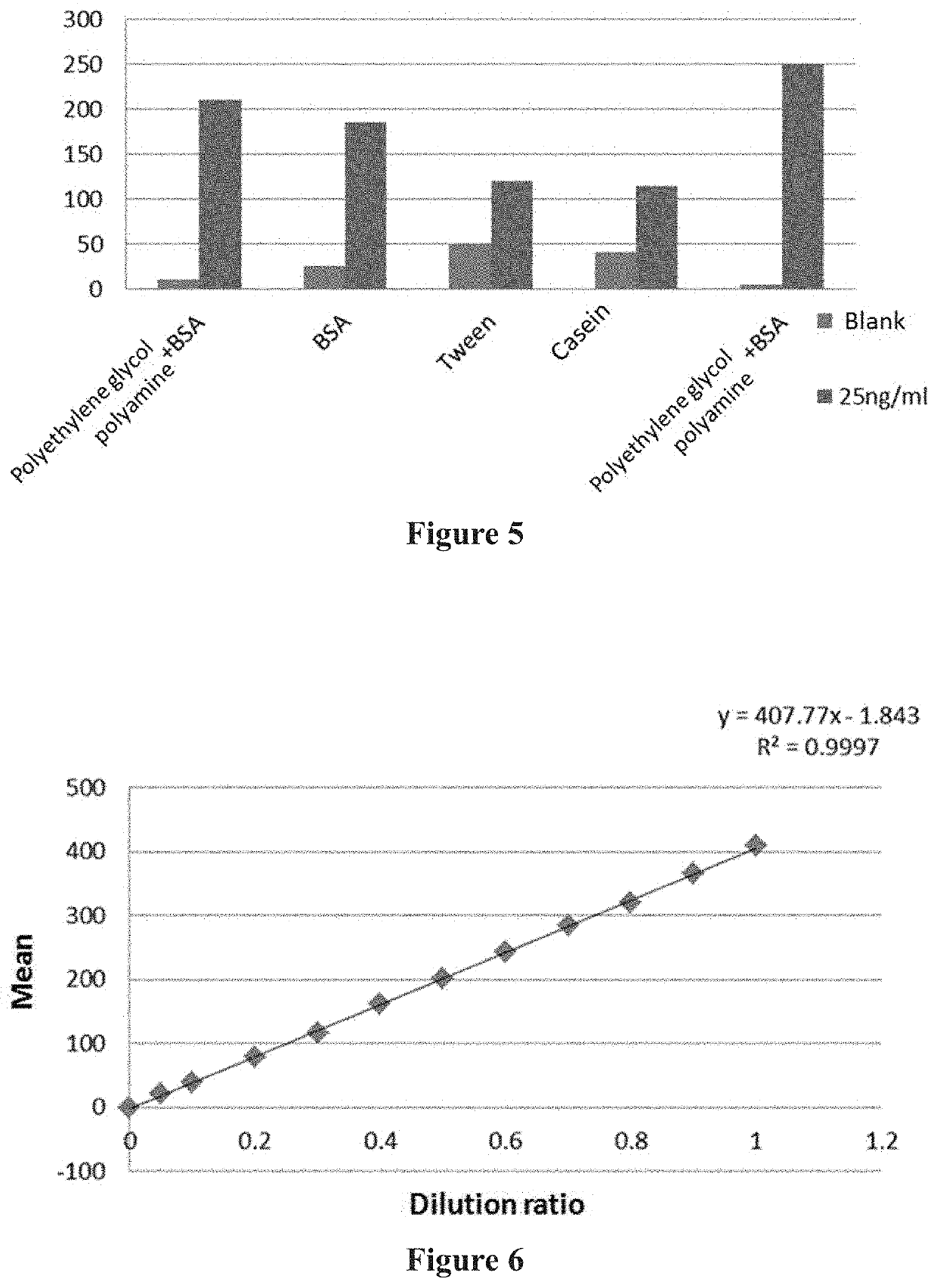
ation Effects of Different Temperatures on the Functional Groups of Latex
[0117]1. The first reagent: same with Example 1.
[0118]2. The second reagent:
[0119]Methods of Preparation:
[0120](1) same with Example 2;
[0121](2) same with Example 2;
[0122](3) the antibody solutions and the latex microsphere suspensions were mixed and shaken at 25° C. for 8 hours;
[0123](4) same with Example 1;
[0124](5) the carbodiimide aqueous solution was added to the mixed solution of step (3), and each of 2 ml mixed solutions was placed at 30° C., 40° C., 45° C., 50° C., 55° C. and 60° C. for reaction and activation for 4 hours to obtain completely cross-linked latex-antibody suspensions;
[0125](6) to (8) were the same with Example 2;
[0126](9) resuspended for later use.
[0127]3. Calibrator(s) and control material(s): same with Example 1.
[0128]4. Detection:
[0129]According to FIG. 3, it was shown that EDC at different temperatures had different activation effects on the latex functional groups (for example carbox...
PUM
 Login to View More
 Abstract
Description
Claims
Application Information
 Login to View More