Check patentability & draft patents in minutes with Patsnap Eureka AI!

Treating main memory as a collection of tagged cache lines for trace logging

a trace logging and main memory technology, applied in the direction of memory adressing/allocation/relocation, instruments, error detection/correction, etc., can solve the problems of slow execution performance, inability to find trace loggers, so as to reduce the size of replayable execution traces, reduce the number of cache influxes, and reduce the size of execution traces

Pending Publication Date: 2022-08-25
MICROSOFT TECH LICENSING LLC
View PDF14 Cites 1 Cited by
  • Summary
  • Abstract
  • Description
  • Claims
  • Application Information

AI Technical Summary

Benefits of technology

The patent describes a method for reducing the size of executable traces by using cache-based trace logging. The method involves logging the influx of cache lines into a first cache level using tags in a higher memory tier. During the influx, the method checks whether the value of a cache line can be reconstructed from prior trace logging. If the value is already captured, the method refrains from recording the current value in the execution trace. This reduces the size of the execution trace and the processor utilization for carrying out the recording. Additionally, the method treats main memory as a collection of tagged cache lines for trace logging, which increases the number of values that can be tracked as being previously captured. This further reduces the size of the execution trace.

Problems solved by technology

Undesired software behaviors can include many things, such as execution crashes, runtime exceptions, slow execution performance, incorrect data results, data corruption, and the like.
Given the variety of triggers, undesired software behaviors are often rare and seemingly random, and extremely difficult to reproduce.
As such, it is often very time-consuming and difficult for a developer to identify a given undesired software behavior.
Once an undesired software behavior has been identified, it is again often time-consuming and difficult to determine its root cause (or causes).
However, since modern processors commonly execute at the rate of tens- to hundreds- of thousands of MIPS (millions of instructions per second), replayable execution traces of a program's thread can capture vast amounts of information, even if mere fractions of a second of the thread's execution are captured.
As such, replayable execution traces quickly grow very large in size in memory and / or on disk.

Method used

the structure of the environmentally friendly knitted fabric provided by the present invention; figure 2 Flow chart of the yarn wrapping machine for environmentally friendly knitted fabrics and storage devices; image 3 Is the parameter map of the yarn covering machine
View more

Image

Smart Image Click on the blue labels to locate them in the text.
Viewing Examples
Smart Image
  • Treating main memory as a collection of tagged cache lines for trace logging
  • Treating main memory as a collection of tagged cache lines for trace logging
  • Treating main memory as a collection of tagged cache lines for trace logging

Examples

Experimental program
Comparison scheme
Effect test

Embodiment Construction

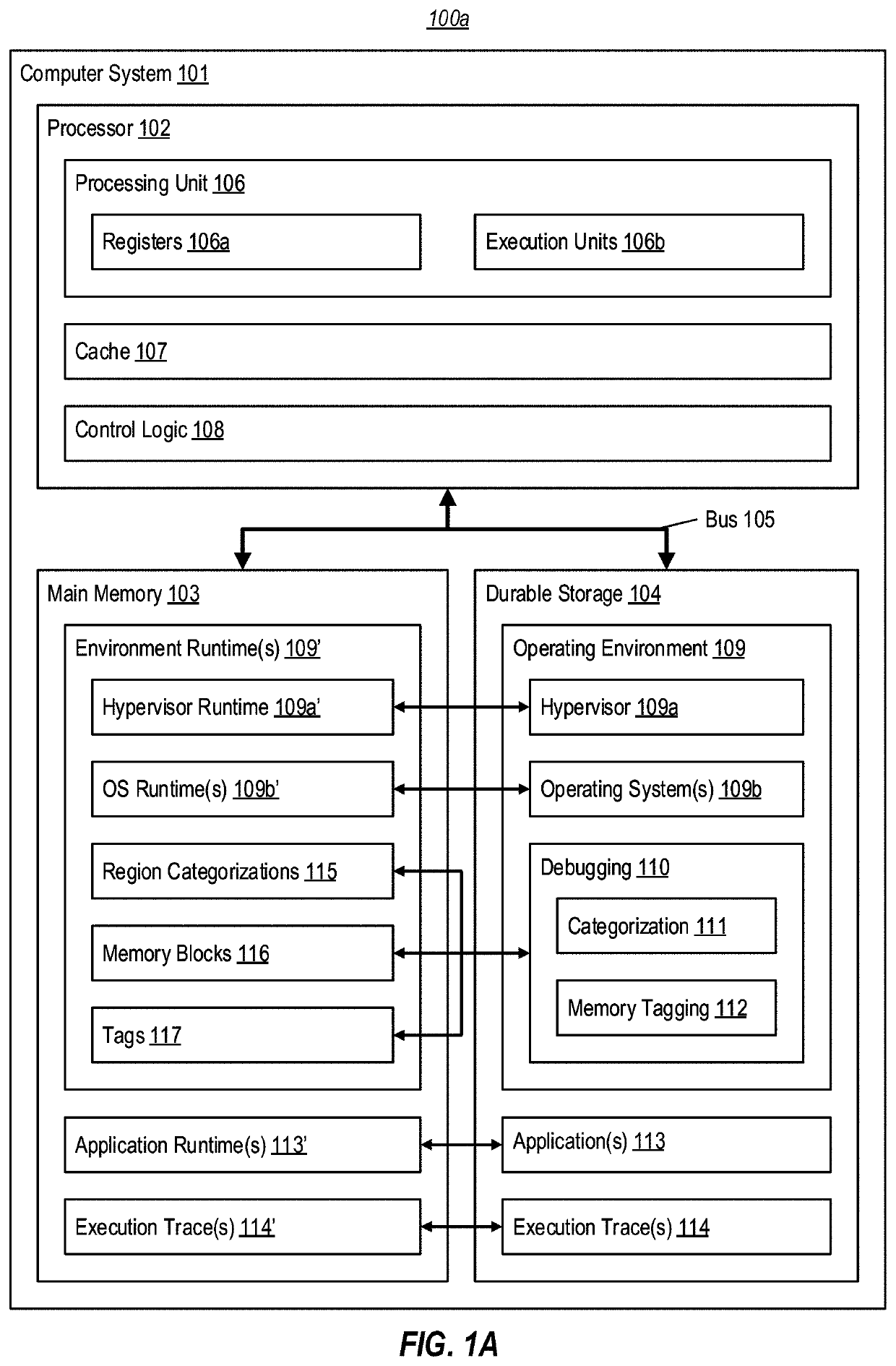
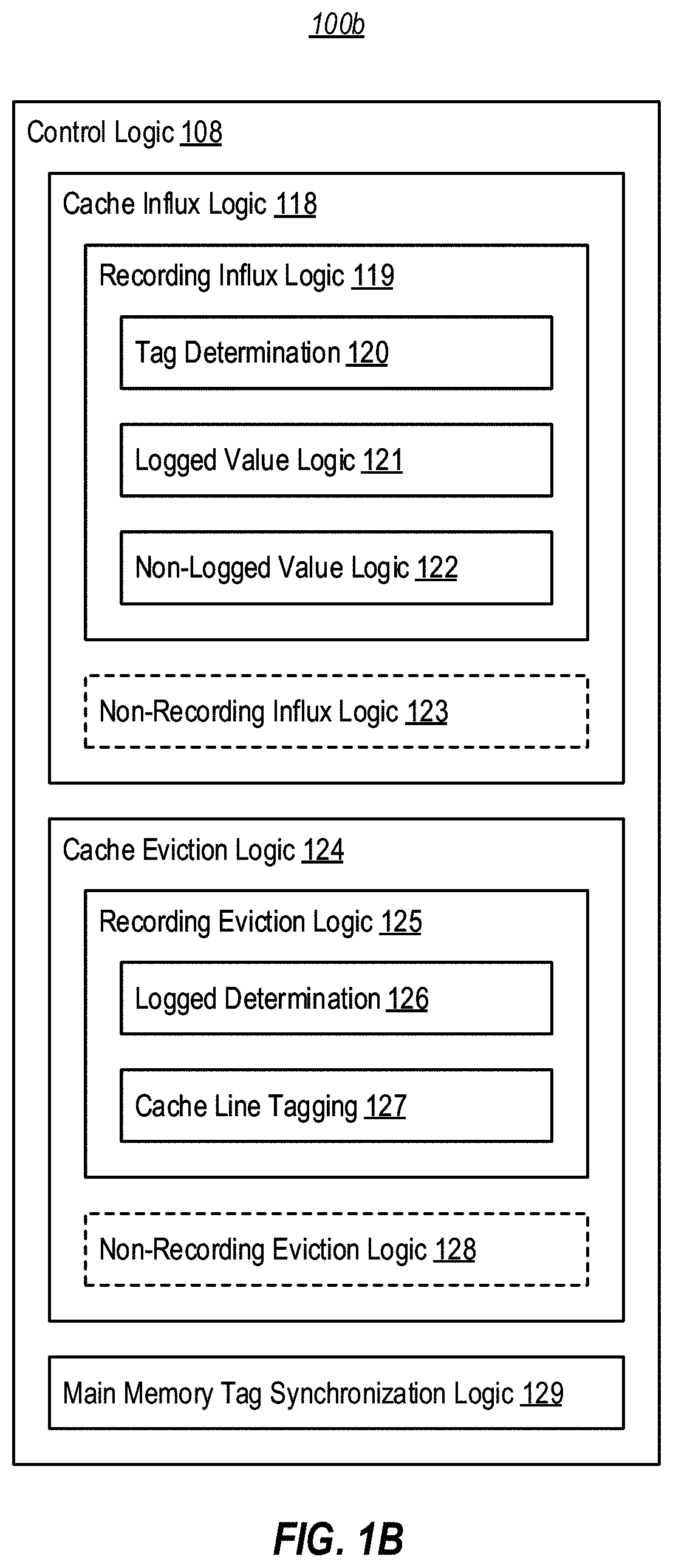
[0021]At least some embodiments described herein reduce the size of replayable execution traces by performing cache-based trace logging using tags in a higher memory tier. In general, these embodiments operate to log influxes to a recording first cache level, but leverage tags within a higher memory tier to track whether a value of a given cache line influx is already captured by an execution trace (or is otherwise recoverable). In some embodiments, during an influx of a cache line to the first cache level, tracing logic consults a tag in the higher memory tier to determine if the value that is being influxed can be reconstructed from prior trace logging, such as trace logging performed in connection with a prior influx of the cache line to the first cache level. If so, these embodiments refrain from capturing a current value of the cache line into the execution trace when influxing the cache line to the first cache level. Additionally, during evictions from the first cache level, t...

the structure of the environmentally friendly knitted fabric provided by the present invention; figure 2 Flow chart of the yarn wrapping machine for environmentally friendly knitted fabrics and storage devices; image 3 Is the parameter map of the yarn covering machine
Login to View More

PUM

No PUM Login to View More

Abstract

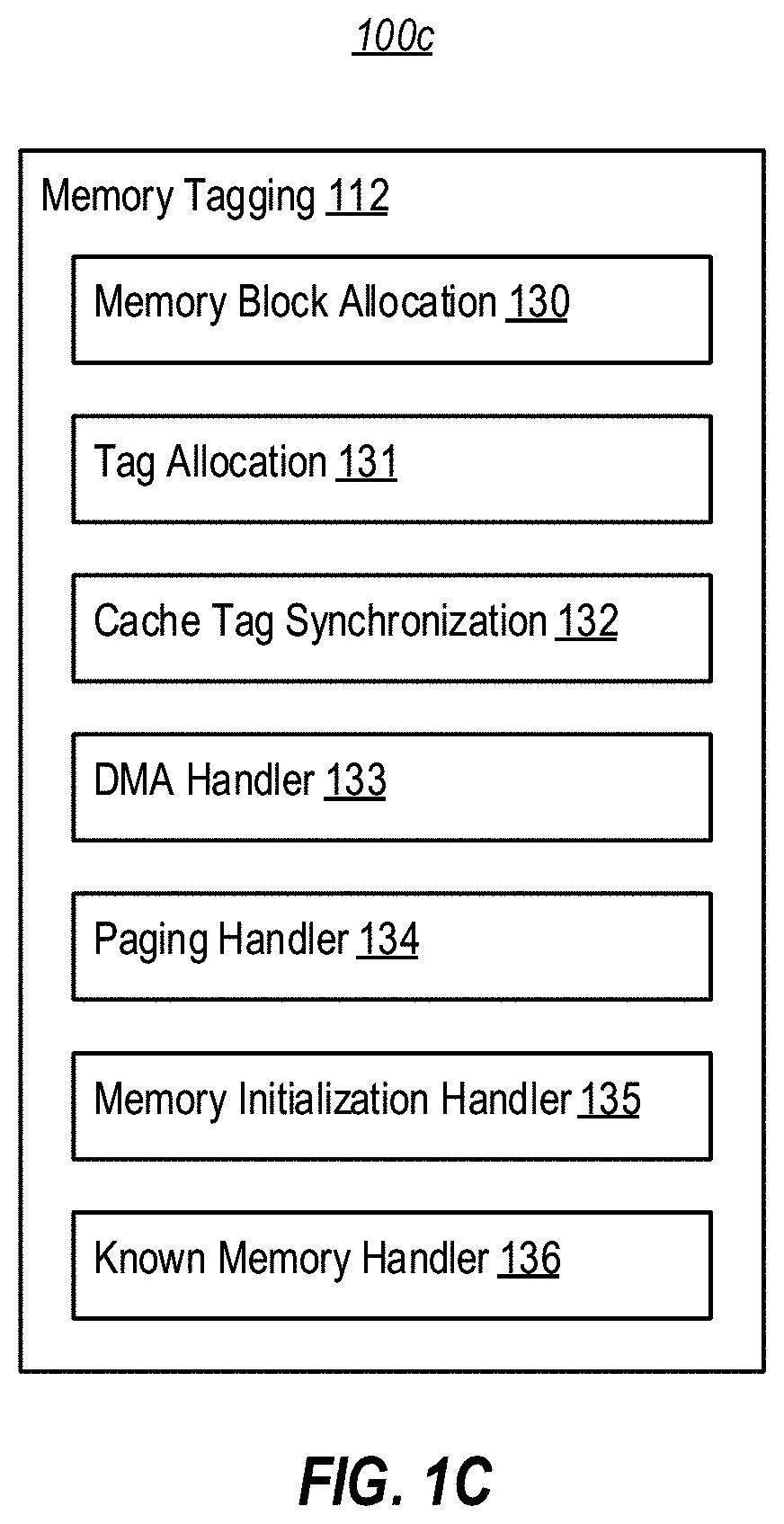
Treating main memory as a collection of tagged cache lines for trace logging. A computer system allocates a plurality of memory blocks, and a corresponding plurality of tags, within a main memory. Each tag indicates whether data stored in a corresponding memory block has been captured by an execution trace. The computer system synchronizes these tags with tags in a memory cache and manages a traced status of the memory blocks. This can include one or more of (i) setting a tag to indicate a memory block has not been captured based on identifying a direct memory access operation, (ii) setting a tag based on whether a paged-in value of a memory block has been captured, (iii) setting a tag or memory categorization based whether a memory block has been initialized, or (iv) setting a tag or memory categorization based whether a memory block is mapped to a file.

Description

CROSS-REFERENCE TO RELATED APPLICATIONS[0001]This application is a continuation-in-part of U.S. patent application Ser. No. 17 / 229,718, filed Apr. 13, 2021, entitled “CACHE-BASED TRACE LOGGING USING TAGS IN SYSTEM MEMORY,” and of U.S. patent application Ser. No. 17 / 229,645, filed Apr. 13, 2021, entitled “CACHE-BASED TRACE LOGGING USING TAGS IN AN UPPER-LEVEL CACHE,” each of which claims priority to, and the benefit of, U.S. Provisional Patent Application Ser. No. 63 / 152,240, filed Feb. 22, 2021, entitled “CACHE-BASED TRACE LOGGING USING TAGS IN A HIGHER MEMORY TIER.” The entire contents of each of these applications are incorporated by reference herein in their entireties.BACKGROUND[0002]Tracking down and correcting undesired software behaviors is a core activity in software development. Undesired software behaviors can include many things, such as execution crashes, runtime exceptions, slow execution performance, incorrect data results, data corruption, and the like. Undesired soft...

Claims

the structure of the environmentally friendly knitted fabric provided by the present invention; figure 2 Flow chart of the yarn wrapping machine for environmentally friendly knitted fabrics and storage devices; image 3 Is the parameter map of the yarn covering machine
Login to View More

Application Information

Patent Timeline
no application Login to View More
Patent Type & Authority Applications(United States)
IPC IPC(8): G06F12/0895G06F12/12G06F13/28
CPCG06F12/0895G06F12/12G06F13/28G06F2212/6012G06F12/0811G06F12/0864G06F12/08G06F2212/1044G06F2212/3042G06F12/0817G06F11/302G06F11/3065G06F11/3476
Inventor MOLA, JORDISPEIER, THOMAS PHILIP
Owner MICROSOFT TECH LICENSING LLC
Features
  • R&D
  • Intellectual Property
  • Life Sciences
  • Materials
  • Tech Scout
Why Patsnap Eureka
  • Unparalleled Data Quality
  • Higher Quality Content
  • 60% Fewer Hallucinations
Social media
Patsnap Eureka Blog
Learn More