Methods and systems for single sign-on authentication in a multi-vendor e-commerce environment and directory-authenticated bank drafts

a multi-vendor e-commerce and authentication system technology, applied in the field of customer and draft authentication in electronic commerce, can solve the problems of theft (or misappropriation), credit card information is particularly sensitive to fraud and misuse, and otherwise valid credit card number may be easily fraudulently used to purchase goods or services over the web, so as to ensure the integrity and security of the personal and financial information of web customers

US6898577B1Inactive Publication Date: 2005-05-24ORACLE INT CORP
8 Cites 145 Cited by

Patent Information

Authority / Receiving Office
US · United States
Patent Type
Patents(United States)
Current Assignee / Owner
Publication Date
2005-05-24
Estimated Expiration
Not applicable · inactive patent

Smart Images

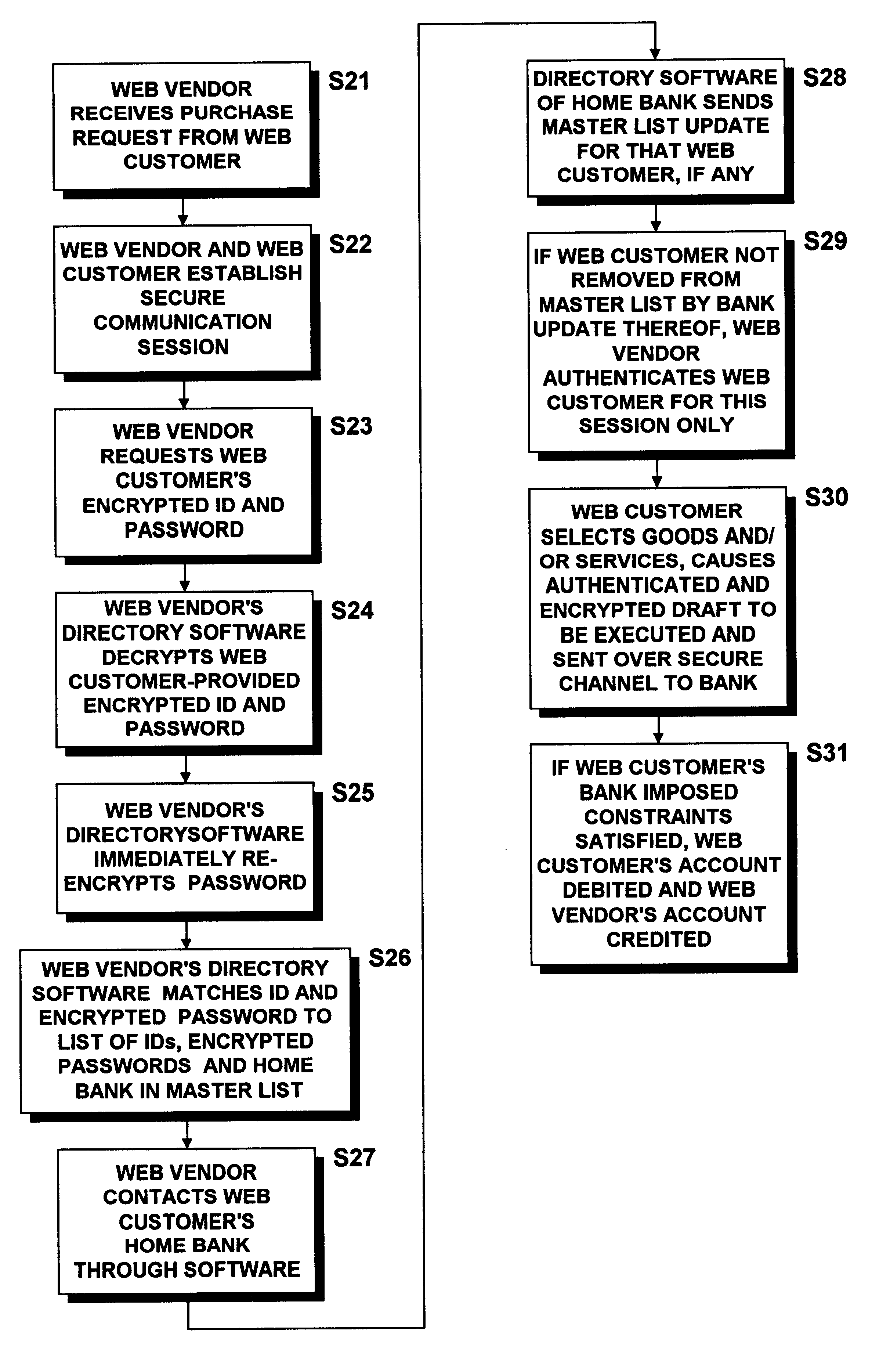
  • Figure 1
    Figure 1
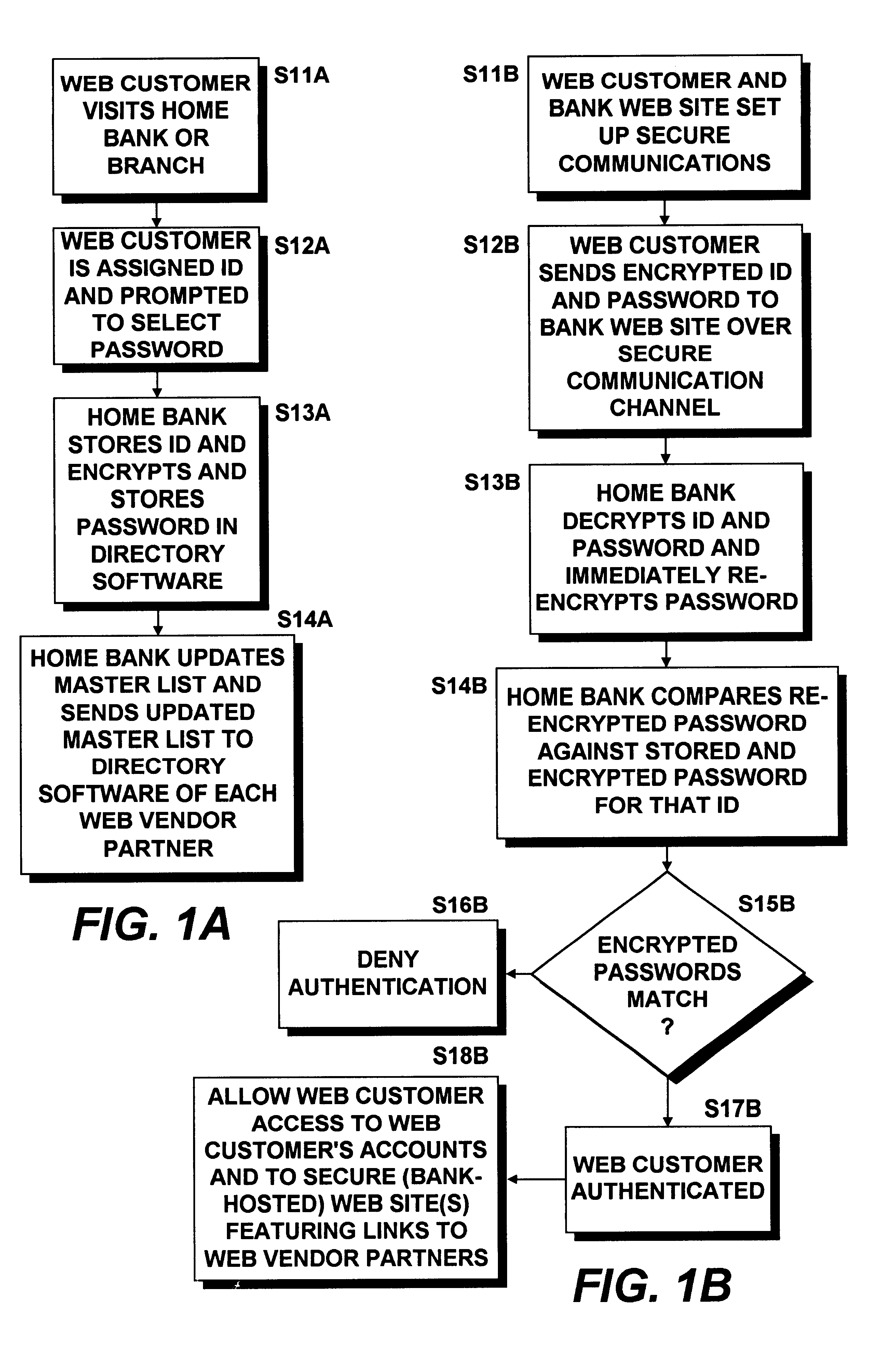
  • Figure 2
    Figure 2
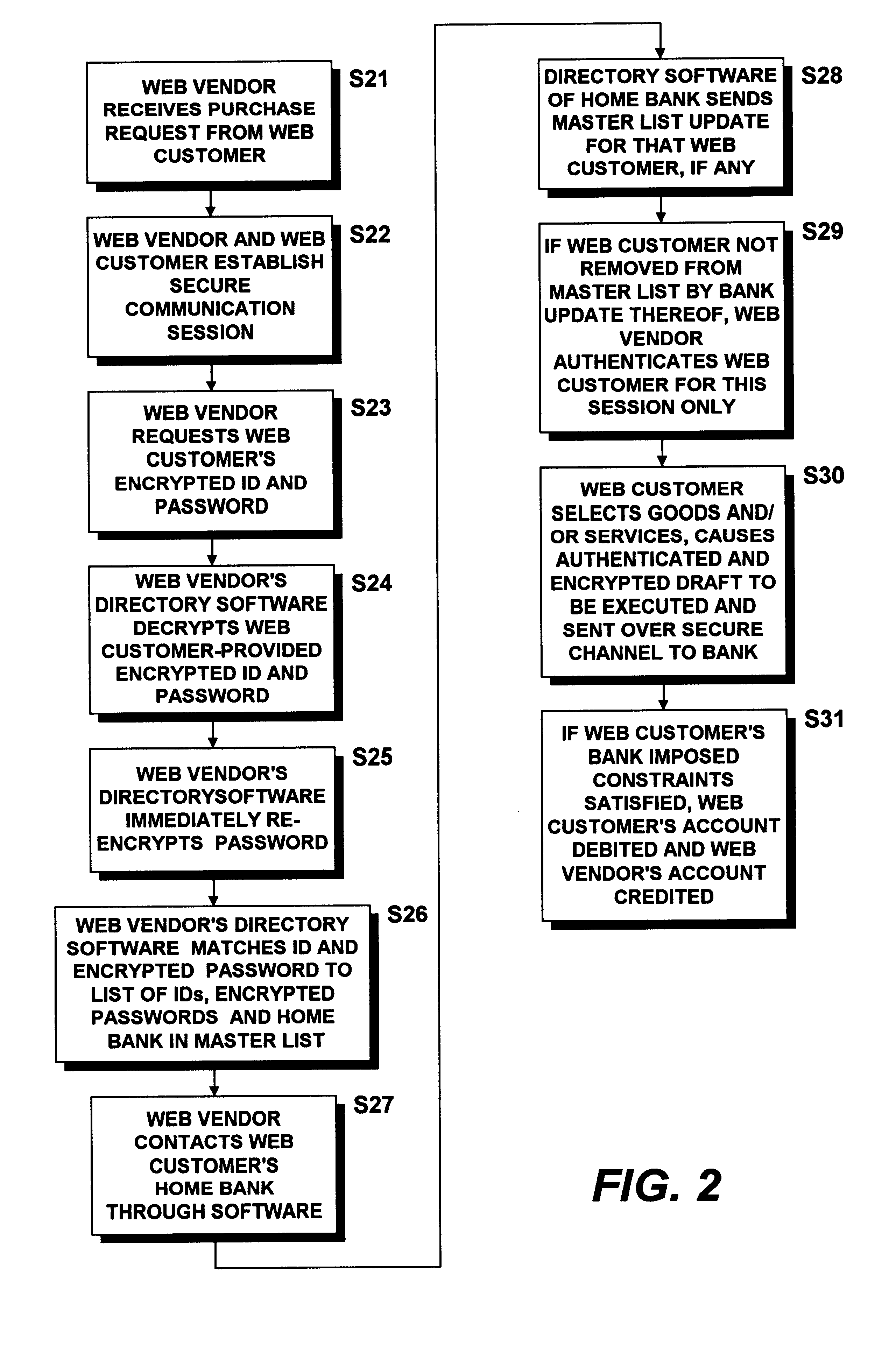
  • Figure 3
    Figure 3
Patent Text Reader

Abstract

A computer-implemented draft authentication method for use in e-commerce includes the steps of establishing partner relationships between a financial institution and a plurality of World Wide Web (Web) vendors and storing, for each of a plurality of Web customers, at least one piece of unique identifying information linked to the Web customer's financial information. Web customers executing drafts or causing drafts to be executed by the Web vendors and presented to the financial institution are authenticated by immediately encrypting at least a portion of an identification data set provided by the Web customer over the network and by successfully matching the immediately encrypted identification data set with the stored piece(s) of encrypted identifying information. The Web customer's financial information is then retrieved only by the financial institution and constraints are established based-on the retrieved information. The financial institution then honors drafts presented by the Web vendors with whom the drawee has a partner relationship only when the Web customer is successfully authenticated and the constraints are satisfied. Only the identification information (such as biometric data and / or ID and password pairs) of each of the Web customers is securely replicated from the financial institution to each of the Web vendors. LDAP-compatible Directory software may be utilized as the means of storing, processing and replicating the Web customer's identification information to each of the Web vendors. The financial institution warrants the security of the system and controls the replication and content of the Directories at each of the Web vendor sites.
Need to check novelty before this filing date? Find Prior Art

Description

BACKGROUND OF THE INVENTION

[0001] 1. Field of the Invention

[0002] This invention relates to the field of customer and draft authentication in electronic commerce (hereafter “e-commerce”). More particularly, the present invention relates to methods and systems that allow a single sign-on authentication of customers in a multi-vendor e-commerce environment and to methods and systems for directory authentication of electronic bank drafts.

[0003] 2. Description of the Related Art

[0004] The network of computers and networks commonly known as the Internet, initially developed as a military and academic communications tool, has now matured into a global communications medium. The explosive growth of the Internet, together with the increasingly ubiquitous availability of high bandwidth access thereto, has spurred efforts in adapting this medium for commercial purposes. The twin developments of the World Wide Web (hereafter “Web”) and the software tools for navigating the Web known as “browsers” ...

Examples

Embodiment Construction

Functional Overview

[0021]The present invention solves many of the problems inherent in conventional e-commerce schemes; notably the dissemination of personal and / or financial information across unsecured networks and Web vendors, transactional security, the need to repeatedly re-enter personal information and the dangers of identity theft and identity confusion, to name a few. According to the present invention, only a limited number of entities (and preferably only one such entity) holds the Web customer's personal and / or financial information, such as bank account numbers and credit / charge card numbers. Preferably, the entity to hold such information is an entity that already enjoys a relationship of trust with the prospective or existing Web customers, such as the Web Customers' bank or banks, credit card holders, etc. In this manner, none of the Web vendors (or fewer Web vendors) hold or have access to the Web customers' personal and / or financial information, such as account num...