
Circuitry and methods for efficient FIFO memory
a fifo memory and circuit technology, applied in the field of circuitry and methods for efficient, can solve the problems of large fifo memory of port memory cells and more complex than standard memory cells, and achieve the effect of efficient first-in-first-out (fifo) memory and similar or better performan
- Summary
- Abstract
- Description
- Claims
- Application Information
AI Technical Summary
Benefits of technology
Problems solved by technology
Method used
Image

Examples
Embodiment Construction
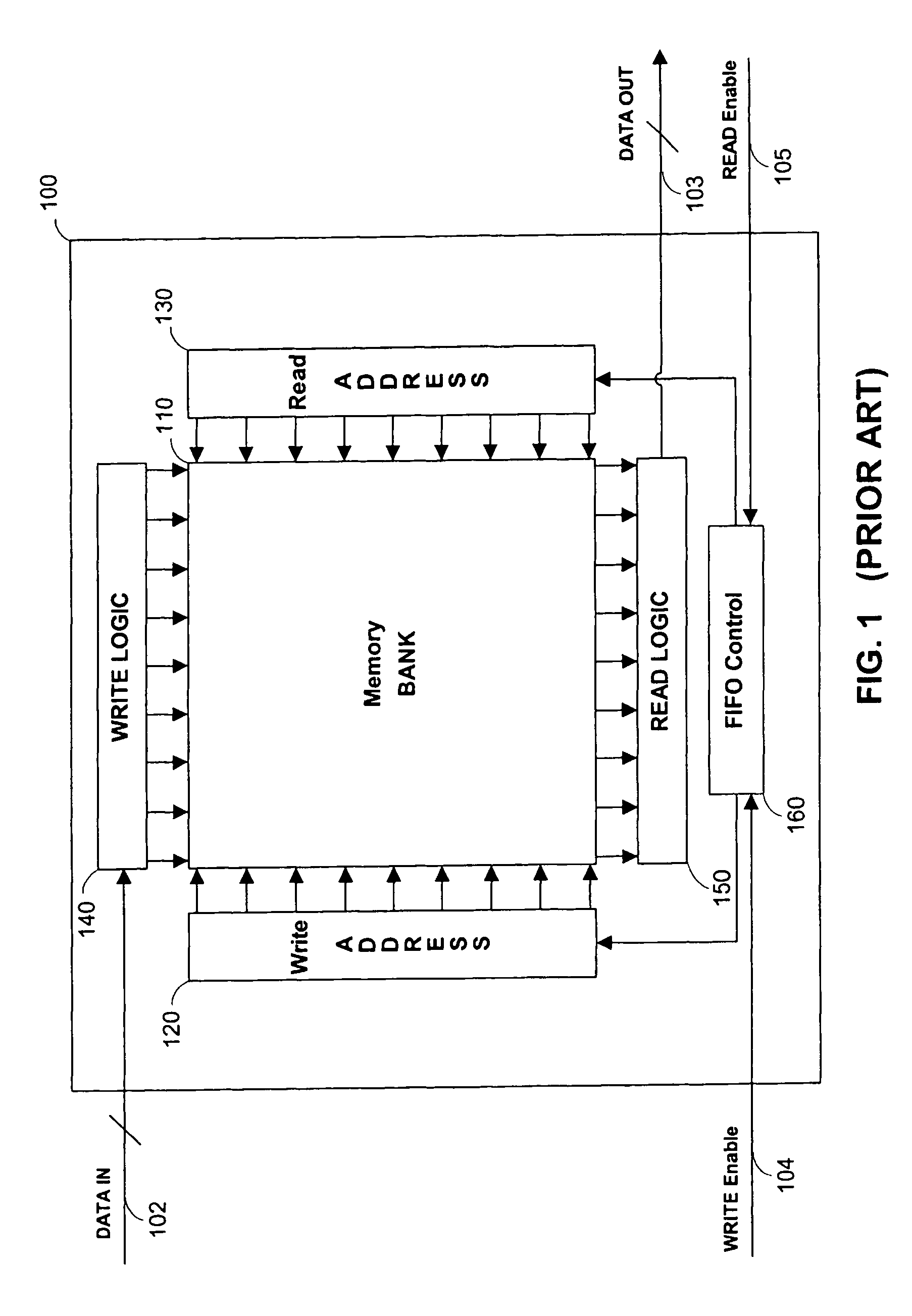
[0014]FIG. 1 shows a simplified schematic of a typical first-in-first-out (FIFO) memory circuit 100. FIFO 100 includes a dual-port memory bank 110, write address decoder 120, read address decoder 130, write logic 140, read logic 150, and FIFO control logic 160.
[0015]When data is written to FIFO 100, data is placed on data-in bus 102, which is connected to write logic 140. Write enable signal 104 alerts FIFO control 160 that there is data to be written to FIFO 100. FIFO control 160 determines whether there is space available in memory bank 110. If there is available space in memory bank 110, FIFO controller 160 sends the address of the next available memory location to write address decoder 120. Alternatively write address decoder 120 may have a counter which keeps track of the last memory address written and the signal from FIFO controller 160 increments the counter to the next valid memory address. Write address decoder 120 activates the address in memory bank 100 where the data is...
PUM
 Login to View More
 Abstract
Description
Claims
Application Information
 Login to View More