Supercharge Your Innovation With Domain-Expert AI Agents!

Composition for forming anti-reflective coating for use in lithography

a technology of anti-reflective coating and composition, which is applied in the direction of photosensitive materials, instruments, photomechanical equipment, etc., can solve the problems of random reflection and standing wave off the substrate, and achieve the effects of effective reflection prevention, useful anti-reflective coating, and high reflection prevention

Inactive Publication Date: 2008-02-19
NISSAN CHEM CORP
View PDF14 Cites 12 Cited by
  • Summary
  • Abstract
  • Description
  • Claims
  • Application Information

AI Technical Summary

Benefits of technology

The composition provides a high reflection-preventive effect, supports excellent resist pattern formation, and offers a higher dry-etching rate than the resist, ensuring precise pattern transfer and easy removal, thus addressing the challenges of reflection and etching efficiency in semiconductor lithography.

Problems solved by technology

Along with this change, influences of random reflection and standing wave off a substrate have become serious problems.

Method used

the structure of the environmentally friendly knitted fabric provided by the present invention; figure 2 Flow chart of the yarn wrapping machine for environmentally friendly knitted fabrics and storage devices; image 3 Is the parameter map of the yarn covering machine
View more

Image

Smart Image Click on the blue labels to locate them in the text.
Viewing Examples
Smart Image
  • Composition for forming anti-reflective coating for use in lithography
  • Composition for forming anti-reflective coating for use in lithography
  • Composition for forming anti-reflective coating for use in lithography

Examples

Experimental program
Comparison scheme
Effect test

synthesis example 1 (

Synthesis of Resin)

[0068]After 90 g of 2-hydroxypropyl methacrylate was dissolved in 455 g of propylene glycol monomethyl ether, the reaction solution was warmed at 70° C. and simultaneously nitrogen gas was passed into the reaction solution. Thereafter, 0.9 g of azobisisobutyronitrile (manufactured by JUNSEI CHEMICAL CO., LTD.) was added as polymerization initiator and stirred under nitrogen atmosphere for 24 hours, and then 0.1 g of 4-methoxyphenol (manufactured by TOKYO KASEI KOGYO CO., LTD.) was added as polymerization terminator. The resulting resin was subjected to GPC analysis and as a result, its weight average molecular weight was found to be 71,300 in terms of standard polystyrene. The solids content in the solution was 20%.

synthesis example 2

[0069]Cresol novolak resin (manufactured by ASAHI CIBA CO., LTD., trade name ECN1299, weight average molecular weight: 3,900, the structure being shown by formula (5)) was provided.

[0070]

[0071]10 g of cresol novolak resin described above was added in 80 g of propylene glycol monomethyl ether and dissolved therein. To the solution, 9.7 g of 9-anthracenecarboxylic acid and 0.26 g of benzyltriethylammonium chloride were added. The resulting mixture was reacted at 105° C. for 24 hours. GPC analysis of the resulting polymer resin gave a weight average molecular weight of 5,600 in terms of standard polystyrene. The chemical structure of the resin is shown by formula (6).

[0072]

synthesis example 3

[0073]Tris-(2,3-epoxypropyl)-isocyanurate (manufactured by NISSAN CHEMICAL INDUSTRIES, LTD., trade name TEPIC, the structure being shown by formula (7)) was provided.

[0074]

[0075]3.0 g of the above-mentioned tris-(2,3-epoxypropyl)-isocyanurate was added and dissolved in 7.0 g of xylene. Then 2.8 g of phenol and 0.17 g of benzyl triethyl ammonium chloride were added to the dissolved solution, and thereafter reacted at 140° C. for 24 hours. After the reaction was completed, the reaction solution was gradually cooled, crystals separated out were filtered, and then purified by recrystalization from a mixed solvent of isopropylalcohol / acetone=9 / 1. The chemical structure of the resulting compound is shown by formula (8).

[0076]

the structure of the environmentally friendly knitted fabric provided by the present invention; figure 2 Flow chart of the yarn wrapping machine for environmentally friendly knitted fabrics and storage devices; image 3 Is the parameter map of the yarn covering machine
Login to View More

PUM

PropertyMeasurementUnit
wavelengthaaaaaaaaaa
thicknessaaaaaaaaaa
pore diameteraaaaaaaaaa
Login to View More

Abstract

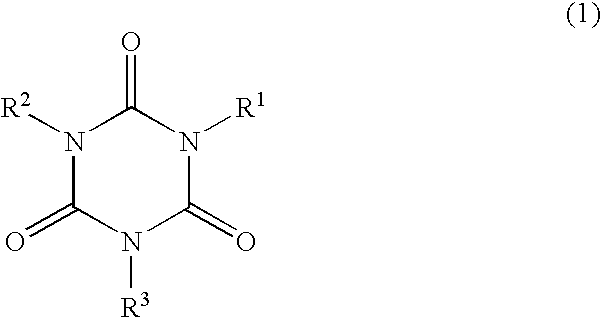
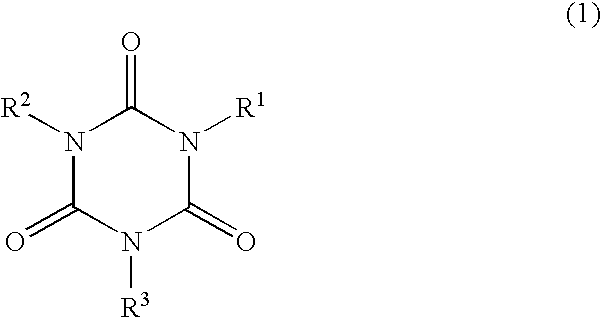
A composition for forming anti-reflective coating for use in a lithographic process in manufacture of a semiconductor device, comprising as a component a resin containing cyanuric acid or a derivative thereof, or a resin containing a structural unit derived from cyanuric acid or a derivative thereof. The structural unit is preferably represented by formula (1):and can be contained in a main chain or a side chain, or both main chain and side chain of a resin. The anti-reflective coating for lithography obtained from the composition has a high reflection reducing effect and does not cause intermixing with a resist layer to give an excellent resist pattern. It has a higher selectivity in dry-etching compared with the resists.

Description

TECHNICAL FIELD[0001]The present invention relates to a composition for forming anti-reflective coating that is effective in lowering of adverse effects due to reflection off an underlying substrate in a lithographic process by using ArF excimer laser; and a method of forming a resist pattern by using the composition for forming anti-reflective coating.BACKGROUND ART[0002]Conventionally, in the manufacture of semiconductor devices, micro-processing by lithography using a photoresist composition has been carried out. The micro-processing is a processing method including forming a thin film of a photoresist composition on a silicon wafer, irradiating actinic rays such as ultraviolet rays via a mask pattern depicting a pattern for a semiconductor device, developing it to obtain a resist pattern, and etching the silicon wafer using the resist pattern as a protective film to form fine concavities and convexities corresponding to the pattern on the device. However, recent progress in high...

Claims

the structure of the environmentally friendly knitted fabric provided by the present invention; figure 2 Flow chart of the yarn wrapping machine for environmentally friendly knitted fabrics and storage devices; image 3 Is the parameter map of the yarn covering machine
Login to View More

Application Information

Patent Timeline
no application Login to View More
Patent Type & Authority Patents(United States)
IPC IPC(8): G03F7/23C08G18/79C08G73/06C09D179/04G03F7/09H01L21/027
CPCC08G18/791C08G73/0655C09D179/04G03F7/091H01L21/0276G03F7/11
Inventor KISHIOKA, TAKAHIROARASE, SHINYAMIZUSAWA, KEN-ICHI
Owner NISSAN CHEM CORP
Features
  • R&D
  • Intellectual Property
  • Life Sciences
  • Materials
  • Tech Scout
Why Patsnap Eureka
  • Unparalleled Data Quality
  • Higher Quality Content
  • 60% Fewer Hallucinations
Social media
Patsnap Eureka Blog
Learn More