Unlock instant, AI-driven research and patent intelligence for your innovation.

Method and system for minimizing an amount of data needed to test data against subarea boundaries in spatially composited digital video

a digital video and subarea boundary technology, applied in the field of computer graphics technology, can solve the problems of reducing the speed at which a frame of an image is rendered by a graphics pipeline, affecting the performance of the image, and affecting the quality of the image, so as to minimize the amount of data and optimize the processing power of the given architectur

Inactive Publication Date: 2008-04-15
MORGAN STANLEY +1
View PDF33 Cites 5 Cited by
  • Summary
  • Abstract
  • Description
  • Claims
  • Application Information

AI Technical Summary

Benefits of technology

[0021]The present invention provides a method and system for minimizing an amount of data needed to test data against subarea boundaries in spatially composited digital video. Once the current subarea boundaries are determined, optimization then depends on determining the correct granularity for testing graphics data against the current subarea boundaries. The present invention tests graphics data against subarea boundaries to determine which subarea, and thus graphics unit assigned to that subarea, is responsible to render the graphics data. The greater the granularity that can be used for testing graphics data against the current subarea boundaries, the less amount of data that is communicated to each graphics unit, thereby optimizing the processing power of the given architecture. Sending all of the graphics data to each graphics unit prevents the application from seeing any increase in the rate at which an overall frame is rendered. Yet, it is important that any calculations performed by the present invention do not take so long that they become the bottleneck.
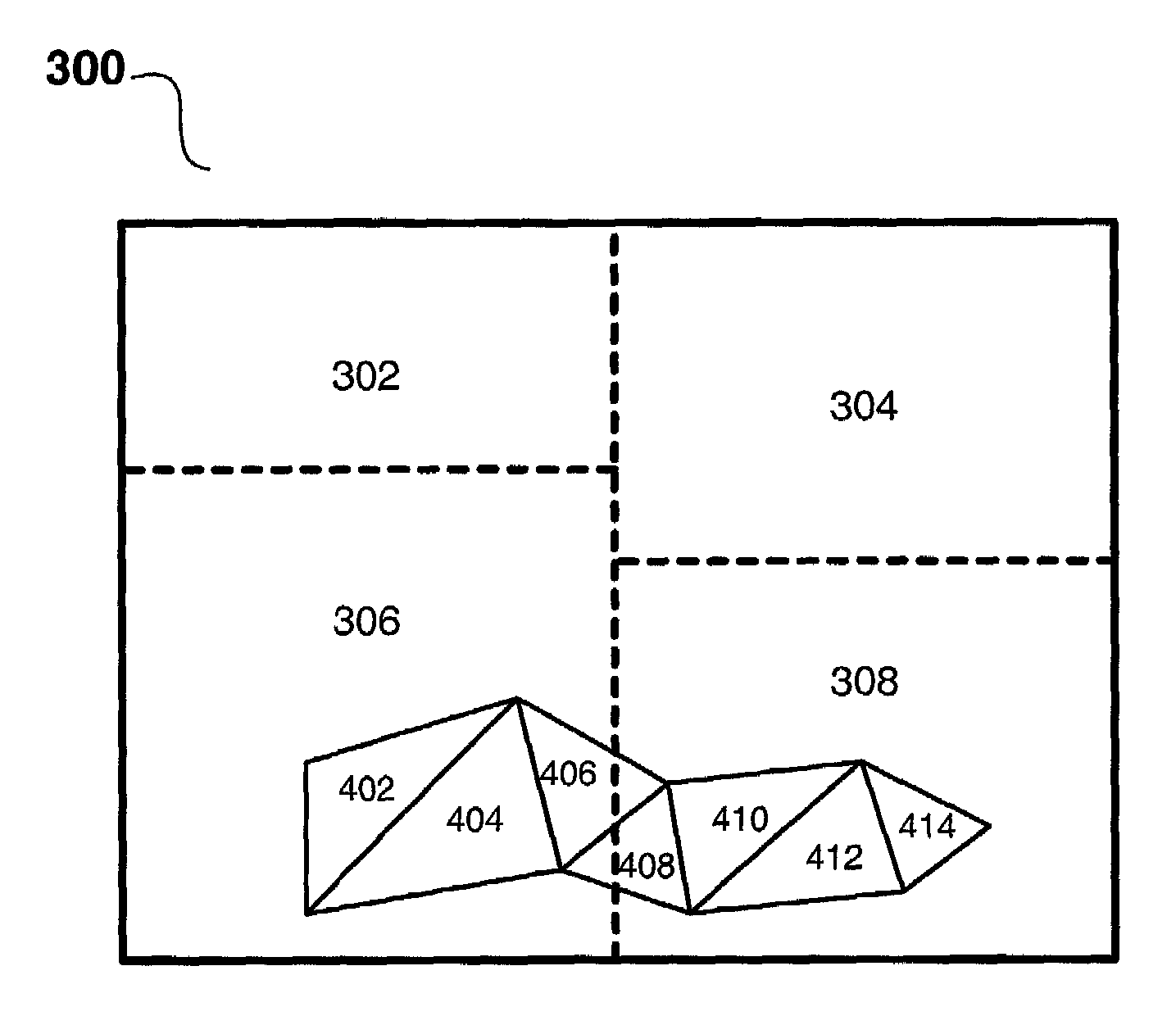
[0022]The present invention includes a method and a system for minimizing an amount of data needed to test graphics data against subarea boundaries in spatially composited digital video. The present invention utilizes the concept of a bounding region in order to delay communicating detailed graphics data (which may include geometric data) to the subareas until the present invention determines which subarea(s) are responsible to render the graphics data. Shapes, sizes, and / or positions of the subareas can define a compositing window along with the subarea boundaries. Graphics data may be represented by pixels, where each pixel may store color data, texture data, intensity data and so forth. Therefore, if only the parameters that define the bounding region (i.e., defines the space the geometry chunk occupies on the compositing window) are communicated, it is possible to delay the need to communicate the detailed graphics data until it is determined which subarea will render the geometry represented by the particular bounding region. Note that any common coordinate space that is convenient or efficient may be used.
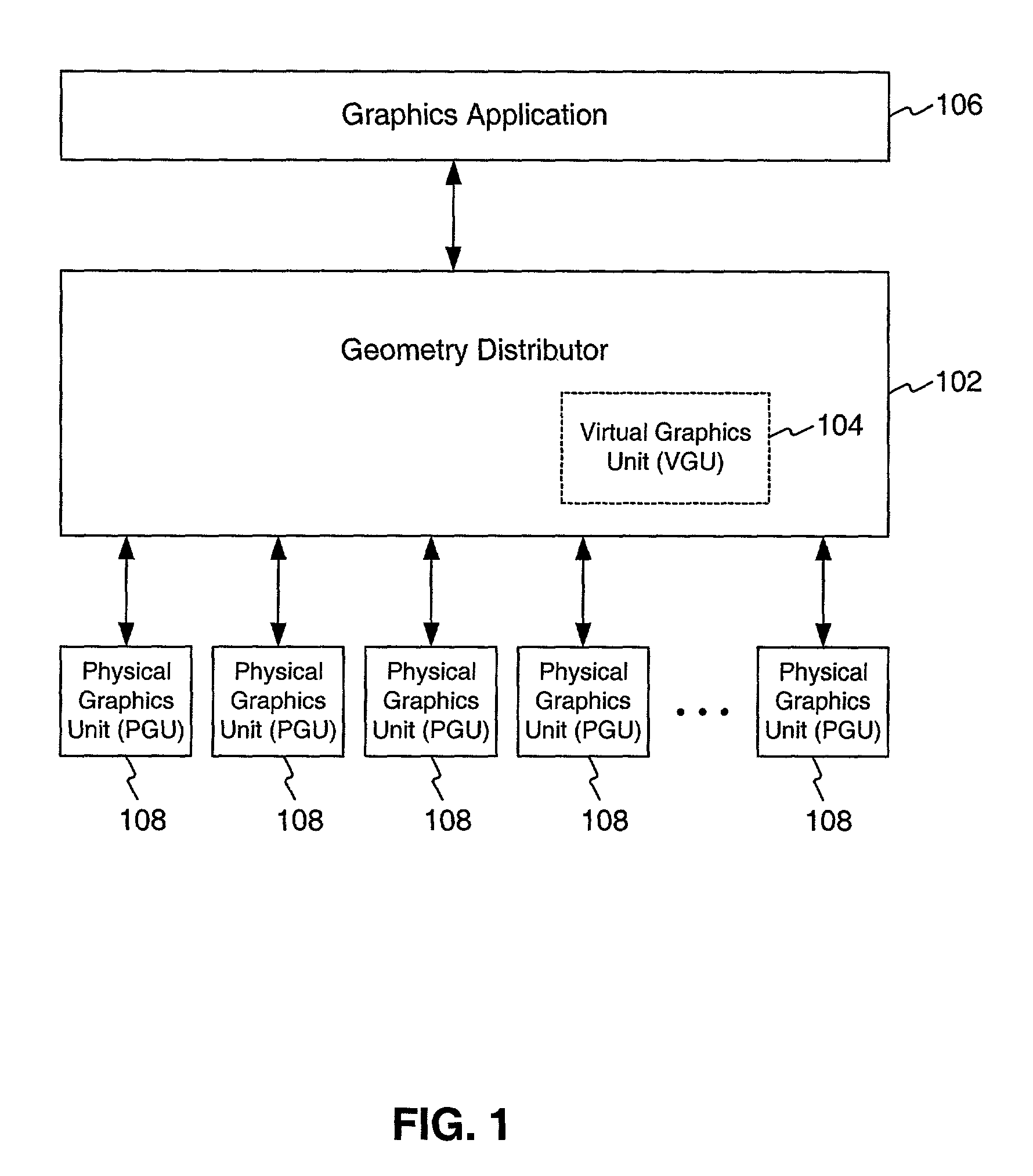
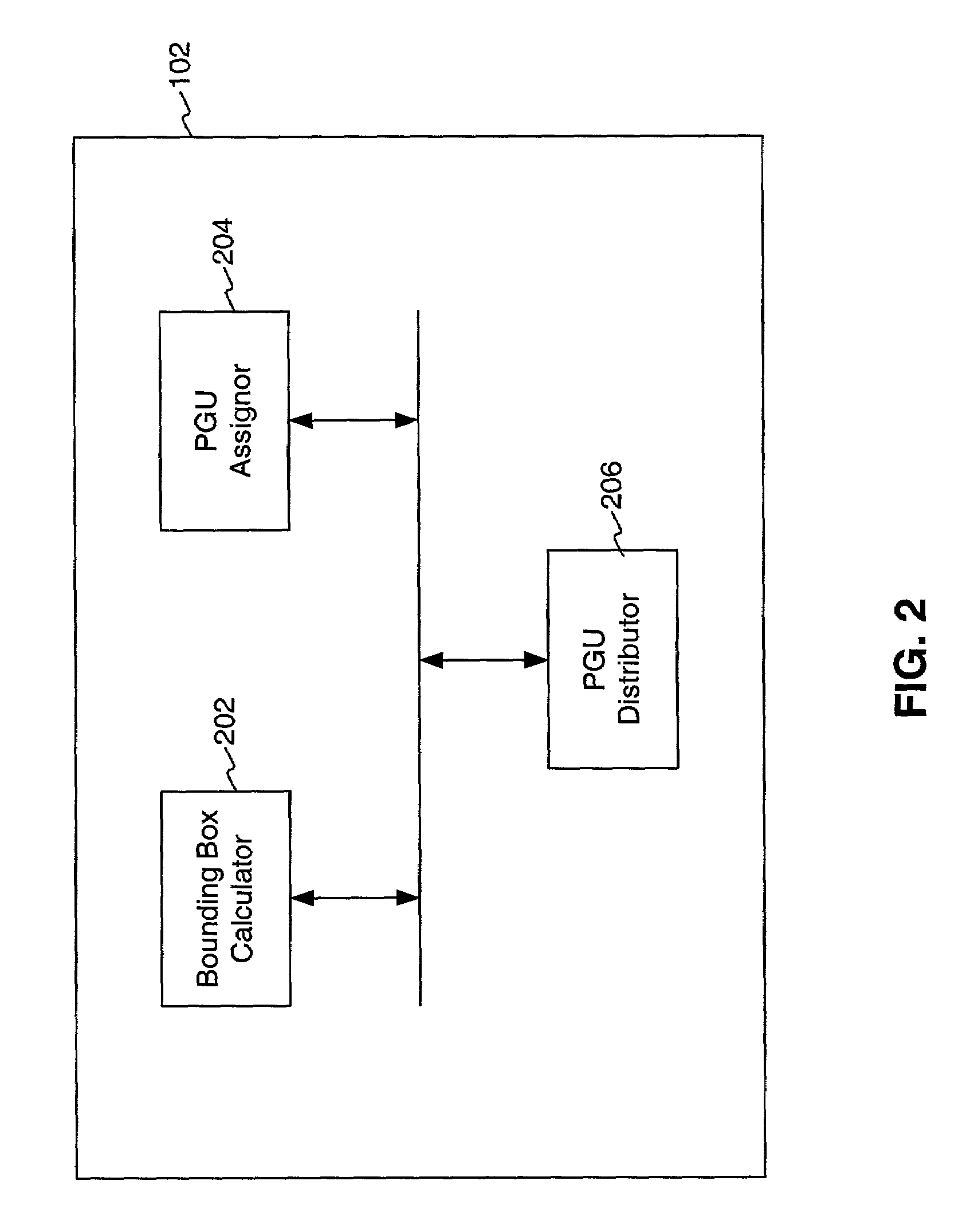
[0023]In another embodiment of the present invention, a system for minimizing an amount of data needed to test a geometry chunk in a frame against subarea boundaries in a compositing window includes a geometry distributor and one or more graphics units. The geometry distributor defines a bounding region for the geometry chunk, where the bounding region defines the space the geometry chunk occupies on the compositing window. The graphics units are assigned to the subareas in the compositing window. The geometry distributor sends a bounding region to each of the graphics units to determine which graphics unit will render the geometry chunk defined by the bounding region. Once this is determined, the geometry distributor communicates the geometry chunk to the graphics unit that will render the geometry chunk.

Problems solved by technology

While temporal compositing marks a major advancement in computer graphics performance, there are situations in which this approach may not optimize the processing power of the given architecture.
A higher degree of image complexity, caused by additional features or geometrical entities (e.g., edges, polygons, etc) to improve the quality of the image, can reduce the speed at which a frame of an image is rendered by a graphics pipeline.
Another problem posed by the temporal compositing process arises when the rendered images reside in an interactive environment.
In a temporal compositing system, there is a substantial delay between the time at which the user provides the feedback signal and the time at which the system responds to it.
Because the other pipelines are already in the process of rendering their pre-feedback frames, the system typically imposes a time delay to allow the other pipelines to complete their rendering of these frames before acting on the feedback signal.
The cost of this approach is the necessity to communicate, in conjunction with each frame, the number, sizes, and positions of subareas being used for that given frame.
Where spatial compositing involves the use of a large number of subareas and / or complex graphics data, this can add substantially to the overhead information that must be communicated for each frame of spatially composited digital video.
This situation compounds an already difficult problem with state of the art computer hardware technologies.
As advancements in memory capacities and processor speeds have outstripped improvements in interconnect bus throughputs, data links have become bottlenecks of serious concern.

Method used

the structure of the environmentally friendly knitted fabric provided by the present invention; figure 2 Flow chart of the yarn wrapping machine for environmentally friendly knitted fabrics and storage devices; image 3 Is the parameter map of the yarn covering machine
View more

Image

Smart Image Click on the blue labels to locate them in the text.
Viewing Examples
Smart Image
  • Method and system for minimizing an amount of data needed to test data against subarea boundaries in spatially composited digital video
  • Method and system for minimizing an amount of data needed to test data against subarea boundaries in spatially composited digital video
  • Method and system for minimizing an amount of data needed to test data against subarea boundaries in spatially composited digital video

Examples

Experimental program
Comparison scheme
Effect test

Embodiment Construction

Table of Contents

[0039]

I.OverviewII.TerminologyIII.System Architecture OverviewIV.Environment of the InventionV.Software and Hardware EmbodimentsVI.Conclusion

I. Overview

[0040]The present invention provides a method and system for minimizing an amount of data needed to test data against subarea boundaries in spatially composited digital video. A bounding region delays communicating detailed graphics data to the subareas until the present invention determines which subarea(s) are responsible to render the graphics data.

II. Terminology

[0041]Digital video images are a sequence of images presented for continuous viewing from a digital electronic format by a digital video display unit. The color, intensity, texture, and other information for each location on an image is represented by values stored in a pixel. Pixels in a display unit reside in an array of rows and columns.

[0042]Scanning is a process by which pixels are sequentially traversed. A single complete video image is referred to ...

the structure of the environmentally friendly knitted fabric provided by the present invention; figure 2 Flow chart of the yarn wrapping machine for environmentally friendly knitted fabrics and storage devices; image 3 Is the parameter map of the yarn covering machine
Login to View More

PUM

No PUM Login to View More

Abstract

A method and system for minimizing an amount of data needed to test data against subarea boundaries in spatially composited digital video. Spatial compositing uses a graphics unit or pipeline to render a portion (subarea) of each overall frame of digital video images. This reduces the amount of data that each processor must act on and increases the rate at which an overall frame is rendered. Optimization of spatial compositing depends on balancing the processing load among the different pipelines. The processing load typically is direct function of the size of a given subarea and a function of the rendering complexity for objects within this subarea. Load balancing strives to measure these variables and adjust, from frame to frame, the number, sizes, and positions of the subareas. The cost of this approach is the necessity to communicate, in conjunction with each frame, the graphics data that will be rendered. Graphics data for a frame is composed of geometry chunks. Each geometry chunk is defined by its own bounding region, where the bounding region defines the space the geometry chunk occupies on the compositing window. Only the parameters that define the bounding region are communicated to each graphics unit in conjunction with the determination of which graphics unit will render the geometry chunk defined by the bounding region. The actual graphics data that comprises the geometry chunk is communicated only to those geometry units that will actually render the geometry chunk. This reduces the amount of data needed to communicate graphics data information in spatially composited digital video.

Description

CROSS-REFERENCE TO RELATED APPLICATIONS[0001]This patent application claims priority to the following provisional patent application:[0002]“Method and System for Minimizing an Amount of Data Needed to Test Data Against Subarea Boundaries in Spatially Composited Digital Video,” Serial No. 60 / 264,254, filed Jan. 29, 2001, incorporated herein by reference in its entirety.[0003]This patent application is related to the following commonly owned, co-pending U.S. utility patent applications:[0004]1. “Method and System for Minimizing an Amount of Data Needed to Communicate Information in Spatially Composited Digital Video,” Ser. No. 09 / 689,784, filed Oct. 13, 2000, incorporated herein by reference in its entirety;[0005]2. “Method and System for Spatially Compositing Digital Video Images with a Tile Pattern Library,” Ser. No. 09 / 689,785, filed Oct. 13, 2000, incorporated herein by reference in its entirety; and[0006]3. “Method and System for Spatially Compositing Digital Video Images with Co...

Claims

the structure of the environmentally friendly knitted fabric provided by the present invention; figure 2 Flow chart of the yarn wrapping machine for environmentally friendly knitted fabrics and storage devices; image 3 Is the parameter map of the yarn covering machine
Login to View More

Application Information

Patent Timeline
no application Login to View More
IPC IPC(8): G06F15/80G06T15/30G06T15/00G06T17/10G09G5/00
CPCG06T15/00G06T17/10
Inventor BLYTHE, DAVID R.SCHAFER, MARCUNGAR, PAUL JEFFREYYU, DAVID
Owner MORGAN STANLEY