Multi-chamber ventricular automatic capture method and apparatus for minimizing true and blanking period induced ventricular undersensing

a multi-chamber, ventricular automatic capture technology, applied in the direction of heart stimulators, electrotherapy, therapy, etc., can solve the problems of reducing affecting the efficiency of ventricular stimulation, and affecting the patient's heart rate, so as to prevent the loss of heart rate support and minimize the frequency of ventricular stimulation competition

US7400923B1Inactive Publication Date: 2008-07-15PACESETTER INC
13 Cites 0 Cited by

Patent Information

Authority / Receiving Office
US · United States
Patent Type
Patents(United States)
Current Assignee / Owner
Publication Date
2008-07-15
Estimated Expiration
Not applicable · inactive patent

Smart Images

  • Figure 1
    Figure 1
  • Figure 2
    Figure 2
  • Figure 3
    Figure 3
Patent Text Reader

Abstract

An implantable cardiac stimulation device and associated method perform a true or blanking period ventricular undersensing detection algorithm in response to ventricular loss of capture not associated with fusion or a change in capture threshold. The test identifies an originating cause of loss of capture, which may be ventricular undersensing of intrinsic R-waves or premature ventricular contractions occurring during a ventricular blanking period or atrial undersensing of P-waves resulting in blanking period ventricular undersensing. A corrective action is taken to reduce the likelihood of blanking period ventricular undersensing by automatically adjusting device operating parameters. The corrective action may include automatic adjustment of atrial sensitivity, shortening of the ventricular blanking period, or adjustment of the base stimulation rate. Minimizing the blanking period ventricular undersensing improves device performance by avoiding back-up stimulation and minimizing the risk of pacemaker competition-induced arrhythmias.
Need to check novelty before this filing date? Find Prior Art

Description

CROSS-REFERENCE TO RELATED APPLICATIONS

[0001] This application is a divisional of copending U.S. patent application Ser. No. 09 / 973,300, filed Oct. 9, 2001.FIELD OF THE INVENTION

[0002] This invention relates generally to programmable cardiac stimulating devices. Particularly, the present invention is directed to an implantable stimulation device and associated method capable of automatically adjusting sensitivity and blanking interval settings in a way that minimizes the frequency of ventricular stimulation competition with natural ventricular depolarizations. More specifically, the present cardiac stimulation device offers various automatic capture features, and further allows automatic atrial sensitivity adjustment, automatic ventricular sensitivity adjustment, automatic mode switching, automatic base rate adjustment, and automatic AV interval adjustment.BACKGROUND OF THE INVENTION

[0003] In the normal human heart, the sinus node, generally located near the junction of the superior ve...

Examples

Embodiment Construction

[0030]The following description is of the best mode presently contemplated for practicing the invention. This description is not to be taken in a limiting sense but is made merely for the purpose of describing the general principles of the invention. The scope of the invention should be ascertained with reference to the issued claims. In the description of the invention that follows, like numerals or reference designators will be used to refer to like parts or elements throughout.

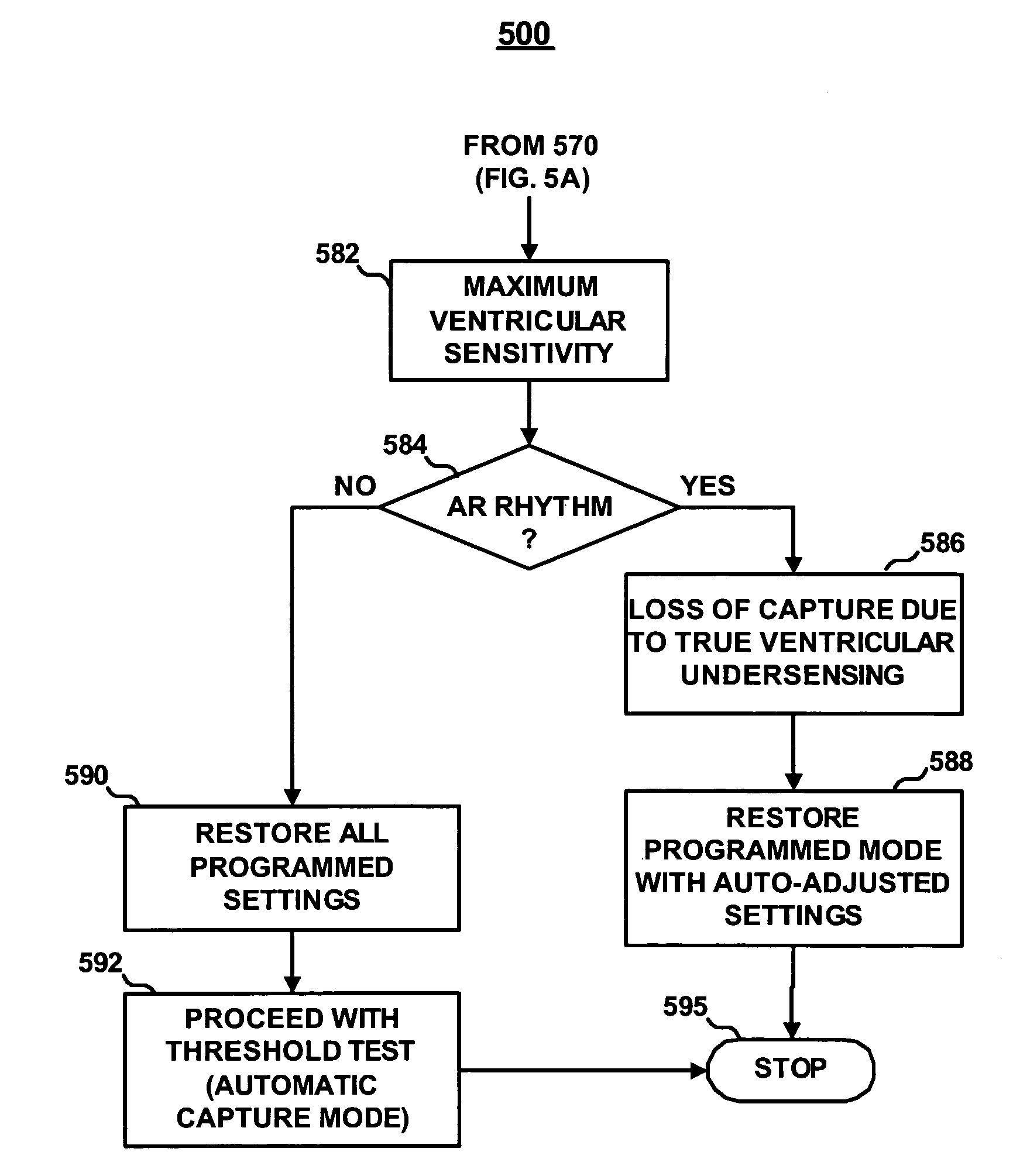
[0031]As described above, the present invention aims at providing a method for determining when ventricular blanking period undersensing is suspected to be causing ventricular loss of capture. This method also takes corrective action to reduce the likelihood of ventricular blanking period undersensing. The methods of the present invention are intended for use in a dual-chamber or multi-chamber cardiac stimulation system possessing various features of automatic capture. While the present invention could be s...