
Hydrated crystalline esters of camptothecin
a technology of esters and camptothecin, which is applied in the direction of heterocyclic compound active ingredients, biocide, drug compositions, etc., can solve the problems of cancer patients, unavoidable toxic effects of most anti-cancer agents in patients receiving chemotherapy, and side effects of patients suffering, etc., to achieve a wide spectrum of anti-tumor activity and low or no observable toxicity
- Summary
- Abstract
- Description
- Claims
- Application Information
AI Technical Summary
Benefits of technology
Problems solved by technology
Method used
Image

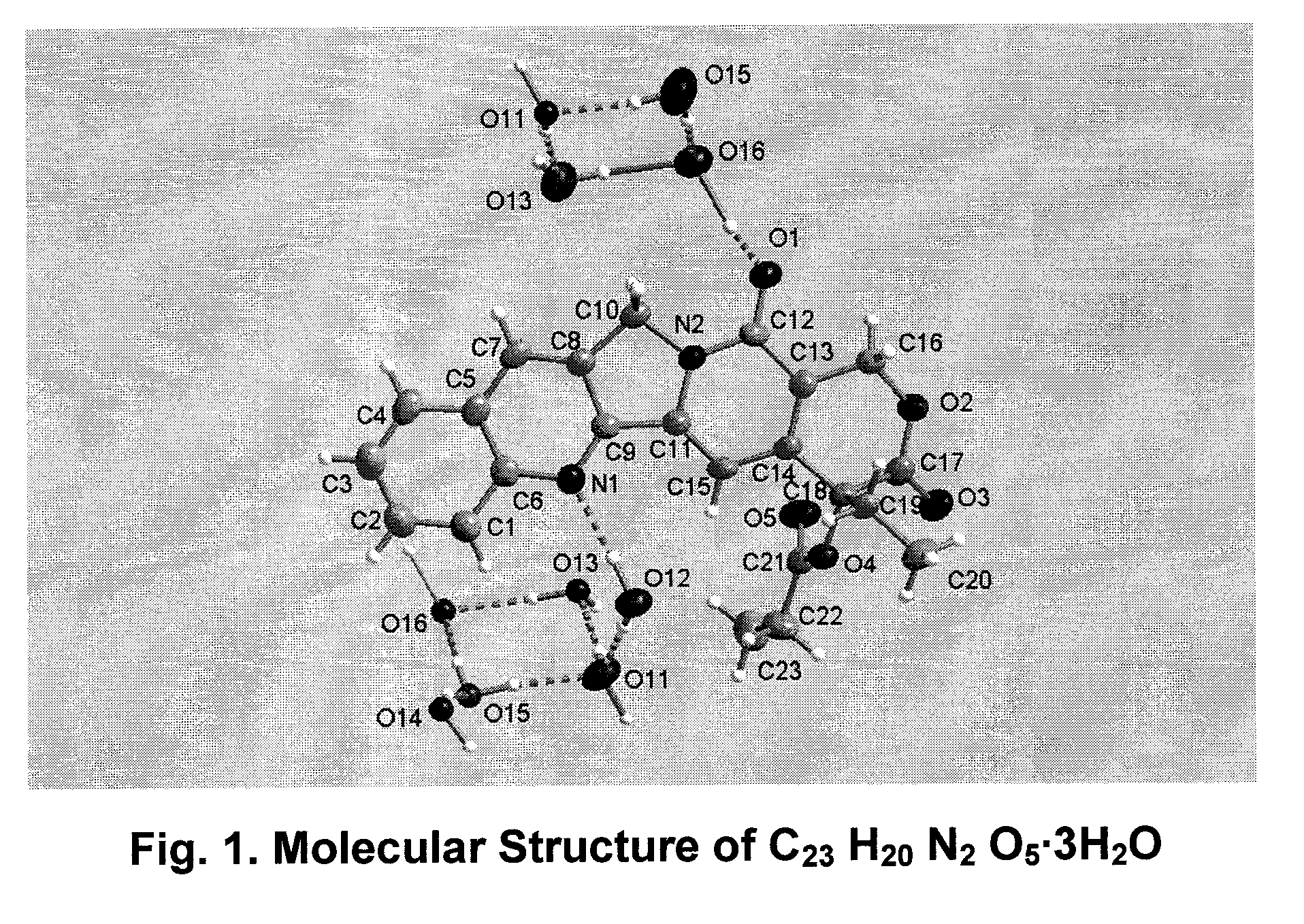
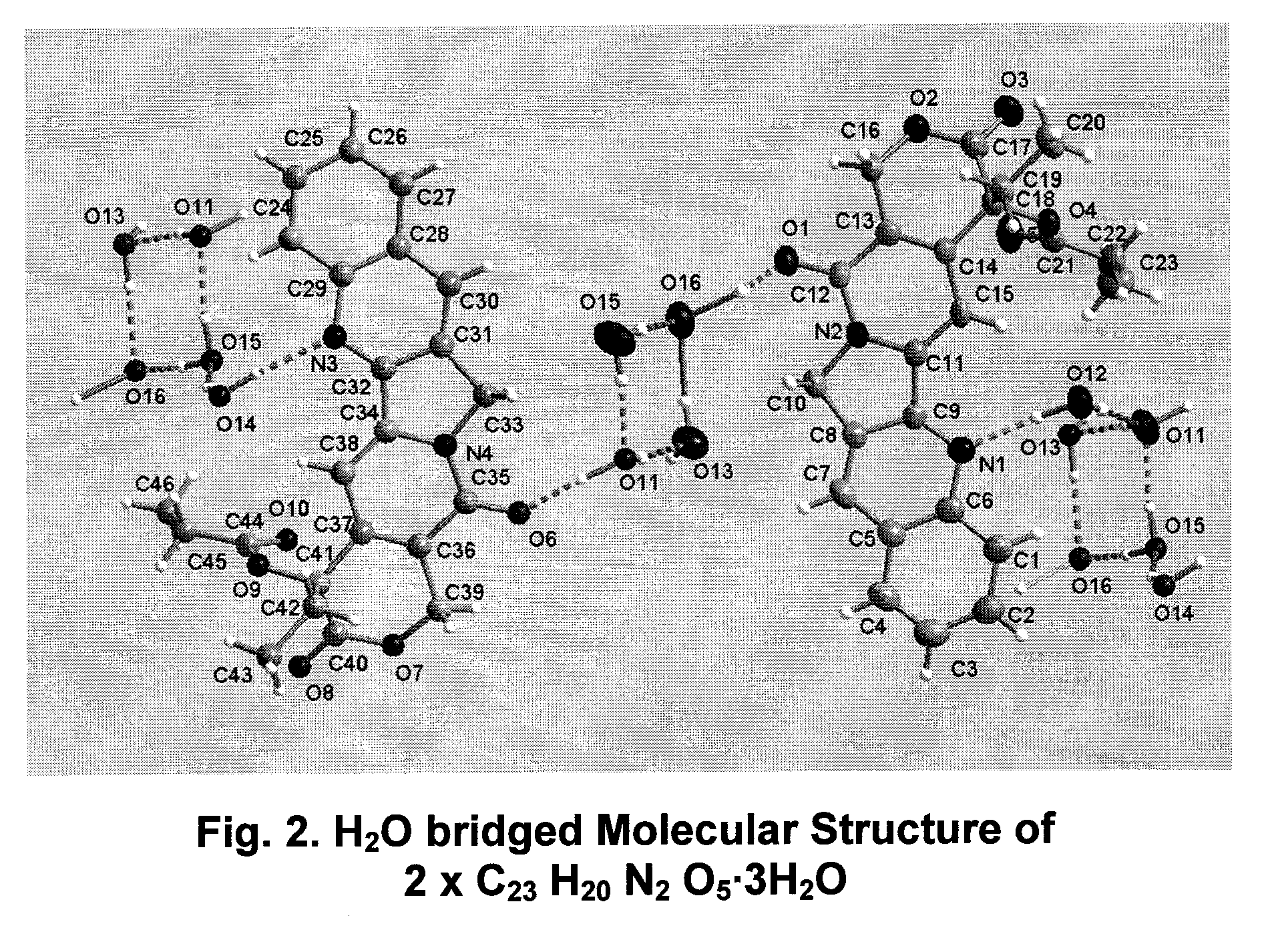
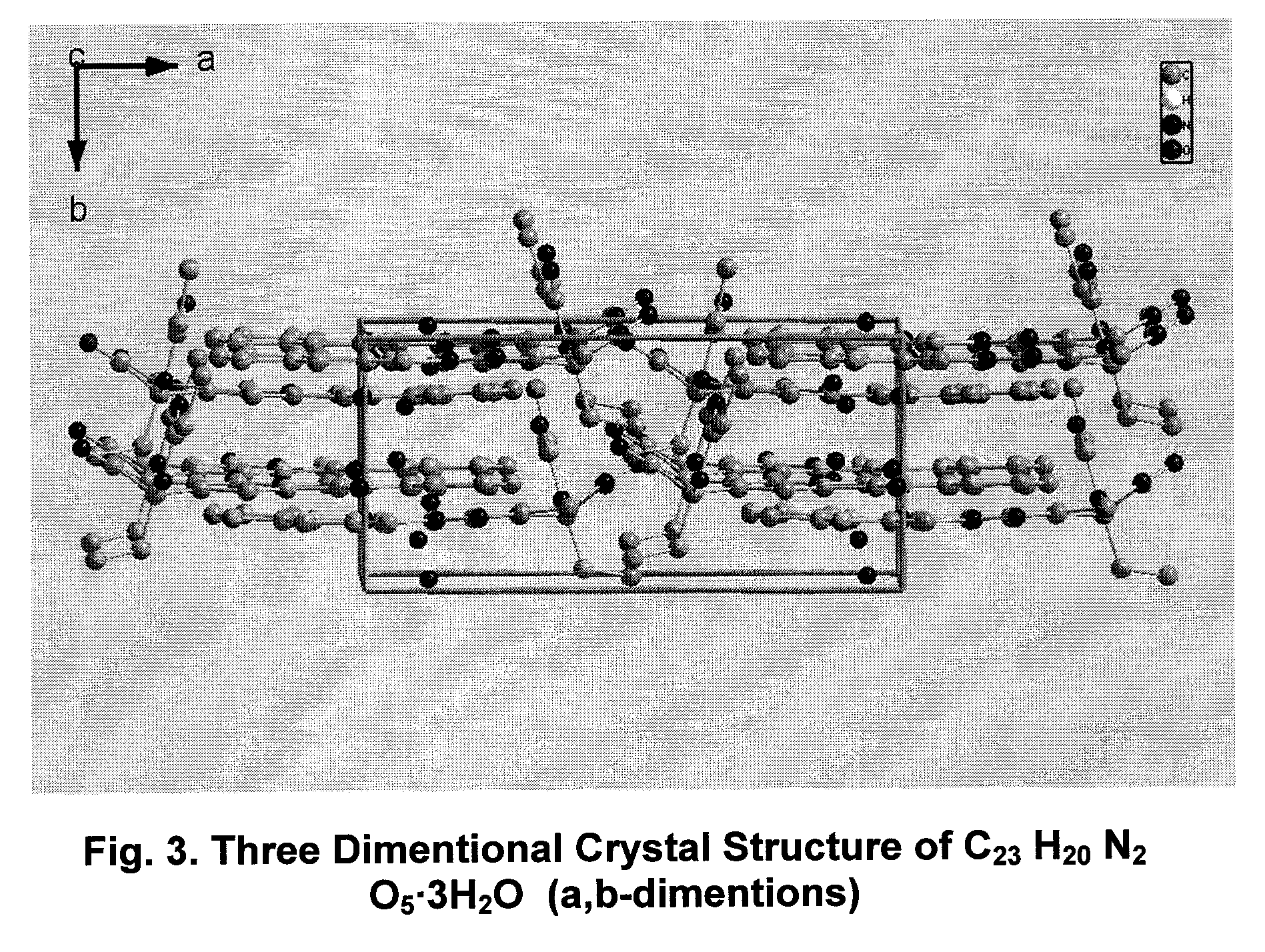
Examples
example 1
[0131]Crystalline camptothecin-20-propionate (CZ48) hydrate was prepared as follows. About 20 g camptothecin (0.05747 mole) and about 100 ml propionic anhydride (97%, Aldrich Chemical Co., Milwaukee, WD were added to a 200 ml round-bottomed flask equipped with a magnetic stirrer and a sand bath. The mixture was heated by sand bath while stirring. A few drops (8 to 10) of concentrate sulfuric acid (95-98%, A.C.S. reagent, Aldrich Chemical Co.) were added drop by drop when the sand bath temperature reached 80° C. The mixture was then stirred at 110±10° C. for overnight (˜14 hr). After cooling down to room temperature, the reaction mixture was poured onto 1000 ml ice water portion by portion while stirring. After stirring for roughly 45 min, the mixture was filtrated. The residue obtained from filtration was allowed to air-dry for 24 hr. The dried crude product was transferred to a 500 ml round-bottomed flask equipped with a heating mantle.
[0132]To this crude product was added 200 ml a...
example 2
[0135]In vivo anti-tumor activity determination. All the animal experiments were performed on nude Swiss mice of the NIH, high-fertility strain. They were bred and raised in laboratory under strict pathogen-free conditions. For anti-tumor activity determination, a tumor xenograft growing in a nude mouse, approximately 1 cm3 in size, was surgically removed under sterile conditions, finely minced with iridectomy scissors, and suspended in cell culture medium at the ratio 1:10, v / v. One half of 1 mL of this suspension, containing about 50 mg of wet-weight tumor mince was subcutaneously inoculated on the upper half of the dorsal thorax of the mouse. Groups of four or five animals were used. Hydrated crystalline CZ48 was finely suspended in cottonseed oil and then injected into the stomach cavity of the mouse through the anterior abdominal wall using a 26 gauge needle. The weekly schedule used for oral administration of hydrated crystalline CZ48 was once a day for 7 days, or five days on...
example 3
[0137]In vivo toxicity determination. Groups of 4 or 5 animals of about the same age and having similar weights were chosen and treated with crystalline CZ48 hydrate orally at doses of 1500 mg / kg and 2000 mg / kg, respectively, continuously for 60 days. The 3 groups of mice chosen for the toxicity studies were healthy, of similar age and weights, and non-tumor-bearing. One group was used as control, and the other two groups were treated with the drug at two high-dose levels, 1500 mg / kg and 2000 mg / kg respectively, for about two months. The body weight changes in animals during the treatment were recorded for the treated group versus the untreated group beginning at day 0 and ending at the 60th day. The results were shown in Table 3.
[0138]
TABLE 3Toxicity of crystalline CZ48 hydrate in nude miceaBody weight (in grams)DaysControlbDose 1 (1.5 g / Kg)bDose 2 (2.0 g / Kg)b 0 (Starting date)32.0 (1.4)31.9 (2.0)32.3 (3.1)1031.9 (1.5)30.4 (3.1)30.7 (4.3)2132.2 (1.7)31.2 (1.9)31.2 (3.9)3532.3 (2.1)...
PUM
| Property | Measurement | Unit |
|---|---|---|
| melting point | aaaaa | aaaaa |
| melting point | aaaaa | aaaaa |
| volumes | aaaaa | aaaaa |
Abstract
Description
Claims
Application Information
 Login to View More