This helps you quickly interpret patents by identifying the three key elements:
Problems solved by technology
Method used
Benefits of technology
Benefits of technology
[0013]The Applicant has surprisingly and unexpectedly found tomato products which do not need either dilution or concentration before their use, for instance on foods, said tomato products
It is also known that it is not feasible to filter the tomato products, in particular tomato juices and tomato passatas, since the filter is quite immediately occluded.
However, as above mentioned, said concentrated products must be diluted before or during use because of their too strong and unpleasant taste.
Generally all the commercial tomato concentrates having a dry residue above 12% wt. show such taste problem and therefore must be diluted.
Method used
the structure of the environmentally friendly knitted fabric provided by the present invention; figure 2 Flow chart of the yarn wrapping machine for environmentally friendly knitted fabrics and storage devices; image 3 Is the parameter map of the yarn covering machine
View more
Image
Smart Image Click on the blue labels to locate them in the text.
Viewing Examples
Smart Image
Click on the blue label to locate the original text in one second.
Reading with bidirectional positioning of images and text.
Smart Image
Examples
Experimental program
Comparison scheme
Effect test
example 1
Preparation of a Tomato Product (Ro2 Code)
[0100]The processing is carried out under sterile conditions.
[0101]Kg of tomato juice (free from seeds and peels), previously hot break to inactivate enzymes, are portionwise transferred in a 10 liter separator equipped with stirrer. The separator is constituted by food grade stainless steel wherein the walls are constituted by woven wire cloth having a hole diameter of 0.5 mm, the bottom wall of the separator does not have slots or holes. The stirring in the separator is such that the solid is conveyed towards the central zone of the separator. The distance between the separator walls and the stirrer blades is of 0.5 cm. The stirring (3 rpm) is started and it is operated at a temperature in the range 5° C.-10° C.
[0102]After 3 hours stirring speed is reduced to 2 rpm. It is noticed that the mass in the separator has become compact and homogeneous. After 7 hours from the process beginning, no serum is any longer separated from the mass in the...
example 2
Preparation of a Tomato Product (Ro1) by Adding to the Product Ro2 Lyophilized Tomato Serum
[0115]980 g of the product Ro2, to which 20 g of lyophilized tomato serum are then added, are transferred into a vessel equipped with stirrer, in a sterile environment. It is stirred at 8 rpm at a temperature in the range 5° C.-10° C., until a homogeneous mass is obtained (product Ro1).
[0116]It is found that Ro1 has a dry residue of 11.8% by weight, water 88.2%, the water soluble solids are 58.5% and the water insoluble solids are 41.5% of the dry residue.
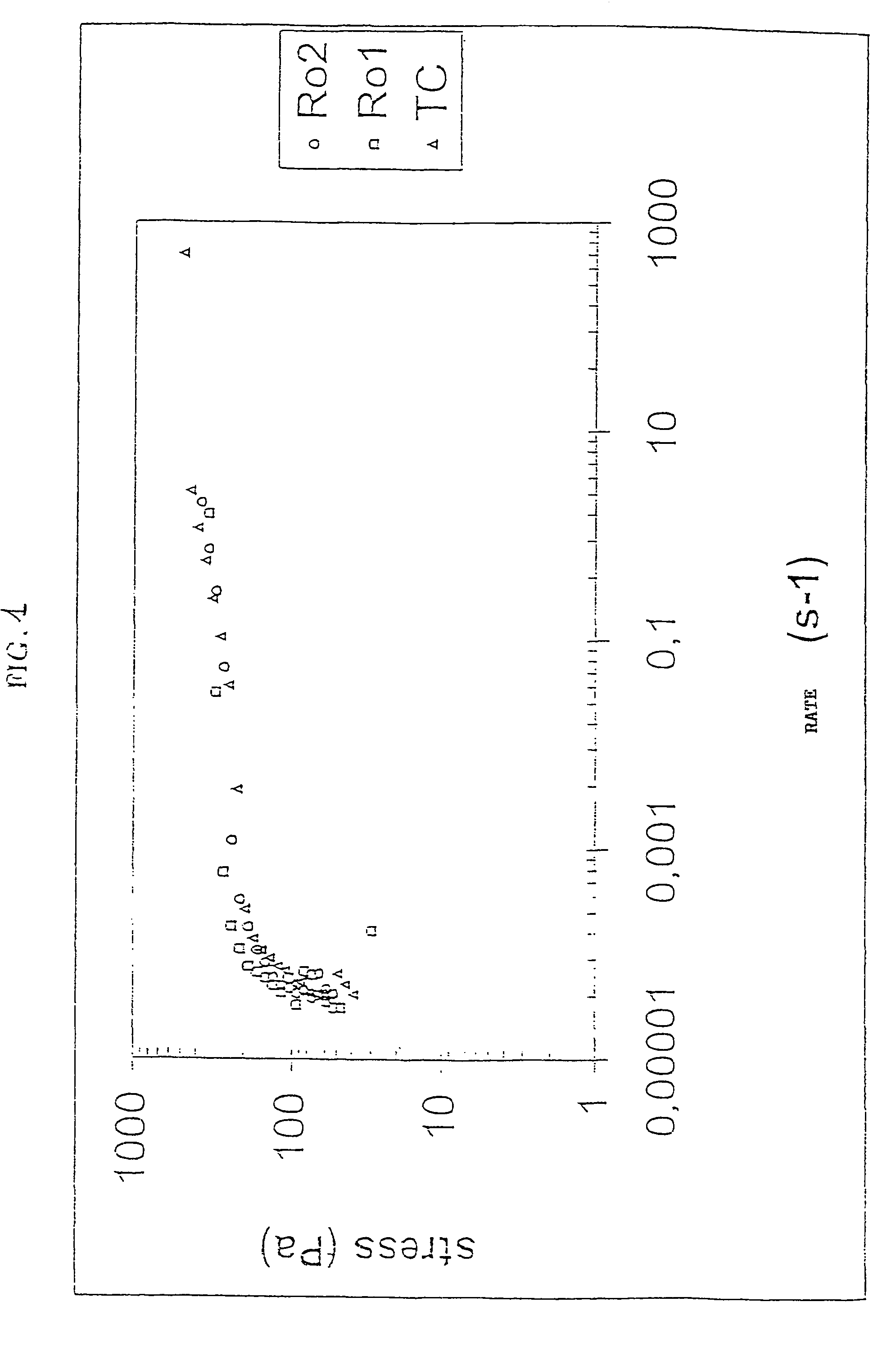
[0117]The rheological properties (shear stress / speed gradient (s−1) trend) of the product Ro1 have been measured and compared with the same commercial products used for obtaining Ro2.
[0118]The Ro1 trend is reported in FIG. 1 and the data with which the rheogram has been plotted are reported in Table 2.
[0119]It can be repeated the same conclusions above mentioned for Ro2.
[0120]A composition of tomato product Ro1 and olive oil was prepared. In a vessel, under stirring at 200 rpm, olive oil was slowly added, at small portions, to the product Ro1, leaving the mass under stirring for 5 minutes. The englobed oil amount is 15% by weight. The product was recovered and let stand one month at +4° C., in a closed vessel, without showing substantial oil separation.
the structure of the environmentally friendly knitted fabric provided by the present invention; figure 2 Flow chart of the yarn wrapping machine for environmentally friendly knitted fabrics and storage devices; image 3 Is the parameter map of the yarn covering machine
Login to View More
PUM
Login to View More
Abstract
Tomato products obtained from tomato juice or tomato passata having the following composition in percentage by weight:dry residue 5.5-20%,water 94.5-80%,100% being the sum of the two components,wherein the amount of water-insoluble and water-soluble solids in the dry residue ranges in percentage by weight:Water-insoluble solids from 18% to 70%Water-soluble solids from 82% to 30%,the sum of the two components being 100% of the dry residue.
Description
BACKGROUND OF THE INVENTION[0001]1. Field of the Invention[0002]The present invention relates to novel tomato products having an improved saucing power in particular on pasta.[0003]2. Description of the Related Prior Art[0004]Tomato products, prepared from the tomato juice obtained by fruit trituration, seed and peel separation, are known in the prior art. The tomato juice is an aqueous suspension of insoluble solids in an aqueous solution wherein organic and inorganic substances are dissolved.[0005]From the obtained juice other products such as tomato passatas and tomato concentrates can be obtained. Tomato passatas in general are obtained from juices by partial concentration. The tomato concentrates are obtained by stronger concentration processes. The methods generally used are the reverse osmosis, cryoconcentration and concentration by evaporation. By using the reverse osmosis it is not possible to operate at room temperature. Temperatures of about 70° C. are requested in order ...
Claims
the structure of the environmentally friendly knitted fabric provided by the present invention; figure 2 Flow chart of the yarn wrapping machine for environmentally friendly knitted fabrics and storage devices; image 3 Is the parameter map of the yarn covering machine
Login to View More
Application Information
Patent Timeline
Application Date:The date an application was filed.
Publication Date:The date a patent or application was officially published.
First Publication Date:The earliest publication date of a patent with the same application number.
Issue Date:Publication date of the patent grant document.
PCT Entry Date:The Entry date of PCT National Phase.
Estimated Expiry Date:The statutory expiry date of a patent right according to the Patent Law, and it is the longest term of protection that the patent right can achieve without the termination of the patent right due to other reasons(Term extension factor has been taken into account ).
Invalid Date:Actual expiry date is based on effective date or publication date of legal transaction data of invalid patent.



 Login to View More
  Login to View More