Check patentability & draft patents in minutes with Patsnap Eureka AI!

Method and apparatus for drying organic material

a technology of organic materials and methods, applied in the direction of biochemistry apparatus, lighting and heating apparatus, furnace types, etc., can solve the problems of unprofitable fuels, unfavorable use of end products, and inapplicability of known methods for drying wet organic materials for preparing useful fuels, etc., and achieve the effect of moisture conten

Active Publication Date: 2011-06-14
WRIGHT JAMES
View PDF12 Cites 4 Cited by
  • Summary
  • Abstract
  • Description
  • Claims
  • Application Information

AI Technical Summary

Benefits of technology

This approach allows for efficient drying of organic waste from 65% to 20% moisture or lower, making the end product a commercially practical and economical solid fuel, with a calculated energy output of 40-50 kW of biofuel per kW used.

Problems solved by technology

However, known methods for drying wet organic materials are impractical for preparing useful fuels by reason of their inherent inability to reduce the water content of the organic waste to a sufficiently low level in an energetically economic way.
The water content of the dried organic waste must be brought down to about 20%, and to do so conventional processes consume undue amounts of energy (fossil fuel, electricity).
Consequently, the end product is not commercially useful as a fuel in competition with substances such as coal, etc.
Mechanical means as such can be effective to remove free (interstitial) water from organic materials, but are largely incapable of removing water from within the constituent cells of the raw organic waste, and so are incapable of reaching the lower levels of water content necessary to create a practical fuel.

Method used

the structure of the environmentally friendly knitted fabric provided by the present invention; figure 2 Flow chart of the yarn wrapping machine for environmentally friendly knitted fabrics and storage devices; image 3 Is the parameter map of the yarn covering machine
View more

Image

Smart Image Click on the blue labels to locate them in the text.
Viewing Examples
Smart Image
  • Method and apparatus for drying organic material
  • Method and apparatus for drying organic material
  • Method and apparatus for drying organic material

Examples

Experimental program
Comparison scheme
Effect test

Embodiment Construction

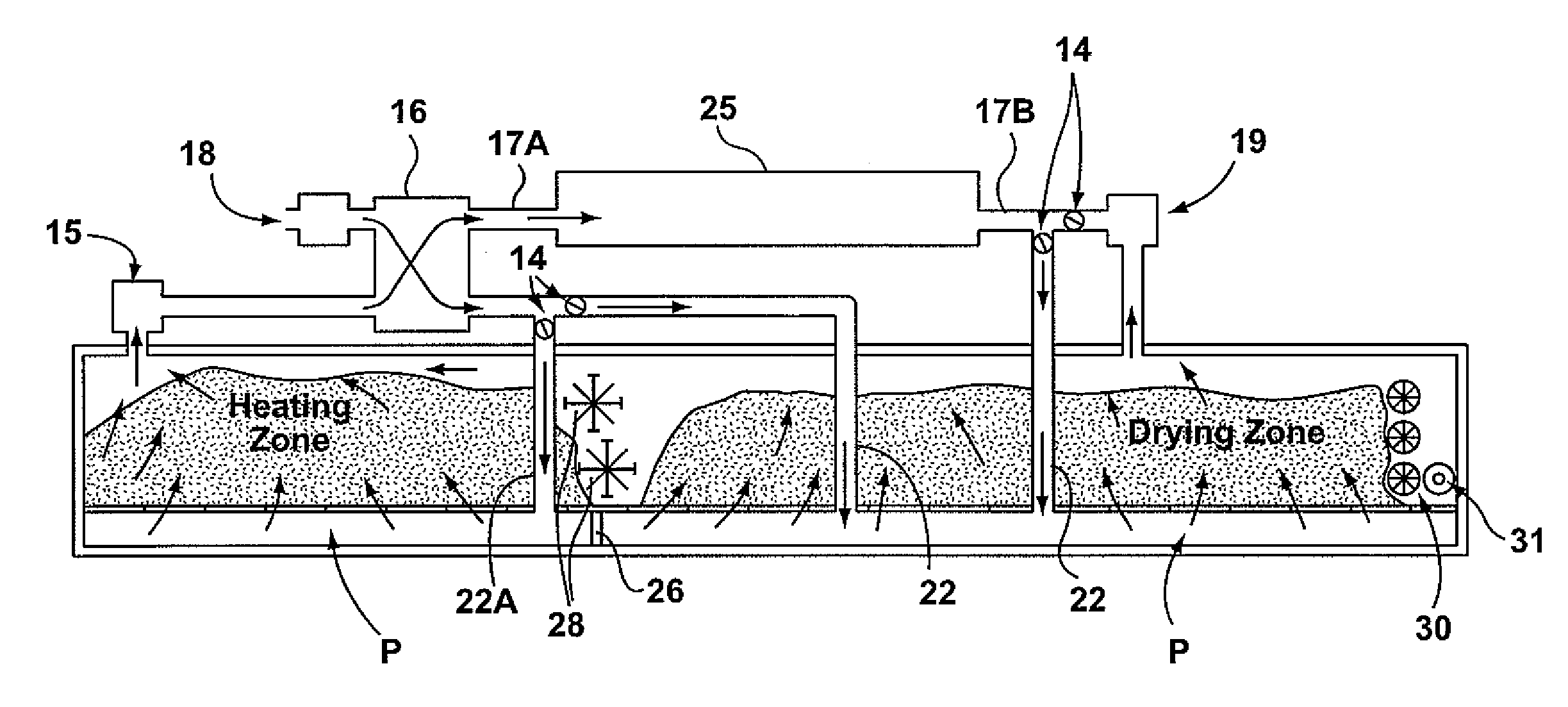
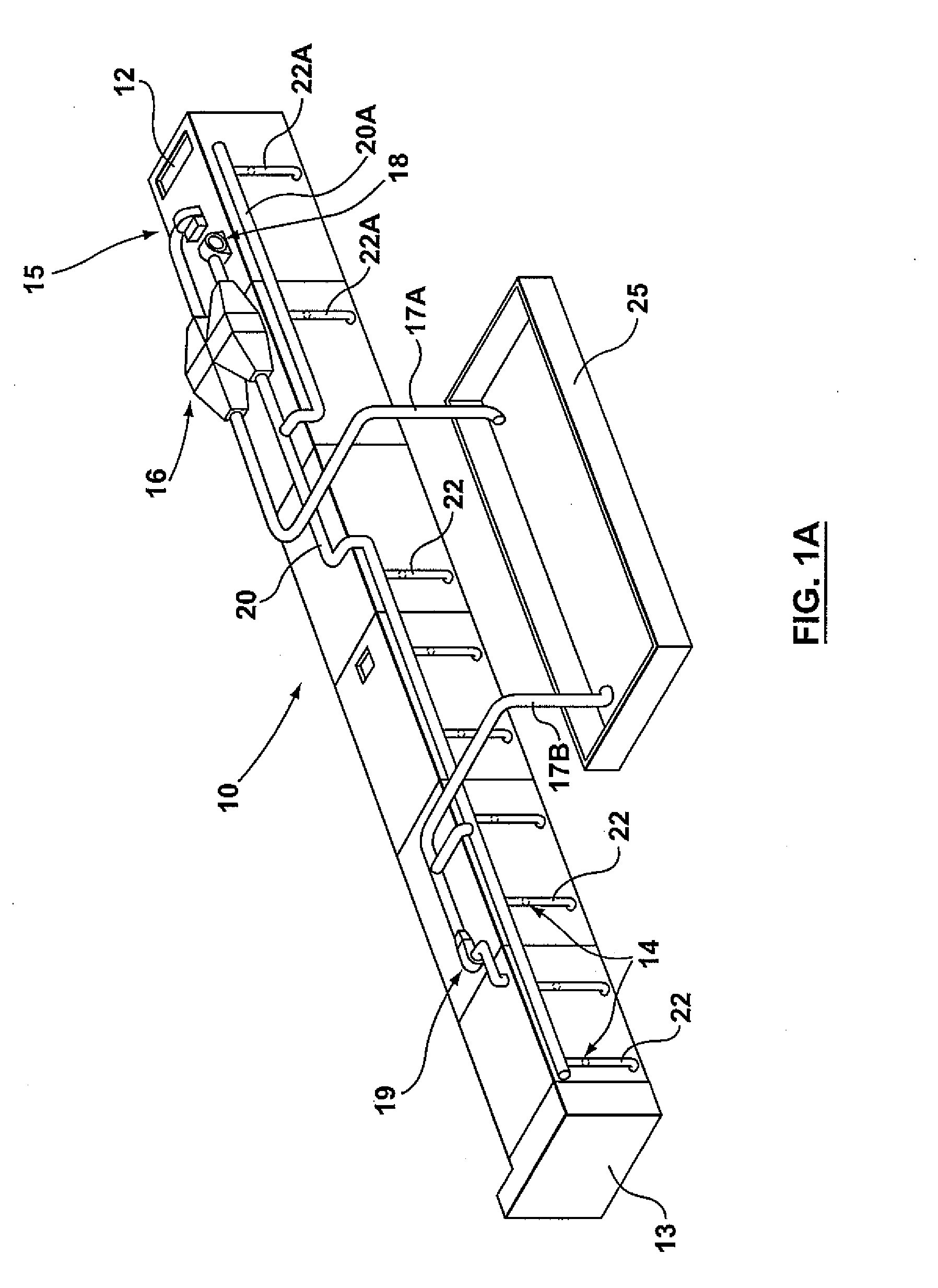
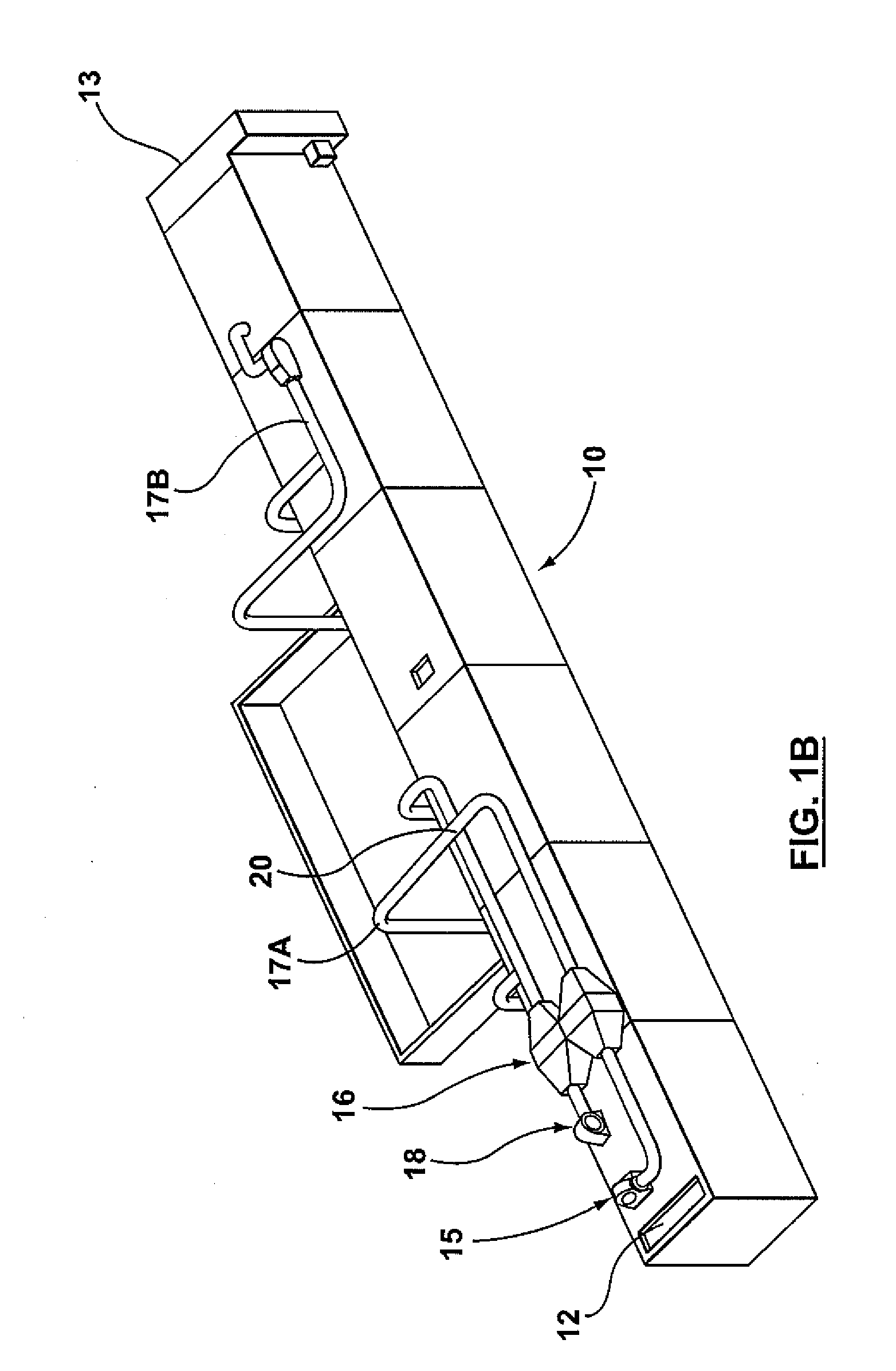
[0022]In apparatus according to the invention, portions of organic material are sequentially conveyed along the interior of a chamber in the form of an elongate tunnel 10 having a first, fermentation zone and sequential drying zones for the controlled application of air which has been heated by hot exhaust gases generated in the fermentation reaction. In the following discussion Zone 1 will refer to the quiescent fermentation zone of apparatus for carrying out the invention and Zone 2, Zone 3 etc. to subsequent downstream zones in which drying of the fermented organic material from Zone 1 progresses to achieve the desired state of dryness for use of the material as a fuel.

[0023]In upstream Zone 1 of the tunnel, raw organic material, typically having a moisture content of about 65%, is deposited through a tunnel loading door 12 and pre-blended. By natural microbial respiration, hot exhaust gases are produced. In this first upstream zone, the maximum biologically generated heat is cre...

the structure of the environmentally friendly knitted fabric provided by the present invention; figure 2 Flow chart of the yarn wrapping machine for environmentally friendly knitted fabrics and storage devices; image 3 Is the parameter map of the yarn covering machine
Login to View More

PUM

PropertyMeasurementUnit
combustibleaaaaaaaaaa
porosityaaaaaaaaaa
temperaturesaaaaaaaaaa
Login to View More

Abstract

Organic waste having a moisture content of about 65% is dried to a level of dryness by applying heat generated by microbial action on the waste organic material to dry that material to usable levels of about 20% moisture. Method of the present invention is more efficient and economical for the drying of waste materials to combustible fuel than conventional drying methods and apparatus. Preblended portions of the organic material are deposited sequentially into a fermentation zone of a chamber and hot exhaust gases generated by the fermentation process are passed through an air-to-air heat exchanger along with cooler ambient intake air which is in its turn heated and turned back on the waste material in the second drying stage.

Description

BACKGROUND OF THE INVENTION[0001]This invention relates to a method and apparatus for biologically and mechanically drying organic material such as garbage, waste, sewage, pulp sludge, food, manure, renderings, wood, agricultural waste, bagasse, peat, mash, silage, biomass, feedstock, etc., particularly for the preparation of a useful fuel but also for products such as DDGS (Distillers Dried Grains with Solubles) or other valuable Nutraceuticals or feed.[0002]A number of attempts have been made to dry wet organic materials and wet biomass into a sufficiently dry state to be useful as combustible solid fuel. A number of these involve the direct application of externally generated heat to the raw material, for example by the use of rotary and other dryers. In the method and apparatus for preparing organic waste fuels which is the subject of U.S. Pat. No. 4,254,716 (Graham) a dryer, either of a single or multiple pass, or fluid bed design makes use of hot flue gases from an energy reco...

Claims

the structure of the environmentally friendly knitted fabric provided by the present invention; figure 2 Flow chart of the yarn wrapping machine for environmentally friendly knitted fabrics and storage devices; image 3 Is the parameter map of the yarn covering machine
Login to View More

Application Information

Patent Timeline
no application Login to View More
Patent Type & Authority Patents(United States)
IPC IPC(8): B09B3/00C12M1/00C12M1/02
CPCC10L5/44C10L5/46C10L5/48F26B3/32F26B15/12F26B25/04F26B23/001Y02P70/405Y02E50/10Y02E50/30F28D21/0014Y02P70/10
Inventor WRIGHT, JAMES
Owner WRIGHT JAMES
Features
  • R&D
  • Intellectual Property
  • Life Sciences
  • Materials
  • Tech Scout
Why Patsnap Eureka
  • Unparalleled Data Quality
  • Higher Quality Content
  • 60% Fewer Hallucinations
Social media
Patsnap Eureka Blog
Learn More