
Indium-based nanowire product, oxide nanowire product, and electroconductive oxide nanowire product, as well as production methods thereof
a technology of oxide nanowires and nanowires, which is applied in the direction of nanostructure manufacturing, solid-state diffusion coating, crystal growth process, etc., can solve the problems of limited metal nanowires for the above-described conventional metal nanowires, nanowires that have not been obtained up, and patent document 2 fully fails to disclose the production of indium wires having diameters of about 0.1 m, etc., to achieve expedient and inexpensive production
- Summary
- Abstract
- Description
- Claims
- Application Information
AI Technical Summary
Benefits of technology
Problems solved by technology
Method used
Image

Examples
example 1
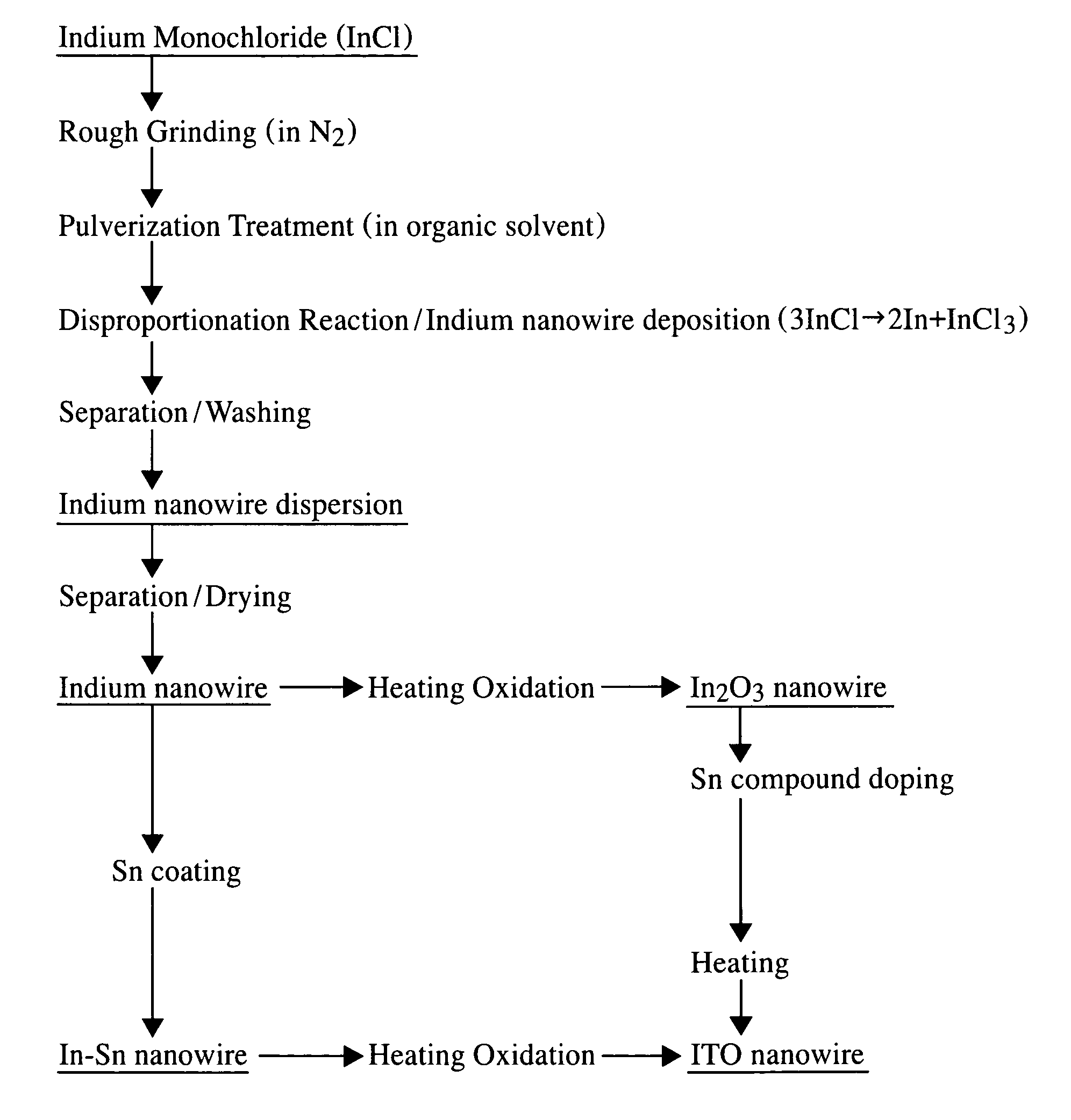
[0077]16 g of indium monochloride (InCl) powder sieved through 42 mesh (sieve opening: 355 μm) was mixed with 128 g of propylene glycol monomethyl ether acetate (PGMEA) and 0.4 g of a polymer dispersant (S36000 made by Avecia), followed by a pulverization treatment by a paint shaker adopting zirconia beads having diameters of 0.3 mm, thereby obtaining a dispersion of InCl fine particles having a particle diameter distribution between about 20 and 80 nm.
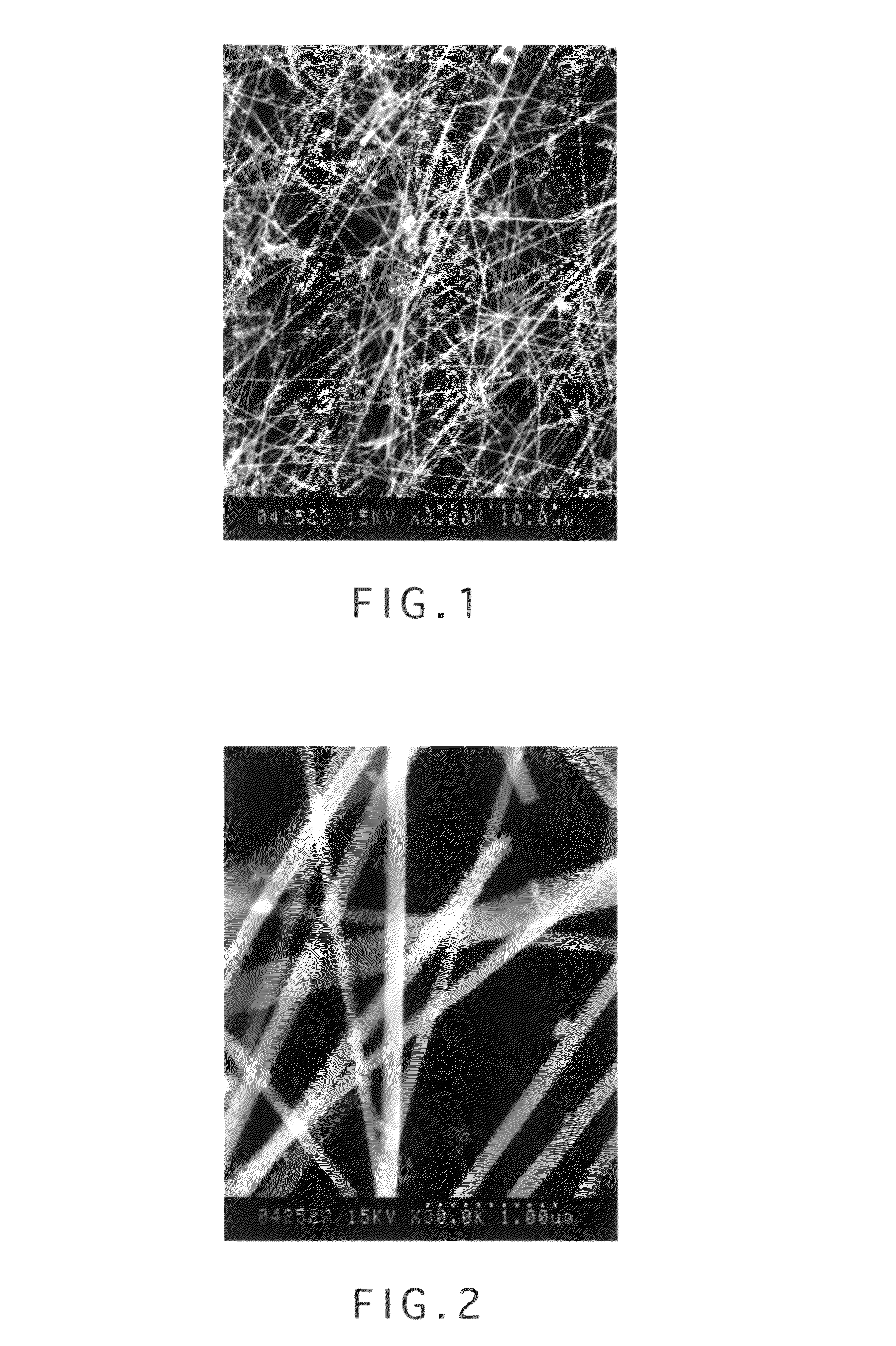
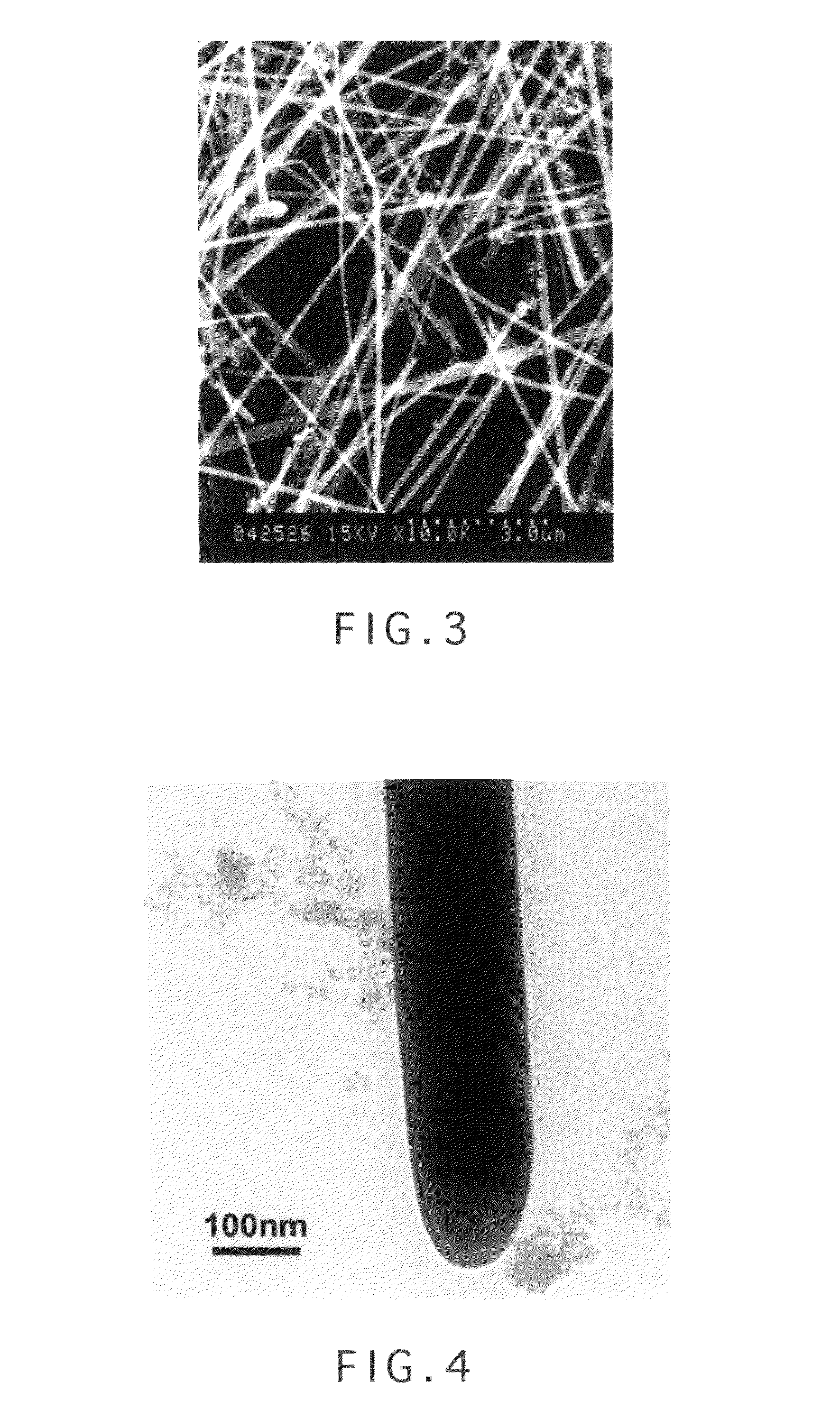
[0078]While 70 g of the dispersion of InCl fine particles was kept stirred, 70 g of ethanol was firstly added thereto, and 70 g of pure water was then gradually added to conduct a disproportionation reaction of the InCl fine particles, thereby obtaining a reacted solution containing indium nanowires (indium nanofibers). Since indium nanowires in the reacted solution gradually sedimented, there were repeatedly conducted operations to remove a supernatant after decantation, to add ethanol, and to stir the remaining solution, in a manner...
example 2
[0084]The indium nanowires obtained in Example 1 were subjected to a heat treatment (at 200° C. for 60 minutes, and then at 400° C. for 60 minutes) in the atmospheric air to cause oxidation of indium, thereby obtaining an indium oxide nanowire product comprising indium oxide nanowires according to Example 2.
[0085]The obtained indium oxide nanowires appeared to be a light yellow powder, and were confirmed to comprise indium oxide from a result of X-ray diffraction analysis. Further, it was confirmed that the nanowires kept shapes of indium nanowires before oxidation as they were, from a result of scanning electron microscope (SEM) observation (see FIG. 6).
example 3
[0086]Added into the indium-nanowire-containing ethanol solution obtained in Example 1 was an aqueous solution of tin chloride (SnCl4.xH2O), followed by addition of an aqueous solution of sodium borohydride to cause a reduction reaction, to thereby conduct coating of tin onto surfaces of the indium nanowires. Thereafter and similarly to Example 1, there were repeatedly conducted operations to remove a supernatant after decantation, to add ethanol, and to stir the remaining solution, in a manner to progress removal of reaction products other than indium nanowires coated with tin, followed by filtering separation and drying, to obtain a tin-containing indium nanowire product comprising tin-containing indium nanowires according to Example 3.
[0087]The content of tin was 0.02 mole relative to 1 mole of metal indium. Further, it was confirmed that the tin-containing indium nanowires kept shapes of indium nanowires before tin coating as they were, from a result of scanning electron microsc...
PUM
| Property | Measurement | Unit |
|---|---|---|
| inclination angle | aaaaa | aaaaa |
| diameters | aaaaa | aaaaa |
| diameters | aaaaa | aaaaa |
Abstract
Description
Claims
Application Information
 Login to View More