Unlock instant, AI-driven research and patent intelligence for your innovation.

Common-mode feedback amplifier

Active Publication Date: 2012-03-20
TEXAS INSTR INC
View PDF5 Cites 3 Cited by
  • Summary
  • Abstract
  • Description
  • Claims
  • Application Information

AI Technical Summary

Benefits of technology

[0064]The present invention provides a stable differential amplifier that has a variable gain and that may be operated at a low power.

Problems solved by technology

Usually the common-mode circuit consists of an extra gain stage and requires bandwidth large enough to suppress the even harmonic components; in general they consume a significant proportion of the power used by the whole circuit.
A condition of input signal and output signal being in phase for differential amplifier 106 with a closed loop gain equal to one or greater than one, results in the circuit configuration of CMFB amplifier 100 becoming unstable.
Typically, a larger value of phase margin is desired, as a circuit with a small phase margin might be susceptible to instability.
However, if common-mode feedback loop does not have enough phase margin or is unstable then it will start to oscillate with such a stimulus.
This step change induces instability in the common-mode portion of CMFB amplifier 100.
If a common mode signal has such a large signal swing by itself then it reduces the available dynamic range for the differential signal and thus is not desirable.
However, a low resistive portion of feedback impedance portion 304 results in lower output impedance in-turn lower gain for the main signal path for differential amplifier 302, which is not desirable.
However the higher resistive portion of feedback impedance portion 304 increases instability of common mode feedback amplifier 306 of the differential-in differential-out amplifier 300.
The relatively large geometric area typically required for compensation capacitors 344 and 350 results in increased costs for manufacturing conventional differential amplifier semiconductor devices.
In light of the above discussion, there are challenges in designing conventional common-mode, feedback amplifier 100.
A zero in the feed-forward path boosts the gain and lags the phase, which in-turn worsens the phase margin of the common mode differential amplifier.
Since common mode feedback amplifier has one extra gain stage, optimization based only on the compensation capacitor is not sufficient.
Based on the value of the compensation capacitor, the common mode feedback amplifier tends to oscillate and have a poor phase margin.
For certain configurations, signal path of a differential amplifier may require reducing the compensation capacitor in order to improve its efficiency, resulting in an unstable common-mode feedback circuit.
This may result in more power consumption because common-mode feedback circuit is a differential-in single-ended-out amplifier configured with a unity gain.
The traditional implementation of a common-mode feedback amplifier, where a feedback resistor is connected between the output and input of the common-mode feedback circuit, may provide an unstable circuit.
In order to improve stability of such a common-mode feedback circuit, a larger compensation capacitor may be required because of its high open loop gain, which may not be desirable by the signal path of a differential amplifier.

Method used

the structure of the environmentally friendly knitted fabric provided by the present invention; figure 2 Flow chart of the yarn wrapping machine for environmentally friendly knitted fabrics and storage devices; image 3 Is the parameter map of the yarn covering machine
View more

Image

Smart Image Click on the blue labels to locate them in the text.
Viewing Examples
Smart Image
  • Common-mode feedback amplifier
  • Common-mode feedback amplifier
  • Common-mode feedback amplifier

Examples

Experimental program
Comparison scheme
Effect test

Embodiment Construction

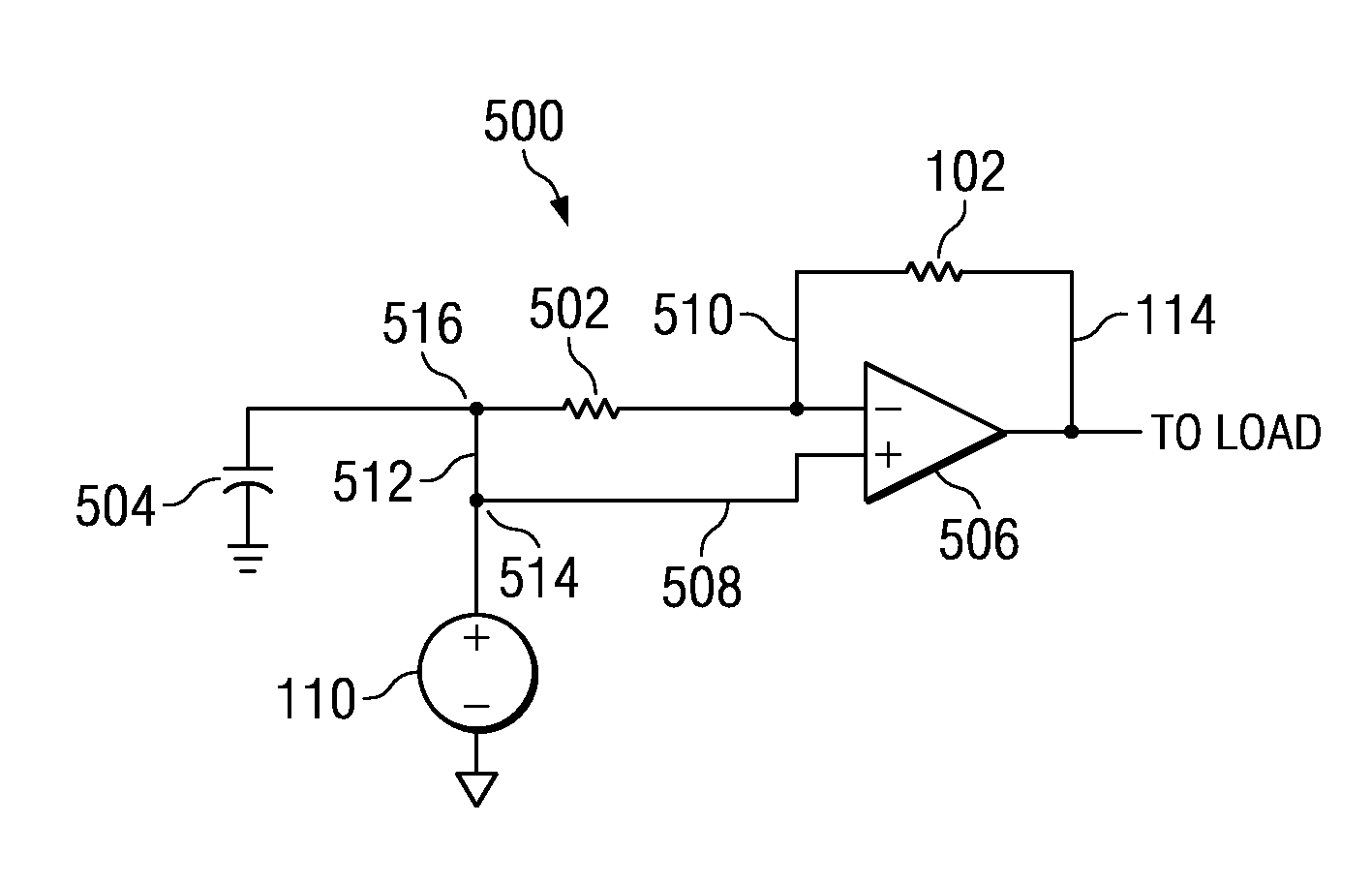
[0077]The present invention solves the instability problem in a common mode feedback circuit of a differential-in differential-out amplifier. In accordance with an aspect of the invention, loop gain of a common mode feedback circuit of a differential-in differential-out amplifier is reduced, thereby improving the phase margin and increasing the stability of the common mode feedback circuit. An example implementation is discussed further, which provides attenuation on open loop gain by introducing a feedback factor in the feedback path of the common mode feedback circuit of a differential-in differential-out amplifier, while maintaining common mode feedback amplifier gain to be one.

[0078]A differential-in and differential-out amplifier has two gain stages. Each gain stage is a high impedance node, therefore has a pole associated with it. A more detailed explanation of the relationship between open loop gain, frequency compensation and phase margin in a differential amplifier will now...

the structure of the environmentally friendly knitted fabric provided by the present invention; figure 2 Flow chart of the yarn wrapping machine for environmentally friendly knitted fabrics and storage devices; image 3 Is the parameter map of the yarn covering machine
Login to View More

PUM

No PUM Login to View More

Abstract

A circuit is provided for use with a reference voltage. The circuit includes a voltage source, a common-mode feedback amplifier and a feedback impedance portion. The common-mode feedback amplifier may be connected to the voltage source and may be arranged to receive the reference voltage. The common-mode feedback amplifier may include an input stage, an output stage, a positive input, a negative input and an output. The output may be connected to the feedback impedance portion. The feedback impedance portion may additionally be connected to one of the positive input and the negative input. A feedback factor, based on the feedback impedance portion, is less than one.

Description

BACKGROUND[0001]A conventional electrical signal is a voltage between an electrical conductor and another electrical conductor. The most common form of electrical signal is where one of the conductors is at ground potential and this form is usually referred to as unbalanced. There is also a common form of signal where neither conductor is at ground potential and each conductor carries a voltage relative to ground potential. This form of signal is usually referred to as balanced or differential.[0002]Differential signals are the voltage difference between the conductors. The average potential of both conductors is usually referred to as the common-mode signal and that common-mode signal is equal on both conductors. Differential signals are the voltage difference between the conductors that represent the information carried by the signal and they vary around the common-mode voltage. When the differential signal on one conductor increases, the differential signal on the other conductor...

Claims

the structure of the environmentally friendly knitted fabric provided by the present invention; figure 2 Flow chart of the yarn wrapping machine for environmentally friendly knitted fabrics and storage devices; image 3 Is the parameter map of the yarn covering machine
Login to View More

Application Information

Patent Timeline
no application Login to View More
IPC IPC(8): H03F3/45
CPCH03F3/45183H03F3/45475H03F3/45941H03F2203/45311H03F2203/45418H03F2203/45511H03F2203/45594H03F2203/45701
Inventor KUMARNAGARAJ, KRISHNASWAMY
Owner TEXAS INSTR INC